Ask a jazz pianist to comp Gm7 behind a soloist and you will often hear two notes: B♭ and F. The root belongs to the bass player and the D is doing no work, so the third and the seventh are left to name the chord on their own. They manage it, but only because somebody else is holding the G down there.
The full chord is G, B♭, D and F, one black key and three white ones. Read it from the second note up and B♭, D and F is an ordinary B♭ major triad, so Gm7 is B♭ major with a G placed underneath. That is also why the same four pitches turn up in print as B♭6, a question the B♭ major 6th chord already settles.
Try It: Gm7 in the Chord Finder
The Notes of Gm7
| Degree | Note | Interval from Root | Semitones |
|---|---|---|---|
| 1 (Root) | G | Perfect unison | 0 |
| ♭3 | B♭ | Minor 3rd | 3 |
| 5 | D | Perfect 5th | 7 |
| ♭7 | F | Minor 7th | 10 |
Written Gm7, Gmin7 or G-7. The seventh is F natural, not the F♯ that the key of G major would hand you, and that one letter is the whole distance between this chord and Gmaj7.
How Gm7 Is Built
Take Gm, the G, B♭ and D of the plain G minor triad, and put F a minor 3rd above the D. Every gap in the stack is now a third: minor from G to B♭, major from B♭ to D, minor again from D to F.
The interval worth weighing is B♭ against F. In G7 the third and seventh are B and F, six semitones apart, and that tritone is why a dominant will not stay still. Here they are seven semitones apart, a perfect 5th, so Gm7 carries a seventh without carrying any tension and an arranger can leave it standing for eight bars.
Gm7 on the Piano
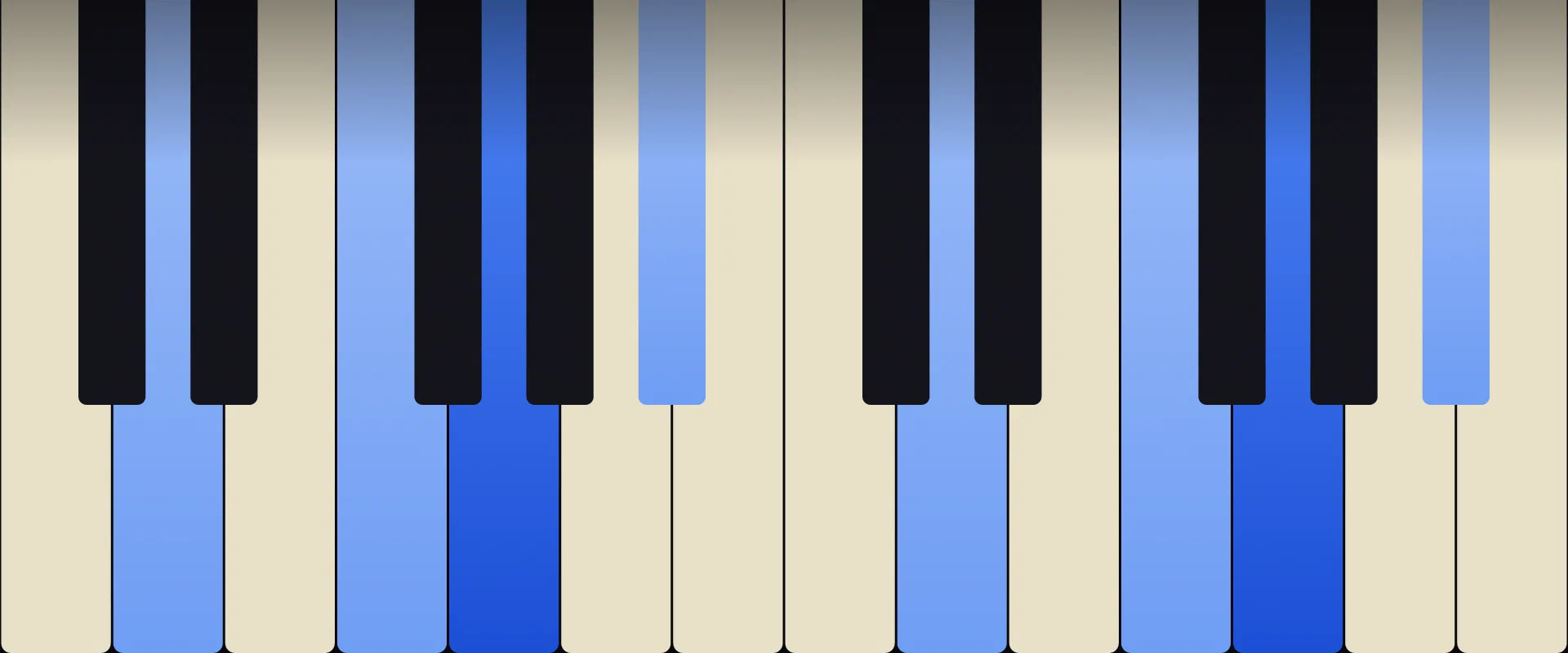
The black key is B♭ and it falls to the second finger, the top of the group of three. Right hand 1 on G, 2 on B♭, 3 on D, 5 on F. Left hand 5, 3, 2, 1. The span is a minor 7th, wide but level: three fingers stay out at the front of the keys and only one reaches back, so the wrist never has to twist.
Low down, the order matters more than the spacing. The left hand shape jazz methods teach here is G, F, B♭ from the bottom: the root, the seventh a minor 7th above it, then the third a fourth above that. Put G on the bottom line of the bass stave and F and B♭ land in the octave below middle C, well clear of the register where G against B♭ turns to mud.
The drill that pays for itself is the two note one. Hold G in the left hand and play only B♭ and F in the right. Now move the left hand to C: B♭ has become the seventh of C7, so only F needs to shift, and it falls a semitone to E. Move the left hand again to F, and this time only B♭ needs to shift, falling a semitone to A. Three chords, Gm7 to C7 to Fmaj7, and the right hand has changed one finger at a time. That line, F with B♭, then E with B♭, then E with A, is the ii V I of F major reduced to bone. Everything else you play over it is decoration.
Gm7 on the Guitar
The standard grip is the E minor 7 shape barred at the 3rd fret, 3 5 3 3 3 3, sounding G, D, F, B♭, D and G. Only one note leaves the barre, the D on the 5th string at the 5th fret, so this is an index barre plus a single ring finger. Three frets from the nut the strings are still stiff, but as four note chords go nothing here is cheaper.
Most of the time you should play less of it.
| Form | Frets | Notes sounded |
|---|---|---|
| Em7 shape, barred at 3 | 3 5 3 3 3 3 | G D F B♭ D G |
| Three note shell | 3 x 3 3 x x | G F B♭ |
| Guide tones alone | x x 3 3 x x | F B♭ |
| Rootless, open D ringing | x x 0 3 3 1 | D B♭ D F |
| Am7 shape, barred at 10 | x 10 12 10 11 10 | G D F B♭ D |
The three note shell is the one to memorise. Root on the 6th string, seventh on the 4th, third on the 3rd, with the 5th string deadened by the underside of the index. It reads upwards as G, F, B♭, and it cuts where the full barre would only thicken. Strip the root too and x x 3 3 x x is F and B♭ at one fret under a single finger, which is the whole chord as far as a listener is concerned provided somebody has the G.
The open string row is the one accident in this key. Fret the top string at the 1st fret for F, the 3rd and 2nd at the 3rd for B♭ and D, and let the open D ring underneath.
One coincidence is worth noticing. The barre above uses frets 3 and 5, and so does the first box of G minor pentatonic, on the same six strings, because that scale is this chord plus C. A rock guitarist soloing in the box over this chord cannot land on a wrong note, and does not have to know why.
Inversions
| Inversion | Notes | Bass | Symbol |
|---|---|---|---|
| Root position | G B♭ D F | G | Gm7 |
| 1st inversion | B♭ D F G | B♭ | Gm7/B♭ |
| 2nd inversion | D F G B♭ | D | Gm7/D |
| 3rd inversion | F G B♭ D | F | Gm7/F |
First inversion is awkward to name rather than to play. Nobody hears B♭, D, F, G over a B♭ bass as an inverted Gm7: it is B♭6 in root position. Put the bass on B♭ under a bar marked Gm7 and you have rewritten the harmony, however faithfully the upper notes sit.
Third inversion is the useful one. With F at the bottom the seventh is in the bass and has to fall, so Gm7/F leads straight into a chord with E♭ or E underneath, and a bass walking G, F, E♭ through this chord is a standard descent in B♭ major.
Voicings
Start from B♭ and F and add deliberately, because every extra note has a price.
D, the fifth, buys nothing. It neither names the chord nor colours it, and it is the first thing a pianist drops and the first string a guitarist mutes.
G, the root, is worth playing only when nothing else is. Add it and the upper three notes become that B♭ major triad on top: play B♭ major in the right hand and Gm7 with your left thumb.
A, the ninth, is the first note that changes the colour rather than the weight. B♭, D, F and A over a G bass is Gm9, and it is what most comping hands actually play.
C, the eleventh, is safe here in a way it never is over a major chord, since it sits a whole step above B♭ rather than grinding a semitone against a major third.
E♭ or E is the addition that commits you, and the chord itself refuses to choose.
Which Keys Contain Gm7
- ii of F major
- vi of B♭ major
- iii of E♭ major
- i of G natural minor
- I of G dorian
- entirely inside G minor pentatonic
The two G entries are the interesting pair. G natural minor and G dorian differ by exactly one note, E♭ against E natural, and Gm7 contains neither. The chord cannot tell you which mode you are in, so a soloist settles the question every time they touch a sixth degree, and that one choice separates a brooding minor from the brighter sound most jazz players default to here.
Where Gm7 Shows Up
| Progression | Chords | Typical use |
|---|---|---|
| ii7, V7, Imaj7 in F | Gm7, C7, Fmaj7 | The chord’s day job |
| I6, vi7, ii7, V7 in B♭ | B♭6, Gm7, Cm7, F7 | Rhythm changes, bar one |
| i7, iv7, v7 in G minor | Gm7, Cm7, Dm7 | Minor blues and soul vamps |
| I7 vamp in G Dorian | Gm7, C7 | Modal jazz and film cues |
| iv7, V7, i in D minor | Gm7, A7, Dm | Minor cadence, C♯ required |
| iii7, vi7, ii7, V7 in E♭ | Gm7, Cm7, Fm7, B♭7 | Descending turnaround |
Learn the first row properly, in the fingers rather than on paper, and a large slice of the standard repertoire opens with no further work. F major is the flat key horns, singers and pianists all agree on, and this chord is its supertonic.
The third row does something the first cannot. Making the fifth degree Dm7 rather than D7 keeps F♯ out of the key altogether, so the music has no leading tone and stops pulling towards G, which is what a soul or minor blues arrangement wants: a tonic that sounds settled without sounding finished.
Then there is the blues reading. The G blues scale is G, B♭, C, D♭, D and F, this chord plus the fourth and the blue note. Flatten the D to D♭ in the chord itself and you get Gm7♭5, which is no resting place at all and has a different job. A guitarist bending into that D♭ over a Gm7 vamp borrows the note without accepting the chord, which is roughly what the blues is.
Related Chords
- G Minor Chord, the triad this is built on
- G Major 7th Chord, the same root with B and F♯
- G Dominant 7th Chord, whose third and seventh make a tritone instead of a fifth
- G Minor 6th Chord, E in place of the F, which is what a swing band ends on
- B♭ Major 6th Chord, these four notes with B♭ underneath
- Gm7♭5, the same chord with D♭ instead of D, which turns a resting chord into a leaning one
- Extended Chords and Jazz Harmony for Gm9 and Gm11
- The G Dorian Scale
- Guitar Chord Shapes: The CAGED System
Learn More
Practice Chords
Drill chord recognition with a metronome, MIDI support, and score tracking.
Start PracticingRelated Articles
A Minor 7th Chord: Notes, Voicings, and How to Play It
Aug 30, 2026 · 8 min
A♭ Minor 7th Chord: Notes, Voicings, and How to Play It
Aug 30, 2026 · 8 min
B Minor 7th Chord: Notes, Voicings, and How to Play It
Aug 30, 2026 · 8 min