Stop the sixth string at the second fret and strum an open A major. Nothing above the bass moves, one new note arrives underneath, and the chord is no longer A: 2 0 2 2 2 0 sounds F♯, A, E, A, C♯, E, all six strings, two of them open, and every one of them a note of F♯m7. For a chord whose plain triad demands a full barre, that is an absurdly low price. It points at why this particular minor seventh gets called so often. F♯m7 is the vi of A major and the ii of E major, and a player who avoids those two keys has walked away from most of the guitar’s repertoire.
Try It: F♯m7 in the Chord Finder
Set the root to F♯, sound the minor triad, then add E on top and hear the chord stop asking to resolve.
The Notes of F♯m7
| Degree | Note | Interval from root | Semitones |
|---|---|---|---|
| 1 (root) | F♯ | Perfect unison | 0 |
| ♭3 | A | Minor 3rd | 3 |
| 5 | C♯ | Perfect 5th | 7 |
| ♭7 | E | Minor 7th | 10 |
Written out: F♯, A, C♯, E. Two black keys and two white ones, and the accidentals are the useful part. F♯ and C♯ are the two sharps of D major. A major adds G♯ and E major adds D♯ as well, and this chord contains neither of them, so it survives every one of those key signatures unchanged. Three keys, one chord, no adjustment: that is the arithmetic behind its working life.
How F♯m7 Is Built
Take the F♯ minor triad and put E ten semitones above the root. Stacked as thirds it runs minor, major, minor: F♯ to A is three semitones, A to C♯ four, C♯ to E three again. No two notes in it are closer together than a minor 3rd, in any inversion, so there is nothing here that can grind.
One note distinguishes it from each of its neighbours on the same root, and each swap costs a key. F♯7 raises the A to A♯ and the chord starts pulling towards B. F♯maj7 raises the E to E♯ and the chord turns into a tonic in six sharps. F♯m6 drops the E to D♯ and the harmony leaves A major altogether. F♯m7 is the version that stays where the triad already lived.
The A Major Triad on Top
Lift the root off and A, C♯ and E is a plain A major triad, so this chord is A major with an F♯ underneath it. Slide that F♯ up above the rest and the same four notes are A6, which sets out the other half of the argument.
What settles the name is not theory but which F♯ you have. In 2 0 2 2 2 0 there is exactly one F♯ in the voicing and it is the lowest note sounding, so the ear has nowhere else to put the root. Fret the first string at the second fret as well and a second F♯ arrives on top, where the ear takes it for the sixth of an A chord rather than a root. Both grips are F♯m7. How hard they insist on it is not the same.
A useful near miss sits next door. Amaj7 is A, C♯, E and G♯, which shares three notes with this chord and differs on the fourth, so the two are relatives rather than twins. Going from Amaj7 to F♯m7 moves a single voice, G♯ down a whole tone to F♯, and drops the bass a minor 3rd.
F♯m7 on the Piano
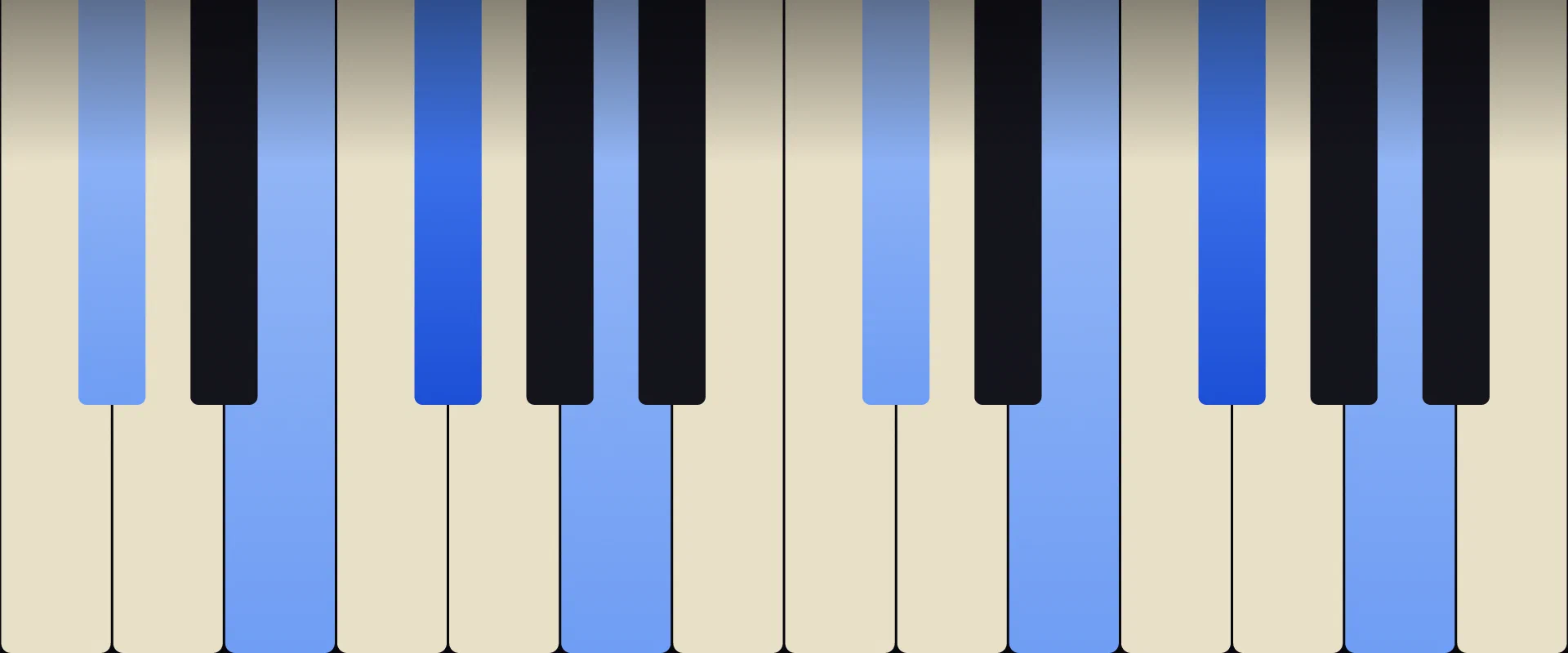
The hand alternates all the way up: F♯ black, A white, C♯ black, E white. Both black notes are the first key of their group, F♯ at the front of the three and C♯ at the front of the two, so neither has to be counted to. Right hand 1 on F♯, 2 on A, 3 on C♯, 5 on E covers ten semitones and stays inside a relaxed span.
The top note has a physical advantage the others lack. E is the white key with nothing raised above it, its whole width free up to F, so the little finger can sit anywhere along the key without hitting a black one. Set the outer two fingers first, then drop A and C♯ into the middle, and the shape lands by feel.
Comping pianists split it the obvious way: left hand on F♯ alone, right hand playing A major, and the seventh chord assembles itself out of two things the hands already know.
F♯m7 on the Guitar
The open form at the top of this page is the one worth owning first. Lay the index flat across the fourth, third and second strings at the second fret, the lazy version of an A major grip, and take the sixth string at the same fret with the middle finger. The fifth and first strings ring open. Two open strings on a chord rooted on a black key is not something this instrument usually offers.
The full barre is the E minor seventh shape at the second fret, 2 4 2 2 2 2: index across all six, middle finger on the fifth string at the fourth fret, and nothing else. One finger behind a barre, one fewer than the plain triad needs, so the seventh is the easier of the two despite having a note more in it.
Higher up, x 9 11 9 10 9 is the A minor seventh shape barred at the ninth fret, where the frets are close and the action is low. For comping without a bass player, x x 4 6 5 5 gives one of each note on the top four strings, and dropping the fourth string leaves x x x 6 5 5, the bare A major triad again.
One coincidence of position: F♯ minor pentatonic starts at the second fret, where the barre already is, and four of its five notes are chord tones.
Inversions
| Inversion | Notes | Bass | Symbol |
|---|---|---|---|
| Root position | F♯ A C♯ E | F♯ | F♯m7 |
| 1st inversion | A C♯ E F♯ | A | A6 |
| 2nd inversion | C♯ E F♯ A | C♯ | F♯m7/C♯ |
| 3rd inversion | E F♯ A C♯ | E | F♯m7/E |
The first inversion has a better name than F♯m7/A, and it is the one in the right hand column: with A underneath, the ear hears a major chord with a sixth added, not a minor chord standing on its third. Write A6 unless the harmony is genuinely still on F♯.
Third inversion is the one to space carefully. E and F♯ end up a whole tone apart at the bottom of the chord, and low in the register that interval clouds everything above it. Lift the F♯ an octave and the same bass note becomes useful, since a seventh in the bass makes the chord lean downwards into the next one. Chord Inversions and Voice Leading covers what the bass note decides.
Voicings
| Voicing | How to play it |
|---|---|
| Open F♯m7 | 2 0 2 2 2 0, an A major grip with the sixth string at the 2nd fret |
| Barre at the 2nd fret | 2 4 2 2 2 2, the Em7 shape moved up, one finger behind the barre |
| Barre at the 9th fret | x 9 11 9 10 9, the Am7 shape, narrow frets and low action |
| Compact grip | x x 4 6 5 5, one of each note on the top four strings |
| Rootless | x x x 6 5 5, the A major triad on its own |
| Piano, two hands | F♯2 in the left hand, A3, C♯4 and E4 in the right |
Which Keys Contain F♯m7
- iii of D major
- ii of E major
- vi of A major
- iv of C♯ natural minor
- i of F♯ natural minor
- v of B natural minor
The last entry is the interesting one. As the v of B minor this chord is a dominant that refuses to behave like one: it holds A natural where a real dominant of B wants A♯, so it leads nowhere and the music can sit on it. Folk and rock writing in B minor loops Bm7 and F♯m7 for that reason, where a jazz chart in the same key swaps in F♯7 and forces the issue.
Where F♯m7 Shows Up
| Progression | In this key | Chords |
|---|---|---|
| I, vi, ii, V | A major | Amaj7, F♯m7, Bm7, E7 |
| ii, V, I | E major | F♯m7, B7, Emaj7 |
| iv, i | C♯ minor | F♯m7, C♯m7 |
| Modal loop | B minor | Bm7, F♯m7 |
| Same notes, A in the bass | A major | A6 |
The A major turnaround is where the chord earns its place. Amaj7 to F♯m7 is one voice moving, so the pair sounds less like two chords than like one chord re-lit from below, which is why soul and bossa comping in this key rocks between them for bars before Bm7 arrives.
E major changes the job description completely. Here the chord is a ii, it has somewhere to go, and what it wants is B7. Not one thing about the grip changes, so a guitarist plays the identical shape in both keys and the chords on either side of it do all the work of telling a listener whether this is a resting place or a step. Hearing that difference is worth more practice than another voicing is.
In C♯ minor the chord turns subdued. As the iv it falls into C♯m7 with no leading note involved anywhere, which is the sound of a minor key declining to be dramatic about itself.
Related Chords
- F♯ Minor Chord the triad underneath this one
- A Major 6th Chord the same four notes with A in the bass
- F♯ Dominant 7th Chord A♯ in place of A, and a tritone appears
- F♯ Minor 6th Chord D♯ in place of E, and the key changes
- Seventh Chords: The Complete Guide
Learn More
- The ii, V, I Progression in Practice
- Diatonic Chords: A Beginner’s Guide
- Extended Chords and Jazz Harmony
- The Circle of Fifths Explained
- The A Major Scale, the key this chord serves most often
Practice Chords
Drill chord recognition with a metronome, MIDI support, and score tracking.
Start PracticingRelated Articles
A Minor 7th Chord: Notes, Voicings, and How to Play It
Aug 30, 2026 · 8 min
A♭ Minor 7th Chord: Notes, Voicings, and How to Play It
Aug 30, 2026 · 8 min
B Minor 7th Chord: Notes, Voicings, and How to Play It
Aug 30, 2026 · 8 min