Not one of a guitar’s six open strings belongs to this chord. F, A♭, C and E♭ share nothing at all with E, A, D, G and B, so nothing rings for free. Then the neck hands the money back. Lay one finger flat across the top four strings at the 1st fret and stop there: E♭, A♭, C and F. The complete chord, four notes, one finger.
The F minor triad already asks less of the hand than F major does, two fingers behind the barre against three. Adding the minor 7th takes away another one.
Try It: Fm7 in the Chord Finder
Set F as the root and switch the seventh chords on. The note joining the triad is E♭, the second black key in the chord.
The Notes of Fm7
| Degree | Note | Interval from Root | Semitones |
|---|---|---|---|
| 1 (Root) | F | Perfect unison | 0 |
| ♭3 | A♭ | Minor 3rd | 3 |
| 5 | C | Perfect 5th | 7 |
| ♭7 | E♭ | Minor 7th | 10 |
Ten semitones from bottom to top: a wide reach for a hand, a mild interval for an ear. Count every pair of notes inside the chord and not one of them is six semitones apart, so there is no tritone anywhere in it. That is why an Fm7 can hold for eight bars while a soloist works, and why so many vamps never bother leaving it.
How Fm7 Is Built
Start from F minor, F A♭ C, and stack another minor 3rd on the 5th to reach E♭. Set the result beside the other two seventh chords on this root and the arithmetic is plain. F7 keeps E♭ and raises the 3rd to A natural, which sets a tritone ringing between those two notes. Fmaj7 keeps A natural and raises the 7th to E, a semitone below the root and audibly rubbing against it. Fm7 lowers both and gets neither: no tritone, no semitone clash, nothing asking to move.
It picks up an alias in the process. A♭, C, E♭ and F are A♭6, the same four notes read from the other end, and the bass decides which name applies.
Fm7 on the Piano
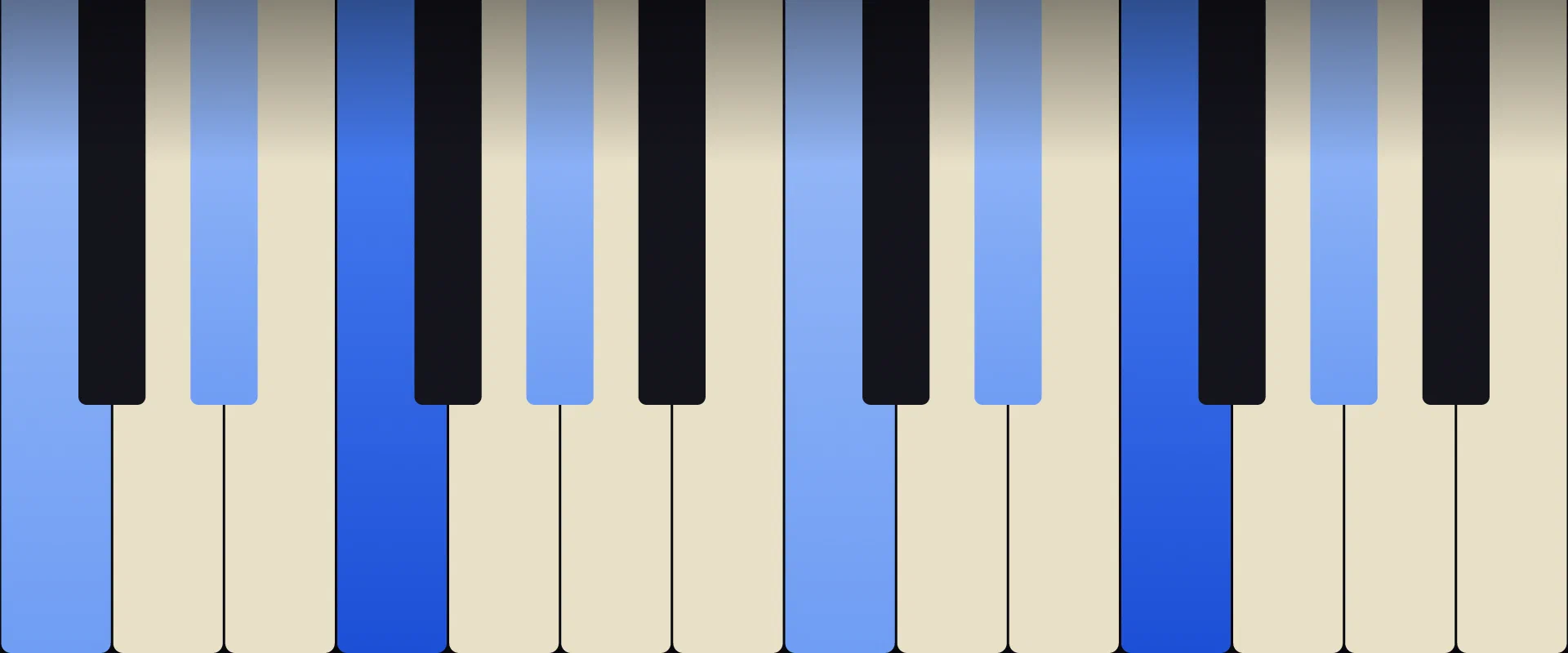
Colours alternate all the way up, F white, A♭ black, C white, E♭ black, and they sort the chord for you. F and C, the two white keys, are the frame every chord on this root has. A♭ and E♭, the two black keys, are the ♭3 and the ♭7, the pair that makes this one minor and makes it a seventh. The chord’s whole character sits on the raised part of the hand.
Right hand root position is 1 on F, 2 on A♭, 3 on C, 5 on E♭, and the little finger has to push in for a black key while the thumb stays out at the front edge of F. The hand is tilted for the whole chord.
So do not play it that way. Give F to the left hand alone and let the right take A♭, C and E♭, which is a plain A♭ major triad and needs no thought at all. Add G on top and the right hand becomes A♭maj7 while the sounding chord becomes Fm9. Keep E♭ near the top of the voicing, though. Buried down below middle C it stops sounding like a 7th and starts sounding like a smear.
Fm7 on the Guitar
The full six string version is the open Em7 shape moved to the 1st fret: index flat across all six, ring finger on the 5th string at fret 3, and no other finger anywhere. Written out that is 1 3 1 1 1 1, sounding F, C, E♭, A♭, C, F. Compare the three barres at this fret in order. F major needs three fingers behind the index, F minor needs two, Fm7 needs one. The chord that beginners are told is advanced is the easiest of the three.
Take the barre off entirely and something better appears. One finger across the top four strings at fret 1, x x 1 1 1 1, sounds E♭, A♭, C and F. That is every note of the chord with nothing doubled, in third inversion, and if there is a bass player on F it is simply Fm7. A complete seventh chord cannot cost less than that anywhere on the neck.
There is a well known accident here too. A learner whose barre is not yet working lays the index across all six strings at fret 1 and gets F, B♭, E♭, A♭, C, F. Not the F major they were reaching for, but not a mistake either: that is Fm7 with a B♭ in it, which a chart would call Fm11.
Higher up, the Am7 shape at the 8th fret, x 8 10 8 9 8, gives the same chord where the strings are slacker. For comping, though, the grip to own is 1 x 1 1 1 x, F, E♭, A♭ and C from the bottom: middle finger on the 6th string, index flat across the 4th, 3rd and 2nd, and the 5th string deadened by the underside of that same index on its way over.
Inversions
| Inversion | Notes | Bass Note | Symbol |
|---|---|---|---|
| Root position | F, A♭, C, E♭ | F | Fm7 |
| 1st inversion | A♭, C, E♭, F | A♭ | Fm7/A♭ |
| 2nd inversion | C, E♭, F, A♭ | C | Fm7/C |
| 3rd inversion | E♭, F, A♭, C | E♭ | Fm7/E♭ |
First inversion is the one that changes its name. Put A♭ underneath and almost every reader hears A♭6, so write Fm7/A♭ only when the bar before it has established F as the tonic and you want that sense kept.
Third inversion behaves differently on the two instruments. On a keyboard, E♭ and F sit next to each other at the bottom and thicken into mud below middle C. On a guitar the identical inversion is the cleanest shape on the neck, since x x 1 1 1 1 spreads those two notes an octave and a tone apart.
Voicings
Leave a gap under the 3rd. F on its own low down carries the chord perfectly well, and A♭ is better placed a tenth above it than a third. The shell is what to memorise: F and E♭ in the left hand, A♭ and C in the right.
| Shape | Frets, low to high | Sounding notes |
|---|---|---|
| Em7 shape, barred at fret 1 | 1 3 1 1 1 1 | F, C, E♭, A♭, C, F |
| One finger, top four strings | x x 1 1 1 1 | E♭, A♭, C, F |
| Four note comping grip | 1 x 1 1 1 x | F, E♭, A♭, C |
| Am7 shape, barred at fret 8 | x 8 10 8 9 8 | F, C, E♭, A♭, C |
Which Keys Contain Fm7
- i7 of F natural minor
- i7 of F dorian
- ii7 of E♭ major
- iv7 of C natural minor
- vi7 of A♭ major
- iii7 of D♭ major
As the ii7 of E♭ and the vi7 of A♭ it holds the commonest supporting job in two neighbouring flat keys at once, which is most of why it turns up on any chart with three or four flats at the front.
One scale swallows it whole, and that scale has two names. F minor pentatonic and A♭ major pentatonic are the same five notes read from opposite ends, and Fm7 sits inside them with only B♭ left over, so a guitarist soloing in the first position box is playing the accompaniment. F blues adds one more note to those five: C♭, the blue note, which is this chord’s 5th flattened.
Where Fm7 Shows Up
The chord’s steadiest job is as the ii of E♭ major. Fm7, B♭7, E♭maj7 is a ii V I in which nothing in the upper harmony ever rises. Going to B♭7, F and A♭ stay put while C falls a whole tone and E♭ falls a semitone; going on to E♭maj7, B♭ and D stay put while F and A♭ fall in the same way. Hold what you can and let the rest sink, and your hand barely moves through the cadence.
An F minor blues lets the chord be the tonic. Fm7 for four bars, B♭m7 for two, Fm7 for two, then D♭7 to C7 and back is the common twelve bar minor form, and it is the one place where a guitarist in this key fights nothing: the shapes sit at the 1st fret and again at the 13th, with the scale under the same fingers.
In A♭ major the useful move is the one that does not arrive. B♭m7, E♭7, Fm7 builds the whole cadence and then withholds the tonic, and the substitution is gentle because A♭, C and E♭ belong to A♭maj7 as well. Only the bass gives the deception away.
Related Chords
- F Minor Chord is the triad this is built on, and the reason the barre here is cheaper than F major’s.
- A♭ Major 6th Chord is these four notes with A♭ in the bass.
- F Dominant 7th Chord keeps the E♭ and restores the A natural.
- F Major 7th Chord restores both notes and loses the minor colour entirely.
- Guitar Chord Shapes: The CAGED System explains why the Em7 and Am7 shapes both land on this chord.
Learn More
For how a ii7 behaves in every key, see Seventh Chords: The Complete Guide and Diatonic Chords: A Beginner’s Guide. Fm9 and Fm11 are covered in Extended Chords and Jazz Harmony, and the naming question in Chord Inversions and Voice Leading. E♭ major and A♭ major sit side by side at three and four flats on the circle of fifths. For every scale containing this chord, see Scales for Piano and Guitar: The Complete Reference Guide.
Practice Chords
Drill chord recognition with a metronome, MIDI support, and score tracking.
Start PracticingRelated Articles
A Minor 7th Chord: Notes, Voicings, and How to Play It
Aug 30, 2026 · 8 min
A♭ Minor 7th Chord: Notes, Voicings, and How to Play It
Aug 30, 2026 · 8 min
B Minor 7th Chord: Notes, Voicings, and How to Play It
Aug 30, 2026 · 8 min