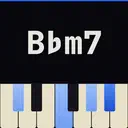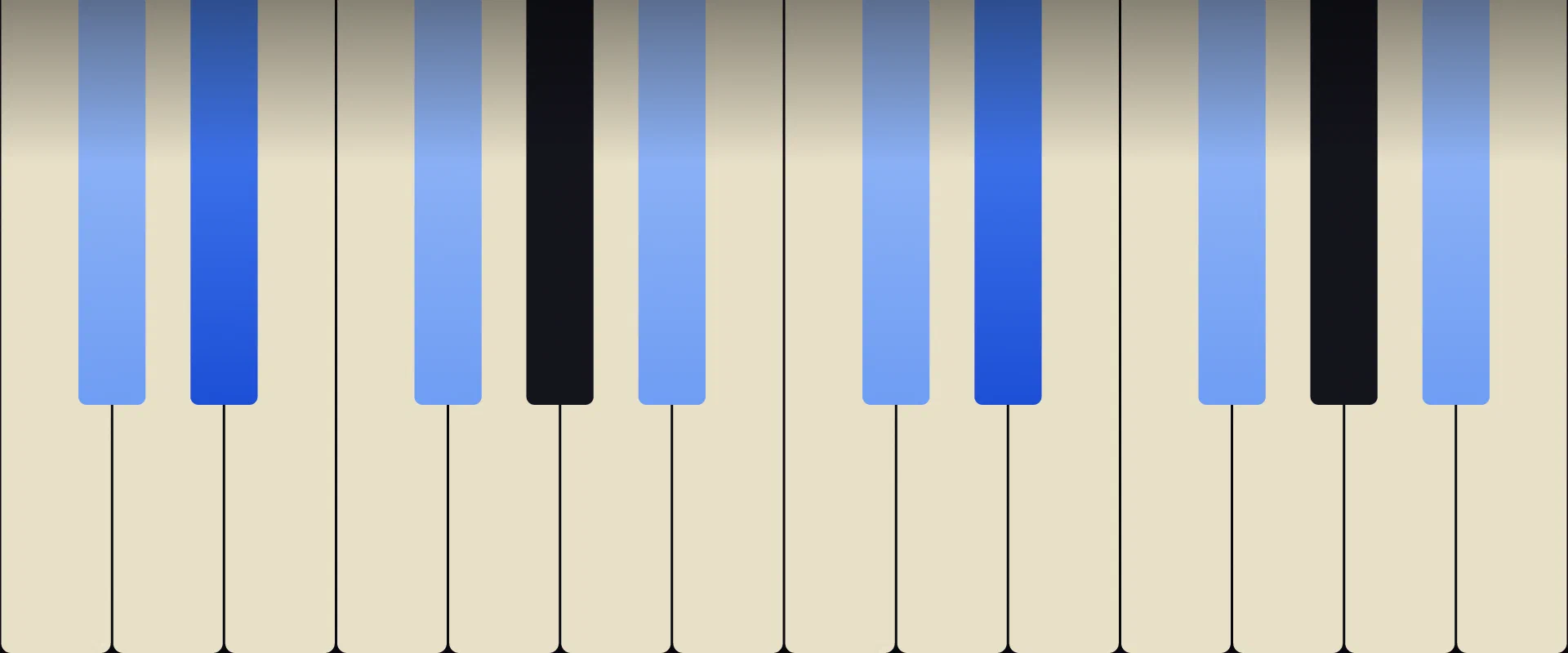
Of the twelve minor 7th chords, exactly one can be played without a white key anywhere in it. E♭, G♭, B♭ and D♭ are four of the five black keys, and the fifth, A♭, is the one note you would most want to add. Miles Davis arrived at the same chord from the other side: the middle eight bars of “So What” are this harmony and nothing else, reached by lifting the whole band one semitone off D minor and leaving it there.
Try It: E♭m7 in the Chord Finder
The Notes of E♭m7
The chord contains four notes: E♭, G♭, B♭ and D♭.
| Degree | Note | Interval from root | Semitones |
|---|---|---|---|
| 1 | E♭ | Root | 0 |
| ♭3 | G♭ | Minor 3rd | 3 |
| 5 | B♭ | Perfect 5th | 7 |
| ♭7 | D♭ | Minor 7th | 10 |
The symbol is E♭m7. Lead sheets also print E♭min7 and E♭-7.
How E♭m7 Is Built
Take the E♭ minor triad and set a D♭ on top of it. Nothing else moves.
What makes this particular seventh cheap is the key signature. D♭ is already the seventh degree of E♭ natural minor, so no accidental is needed to write the chord and nothing has to be cancelled on the page. Compare that with E♭m6, which reaches past the written C♭ for a C natural and needs a sign to say so. The minor 7th is the chord the six flat signature hands you for free.
The major 6th chord hiding inside it
Rebuild the same four pitches from G♭ upwards and you get G♭, B♭, D♭ and E♭: a G♭ major triad with a sixth added. E♭m7 and G♭6 are the same notes and differ only in which one a bass player puts underneath. The site files that chord under its sharp spelling, F♯6, the identical sound written F♯, A♯, C♯ and D♯. Put E♭ in the bass and the harmony is restless and minor. Put G♭ there and it turns bright and finished.
E♭m7 on the Piano
Four black keys, no white ones, and the hand sits at the back of the keyboard for all of it. E♭ is the right hand key of the group of two, G♭ the left hand key of the group of three, B♭ the right hand key of that same group, and D♭ the left hand key of the next group of two an octave along. Right hand fingering 1, 2, 3, 5 covers it; the left hand takes 5, 3, 2, 1.
Because every key is raised by the same amount the hand stays level, but the span from E♭ up to D♭ is a minor seventh, wide for a beginner’s right hand. Drop the D♭ an octave into the left hand and the problem goes away.
The best reason to know this chord at a keyboard has nothing to do with fingering. Hold E♭m7 down and improvise on the black keys with the other hand: every one of them belongs. The chord is four of the five, and the note it leaves out, A♭, is the eleventh. On a major 7th chord the eleventh is the note to avoid, since it grinds against the major third a semitone below it. On a minor 7th there is no such collision, so A♭ is not merely tolerable over E♭m7, it is the note that makes the chord sound modern.
Bill Evans’s voicing on the record does exactly that. Stack E♭, A♭, D♭ and G♭ in fourths and cap it with B♭ and you have the So What chord in this key: five notes, all five black keys, no white key available to spoil it.
E♭m7 on the Guitar
The most useful shape is the Am7 form barred at the 6th fret, x 6 8 6 7 6. The root sits on the 5th string, the position is in the easy middle of the neck, and the index barre spans five strings rather than six, with the ring finger on the 4th string and the middle on the 2nd. The Em7 form at the 11th fret, 11 13 11 11 11 11, gives a deeper root but demands a full six string barre where the frets have closed up, and on an acoustic your thumb is already arguing with the neck joint.
Neither is the cheapest option. Take the open Dm7 grip and move it one fret up: x x 1 3 2 2. That is E♭ on the 4th string, B♭ on the 3rd, D♭ on the 2nd and G♭ on the 1st, four notes, no barre, first position, with the ♭3 and ♭7 both ringing on unwound strings.
Improvising over it is where this root pays for itself. The chord is the E♭ minor pentatonic scale minus its fourth degree, so the pentatonic box rooted at the 11th fret holds every chord tone plus the A♭ that completes it, and the E♭ blues scale adds the A natural on top without disturbing anything. A guitarist who already owns that box owns the chord.
For comping, stay at the 6th fret and let the ii V I do the moving. E♭m7 at x 6 8 6 7 x goes to A♭7 at x x 6 8 7 8, then D♭maj7 at x 4 6 5 6 4. Three grips inside four frets, which is the practical argument for playing flat key jazz in this region rather than near the nut.
Inversions
| Inversion | Notes | Lowest note |
|---|---|---|
| Root position | E♭ G♭ B♭ D♭ | E♭ |
| 1st inversion | G♭ B♭ D♭ E♭ | G♭ |
| 2nd inversion | B♭ D♭ E♭ G♭ | B♭ |
| 3rd inversion | D♭ E♭ G♭ B♭ | D♭ |
The first inversion is the one that changes the chord’s name rather than its colour. G♭ B♭ D♭ E♭ is G♭6 in root position, so the moment a bass player sits on G♭ the ear stops hearing a minor chord at all. Third inversion is the opposite case: D♭ in the bass keeps the chord minor but makes it lean, because a seventh sitting underneath the root wants to fall by a step.
Voicings
Remove the root and what is left, G♭ B♭ D♭, is a plain G♭ major triad. That is the standard piano division of labour: E♭ alone in the left hand, G♭ major in the right, and the chord assembles itself. It also explains why E♭m7 sounds warmer than its symbol suggests, since most of what you hear is a major triad.
Stacked in thirds and kept low it turns muddy fast, since G♭ below middle C is already close to the bottom of where a minor third stays legible. Spread instead, or space it in fourths.
On guitar the three note reduction x 6 x 6 7 x gives E♭, D♭ and G♭: root, seventh and third, no fifth. The fifth is the first note to go in any seventh chord, and dropping it here leaves both strings that carry the chord’s identity ringing.
Which Keys Contain E♭m7
- i7 of E♭ natural minor
- i7 of E♭ dorian
- ii7 of D♭ major
- iv7 of B♭ natural minor
- vi7 of F♯ major
- Contained in E♭ minor pentatonic
The F♯ major page spells this chord D♯, F♯, A♯ and C♯, since a key signature holding six sharps has no room for flats. Same four sounds, same frets, different letters on the page.
Where E♭m7 Shows Up
Eight bars of it, alone. The B section of “So What” and of Coltrane’s “Impressions” is E♭m7 and nothing else, a semitone above the Dm7 that fills the rest of the form. That semitone shift is the entire harmonic event of the tune, and it works because moving a modal centre by the smallest possible distance changes every note in the scale at once.
ii7, V7, Imaj7: E♭m7, A♭7, D♭maj7. E♭ and G♭ are common to the first two chords, and the G♭ you are already holding is the note that makes A♭7 a dominant, so the change happens underneath your fingers rather than in front of them. From A♭7 into D♭maj7, written C♯maj7 on the sharp side of the site, only two voices move again.
i7, iv7: B♭m7, E♭m7. As the iv of B♭ minor the chord is a place the music passes through rather than rests on, and every note of E♭m7 is already inside B♭ minor, so the change is felt as a shift of weight rather than of colour.
Guitar music, under another name. As the vi of F♯ major and the iii of B major the same sound is written D♯m7, and that is how it reaches most players: found on a fretboard in a sharp key, never named E♭. Horn players meet a flat key ballad chord, guitarists meet a shape near the 11th fret in songs built around open E and B, and neither camp tends to notice that the four notes are the same.
Related Chords
Learn More
Practice Chords
Drill chord recognition with a metronome, MIDI support, and score tracking.
Start PracticingRelated Articles
A Minor 7th Chord: Notes, Voicings, and How to Play It
Aug 30, 2026 · 8 min
A♭ Minor 7th Chord: Notes, Voicings, and How to Play It
Aug 30, 2026 · 8 min
B Minor 7th Chord: Notes, Voicings, and How to Play It
Aug 30, 2026 · 8 min