Dm7 is the first chord of the first exercise. Jazz teaching opens on ii, V, I in C major, which spells Dm7, G7, Cmaj7, so more players meet this seventh chord on their first day than meet any other. C major is chosen because it has no accidentals, and the chord inherits that: D, F, A and C are four white keys, and the guitar grip is open D minor with one string moved.
It earns more than a place in a syllabus by how much of the next chord it is already holding. G7 is G, B, D and F, and two of those are under your fingers before the dominant arrives, so the ii chord behaves less like a stop than a run-up.
Try It: Dm7 in the Chord Finder
The Notes of Dm7
Dm7 is four notes: D, F, A and C.
| Degree | Note | Interval from Root | Semitones |
|---|---|---|---|
| 1 (Root) | D | Perfect unison | 0 |
| ♭3 | F | Minor 3rd | 3 |
| 5 | A | Perfect 5th | 7 |
| ♭7 | C | Minor 7th | 10 |
The symbol is Dm7, sometimes D min7 or D-7.
How Dm7 Is Built
Take D minor, D, F and A, and add C above it. The 7th degree of D natural minor is C, so nothing is borrowed and no accidental appears. That is the whole construction, which is why this chord reaches beginners long before most seventh chords do.
Read the same four keys from the other end and they say something else. Stacked from F they are F, A, C and D, which is F6, and the F6 page argues that case from F’s side. What matters here is the practical half: the top three notes, F, A and C, are an ordinary F major triad. Play F major in the right hand, put a D underneath, and the chord is complete. Arrangers write it F/D.
The other two sevenths on this root are close by. D7 raises the F to F♯. Dmaj7 raises the C to C♯ as well, so it stands two alterations away.
Dm7 on the Piano
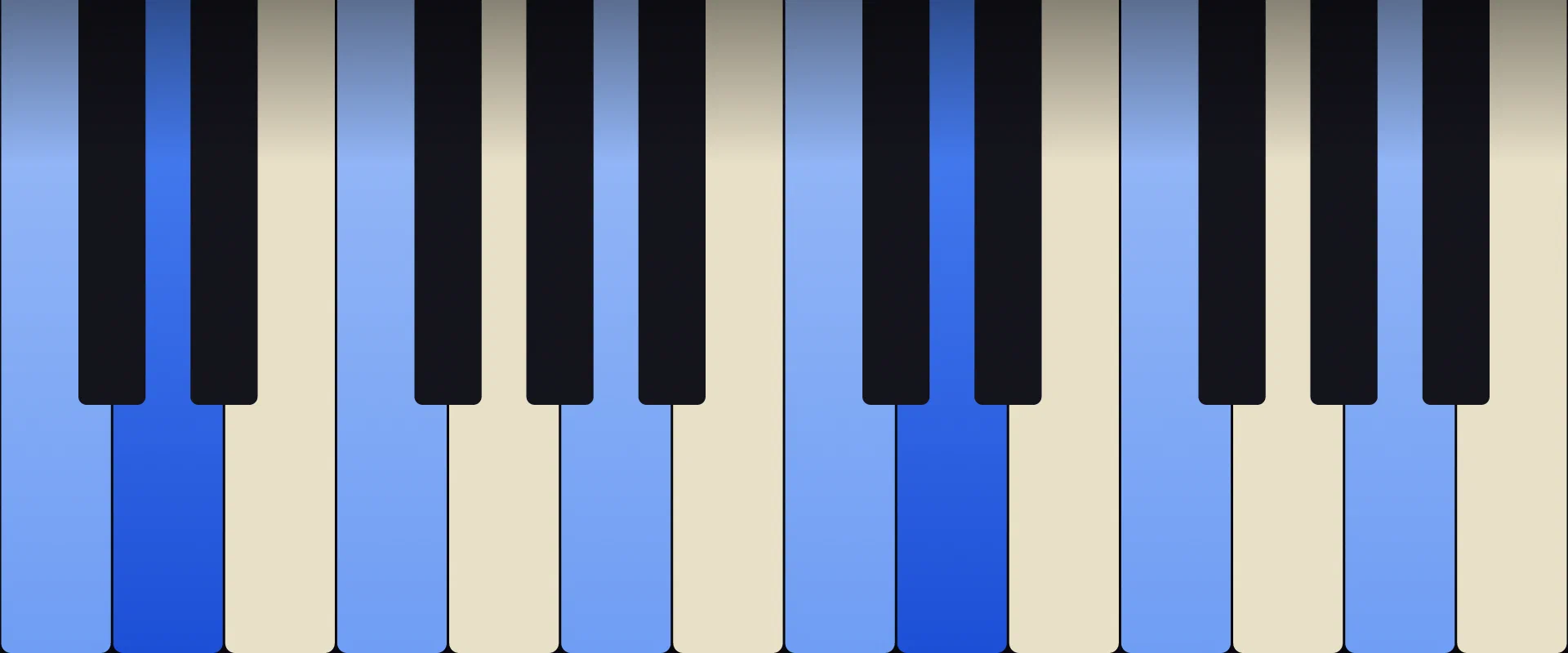
Right hand 1, 2, 3, 5: thumb on D, index on F, middle finger on A, little finger on C. Left hand 5, 4, 2, 1. Every finger lands on a white key and the reach is a minor 7th, so nothing stretches.
Almost nobody plays it that way in real music. Put D alone low in the left hand and take F, A and C in the right, and the right hand is holding a shape it already owns. The 7th then sits on top, where it reads as colour rather than leaning on the root from a whole tone below. That is the common mistake: a C wedged directly under the D turns the bottom of the chord to mud, while the same C ten semitones above it is perfectly clear.
Leaner still is the shell: left hand D and C alone, right hand free. Root and 7th are enough to name the chord, and the A goes first if anything has to, since it is exactly what Dm7 shares with plain D minor.
Then the reason this chord owns the classroom. Three white keys are missing from it, E, G and B, and those are its 9th, 11th and 13th. In C major all three are available, so a beginner can hold Dm7 in the left hand, improvise on white keys with the right, and not play a wrong note.
Dm7 on the Guitar
x x 0 2 1 1, sounding D, A, C, F. Index flat across the top two strings at the 1st fret, middle finger on the 3rd string at the 2nd fret, open 4th string underneath. Two fingers, four notes, nothing doubled, which is rare in an open shape and makes this one arpeggiate cleanly.
Against open D minor, x x 0 2 3 1, only the second string moves. Open Dm spends that string on a second D; Dm7 spends it on the 7th. The 2nd string at the 1st fret is one rung of the chromatic descent that ends on Dm6, and it is the rung players stop on most, because C is the note that makes this the ii of C major.
The cost is that small barre. String tension is highest at the 1st fret, and the index has to lie genuinely flat across two strings there. Let the second string choke and you are left with D, A and F, which is D minor with the seventh deleted.
There is no bass note here: the lowest sounding string is the open 4th. Let the open 5th ring for x 0 0 2 1 1 and the chord costs nothing extra, since A is a chord tone and the result is Dm7/A. For a real root underneath, tune the 6th string down to D and play 0 0 0 2 1 1.
Further up, the Am7 shape barred at the 5th fret gives x 5 7 5 6 5, a barre plus two fingers where the frets are still wide. The Em7 shape at the 10th fret gives 10 12 10 10 10 10, six strings with a low D at the bottom and no room to be inexact.
Inversions
| Inversion | Bass Note | Notes | Symbol |
|---|---|---|---|
| Root position | D | D, F, A, C | Dm7 |
| 1st inversion | F | F, A, C, D | Dm7/F |
| 2nd inversion | A | A, C, D, F | Dm7/A |
| 3rd inversion | C | C, D, F, A | Dm7/C |
First inversion is worth a second look. F, A, C, D is not merely Dm7 rearranged, it is F6 in root position: the same keys in the same order, with only the bass deciding which name goes on the chart.
Third inversion is the one to use sparingly, since the C underneath wants to fall to B, and B is the third of G7, so it reads as transit rather than as a place to sit. Second inversion, by contrast, is free on guitar: x 0 0 2 1 1.
Voicings
Guitar, open (x x 0 2 1 1). Two fingers, four distinct notes.
Guitar, 5th in the bass (x 0 0 2 1 1). Same grip, open A underneath.
Guitar, Am7 shape at fret 5 (x 5 7 5 6 5). Movable, generous fret spacing.
Guitar, Em7 shape at fret 10 (10 12 10 10 10 10). Six strings and a low D, cramped.
Piano, F major over D (D low, F, A and C above). The everyday arranger’s version.
Piano, shell (D and C in the left hand). Root and 7th, right hand free for the melody.
Which Keys Contain Dm7
- ii of C major
- i of D dorian
- i of D natural minor
- vi of F major
- iv of A natural minor
- v of G natural minor
Six is a selection, not a list. Because none of the four notes carries an accidental, more than twenty scales on this site hold Dm7 intact.
D Dorian deserves its line as much as C major does. It is the white key mode, the rotation of C major starting on D, and the only mode with a Dm7 tonic that asks for no accidental at all. All four notes also fit inside the D minor pentatonic scale, which adds only G, and inside the D blues scale.
Where Dm7 Shows Up
ii, V, I in C major: Dm7, G7, Cmaj7. Two voices hold and two move. D and F stay exactly where they are; the A falls a whole tone to G and the C falls a semitone to B. Hearing those two notes move is most of what the exercise teaches, and the fact that the other two never budge is why the change sounds inevitable rather than dramatic.
vi, ii, V, I: Am7, Dm7, G7, Cmaj7. The turnaround under “Fly Me to the Moon” and a good deal of the standard repertoire. The roots fall in fourths and each neighbouring pair shares two notes, so the hand barely travels.
Dm7 over a G bass. Put G underneath and the same four notes become G9sus4: G, C, D, F and A. The C is a suspended 4th nobody makes resolve. It is the ii chord and the V chord at once, which is why soul and gospel intros hang on this sonority for bars before a tonic appears.
vi in F major: Fmaj7, Dm7, Gm7, C7. Here the chord is the tonic’s shadow, a third down and a shade darker, and it stops a turnaround in F from sounding like the end of the tune too early.
Teaching keeps returning to this root for a practical reason. Tell an improviser to play over Dm7 and every note that works is white, so the lesson can be about phrasing instead of about accidentals. Guitarists get the same deal in the first position minor pentatonic box, and both are learning to hear D Dorian without being told so.
Related Chords
- D Minor Chord, the triad this is built on.
- F Major 6th Chord, the same four notes with F in the bass.
- D Minor 6th Chord, one semitone away at the top, and a different job.
- D Dominant 7th Chord, the same frame with a major 3rd.
- The D Dorian Scale, the white key mode this chord sits at the bottom of.
Learn More
Practice Chords
Drill chord recognition with a metronome, MIDI support, and score tracking.
Start PracticingRelated Articles
A Minor 7th Chord: Notes, Voicings, and How to Play It
Aug 30, 2026 · 8 min
A♭ Minor 7th Chord: Notes, Voicings, and How to Play It
Aug 30, 2026 · 8 min
B Minor 7th Chord: Notes, Voicings, and How to Play It
Aug 30, 2026 · 8 min