Take an open E chord and move one finger. The second string goes from open B up to the 2nd fret, a C♯ arrives, and the six strings sound E, B, E, G♯, C♯, E: the four notes of C♯m7 with E at the bottom instead of C♯. On the instrument most people meet this chord on, its cheapest voicing is an inversion, and whether the chart says C♯m7 or E6 is decided by whoever plays the bass.
Put the root underneath and the price goes up to a barre, at the 4th fret or the 9th. That gap between the easy version and the correctly rooted one runs through everything below.
Try It: C♯m7 in the Chord Finder
The Notes of C♯m7
| Degree | Note | Interval from root | Semitones |
|---|---|---|---|
| 1 | C♯ | Root | 0 |
| ♭3 | E | Minor 3rd | 3 |
| 5 | G♯ | Perfect 5th | 7 |
| ♭7 | B | Minor 7th | 10 |
Two sharps and two naturals, and both sharps are already in the key signature of C♯ minor. Nothing in this symbol has to be explained away or rewritten in flats, which is rare on this root.
How C♯m7 Is Built
Add B to the C♯ minor triad. The stack goes minor third, major third, minor third: C♯ to E, E to G♯, G♯ to B. Measure every pair of notes in it and no interval comes out at six semitones, so there is no tritone anywhere in the chord. That absence is why it can hold a groove for eight bars without asking to go anywhere, and it is what separates it from C♯7, which is built round one.
Now read the same four notes from E. E up to G♯ is a major third, E up to B a perfect fifth, and E up to C♯ nine semitones across six letter names, a major sixth. That combination is E6. C♯ minor and E major share a key signature because they are relatives, and here they share a chord as well: the tonic triad of the relative major, sitting on top of the relative minor’s seventh chord. One set of notes, two names, and the bass note settles which one is true.
The chord also refuses to choose a mode. C♯ natural minor and C♯ Dorian differ at the sixth degree, A against A♯, and this chord contains neither, so both produce the same tonic seventh. The melody decides which world you are in.
C♯m7 on the Piano
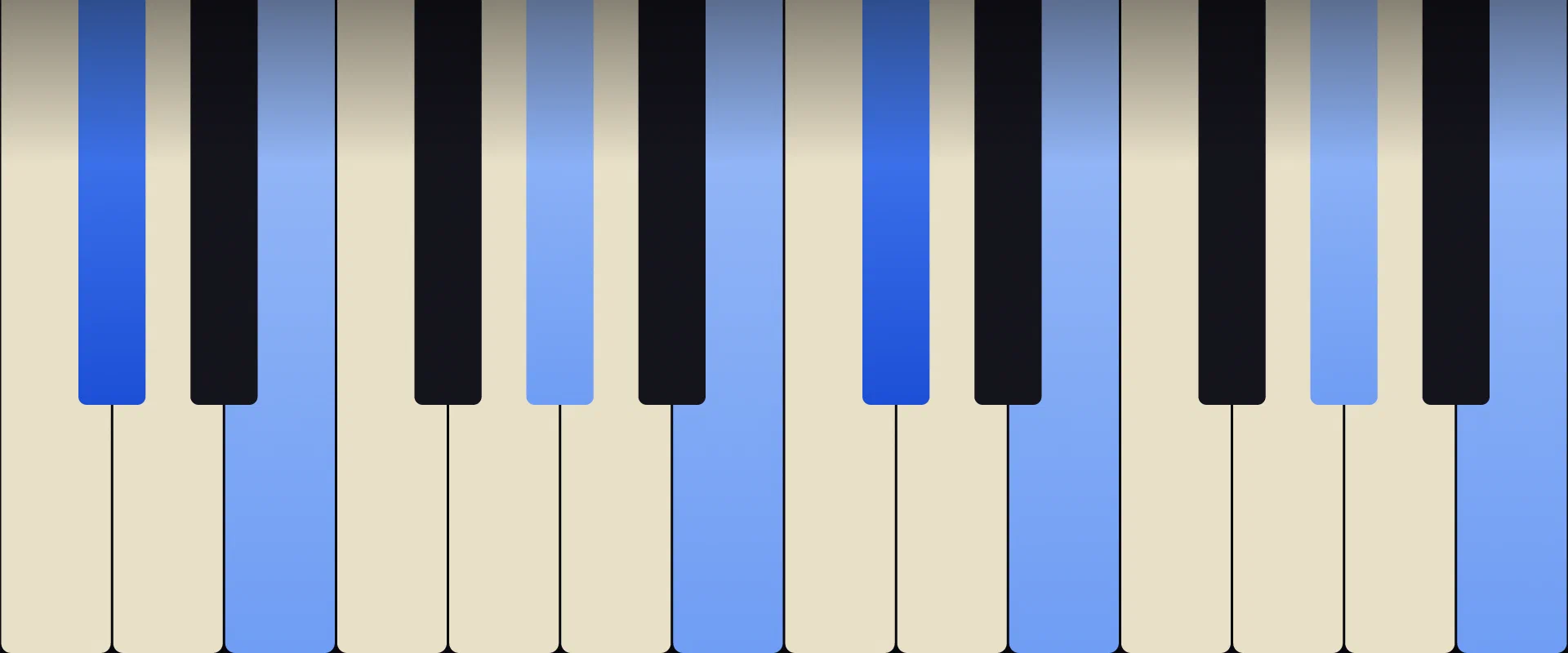
Black, white, black, white going upwards. The two white keys are E and B, the only two on the keyboard with no black key to their right, so both can be met at the front or well back without the hand changing depth.
Right hand, root position: 1 on C♯, 2 on E, 4 on G♯, 5 on B. Left hand mirrors it, 5, 4, 2, 1. Split the chord in the middle instead and two perfect fifths fall out, C♯ up to G♯ and E up to B. The lower fifth is two black keys, the upper one two white keys, so neither hand has to mix rows, and for a repeated accompaniment figure that is worth more than any clever fingering.
First inversion is worth learning second. E, G♯, B, C♯ from the bottom is white, black, white, black, the exact negative of root position, and it is the shape to reach for once a bass player has taken E.
C♯m7 on the Guitar
Two barres carry the chord. The A minor seventh shape at the 4th fret, x 4 6 4 5 4, sounds C♯, G♯, B, E, G♯, and it needs one finger fewer than the plain minor barre at that fret: the third string drops from the 6th fret to the 4th, which means letting go and allowing the barre itself to supply the seventh. Higher up, the E minor seventh shape at the 9th fret is 9, 11, 9, 9, 9, 9, six strings from a barre plus one ring finger. It also lands in the same three frets as the C♯ minor pentatonic box rooted on the sixth string, so rhythm part and solo share an address.
The chord books list no open form. That is half the story, because two of these four notes are open strings: E and B, the third and the seventh, handed over for nothing. Try x 4 2 1 0 0: ring finger on the fifth string at the 4th fret, middle on the fourth at the 2nd, index on the third at the 1st, and the top two strings open. It sounds C♯, E, G♯, B, E, ascending in order, with no barre and no doubled root. Under fingerpicking in E or A, where open strings are ringing anyway, it is the better chord.
The E6 grip from the opening, 0 2 2 1 2 0, is these notes in first inversion. If the band is in E major that low E costs nothing. If C♯ minor is home it undermines the chord, so mute the sixth string and play x 2 2 1 2 0 instead, which puts B in the bass and leaves the rest of the shape untouched.
Inversions
| Inversion | Notes | Lowest note |
|---|---|---|
| Root position | C♯ E G♯ B | C♯ |
| 1st inversion | E G♯ B C♯ | E |
| 2nd inversion | G♯ B C♯ E | G♯ |
| 3rd inversion | B C♯ E G♯ | B |
First inversion is the ambiguous one, and the ambiguity is not subtle: with E underneath, the notes above it spell a plain E major triad and most ears simply hear E6. Second inversion is the least used, since a fifth in the bass leaves the chord neither rooted nor pointed anywhere. Third inversion is more useful than it looks: B is the dominant of E major, and these notes over a B behave like a suspension, happy to fall onto either B or E.
Voicings
Three notes are enough. Keep C♯, E and B and drop G♯, which adds nothing. On guitar that is x 4 x 4 5 x, root, seventh and third, a shell that sits under a vocal.
The pianist’s version of the same economy is to give C♯ to the left hand alone and play E, G♯ and B in the right, which is to say hold an E major triad and put one black key under it. Add D♯ above for C♯m9.
Then move the bass and keep the right hand still. Over E those four notes are E6. Over A they are Amaj9 with the root supplied from below. Over F♯ they are F♯9sus4, since C♯, E, G♯ and B become the fifth, seventh, ninth and eleventh of that chord. Three roots a fourth apart, one hand shape, which is why this grip turns up in so much keyboard comping.
Which Keys Contain C♯m7
- vi7 of E major
- iii7 of A major
- ii7 of B major
- i7 of C♯ natural minor
- i7 of C♯ dorian
- inside C♯ minor pentatonic
The last entry is the practical one. C♯ minor pentatonic is C♯, E, F♯, G♯ and B, so four of its five notes are this chord and the fifth, F♯, is a fourth that sits happily on top. A guitarist soloing in the box at the 9th fret is playing chord tones by default. The first three entries explain the traffic: E, A and B are the keys the instrument is built for, and this is the sixth, third and second degree of them.
Where C♯m7 Shows Up
| Progression | Chords | Turns up in |
|---|---|---|
| vi7 IV I V in E major | C♯m7, A, E, B | Pop, singer-songwriter |
| ii7 V7 I in B major | C♯m7, F♯7, Bmaj7 | Jazz standards in sharp keys |
| i7 ♭VII IV in C♯ Dorian | C♯m7, B, F♯ | Neo soul, house, funk |
| iii7 vi7 ii7 V7 in A major | C♯m7, F♯m7, Bm7, E7 | Turnarounds |
Row one hides a piece of voice leading. E major is E, G♯ and B, and all three are already in C♯m7, so moving from the tonic to this chord means the bass drops from E to C♯ and nothing above it has to move. Arrangers write the seventh here for that reason: the plain triad forces a voice to shift, the seventh does not. Rows two and four are the jazz jobs, the ii of B major opening a cadence and the iii of A major starting a turnaround, and in both the seventh is compulsory.
Row three is where the seventh changes the genre. C♯ minor is a rock and metal address, and the bare triad is what those styles use. Add B and the same key turns into a keyboard key: the chord loses its edge and a Rhodes or a house stab can sit on it for sixteen bars. One note is the difference between brooding and floating.
Related Chords
- C♯ Minor Chord, the triad underneath, and the page with the barre positions worked through
- C♯ Minor 6th Chord, the same triad carrying A♯ instead of B, which puts a tritone back in
- C♯ Dominant 7th Chord, one semitone away on the third, and a completely different job
- E Major 6th Chord, these four notes read from the other end
- Seventh Chords: The Complete Guide
- Chord Inversions and Voice Leading
Learn More
- Diatonic Chords: A Beginner’s Guide
- The ii, V, I Progression
- Extended Chords and Jazz Harmony
- Guitar Chord Shapes: The CAGED System
- The Circle of Fifths Explained
- E Major Scale, the key that borrows this chord most often
Practice Chords
Drill chord recognition with a metronome, MIDI support, and score tracking.
Start PracticingRelated Articles
A Minor 7th Chord: Notes, Voicings, and How to Play It
Aug 30, 2026 · 8 min
A♭ Minor 7th Chord: Notes, Voicings, and How to Play It
Aug 30, 2026 · 8 min
B Minor 7th Chord: Notes, Voicings, and How to Play It
Aug 30, 2026 · 8 min