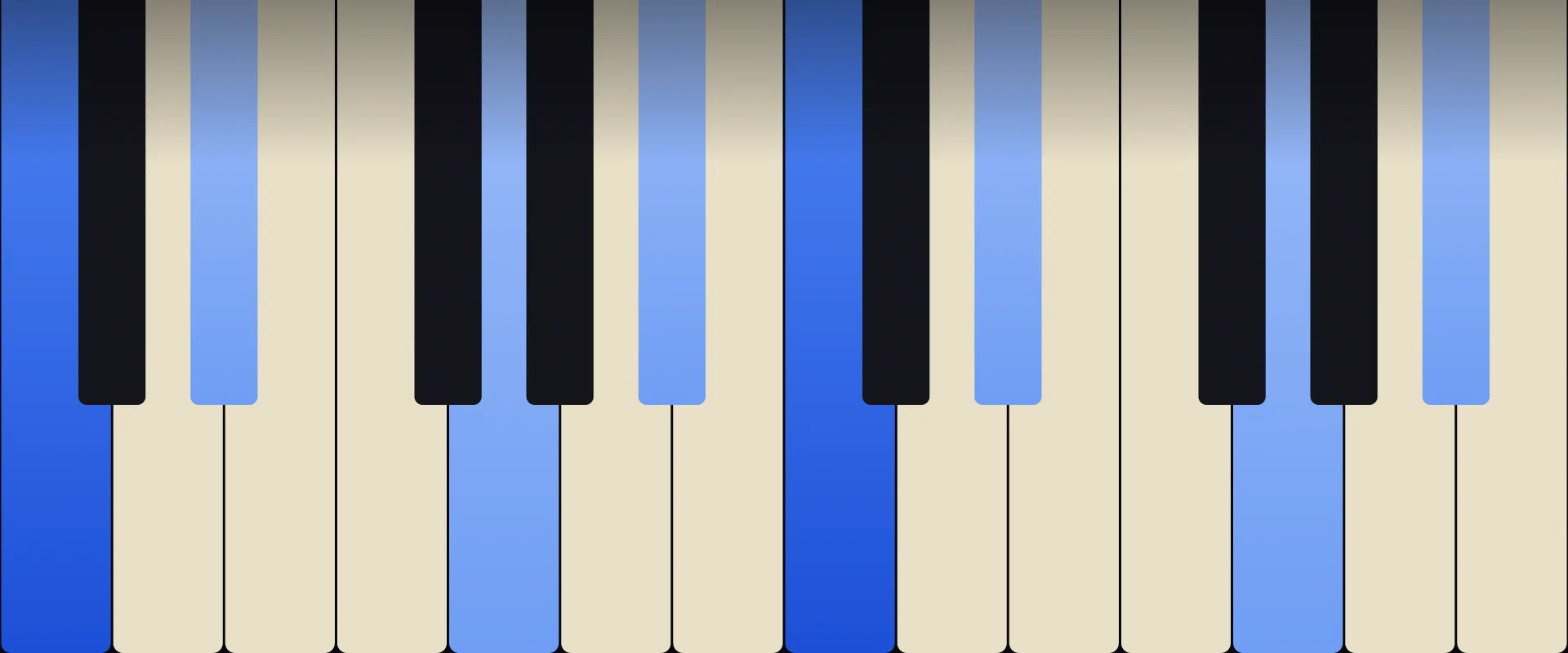
Nothing inside these four notes says which one is the root. C, E♭, G and B♭ spell Cm7 with C at the bottom and E♭6 with E♭ at the bottom, and the only thing settling the argument is whoever plays the lowest note. That is not a curiosity, it is how the chord gets voiced: the top three notes are a plain E♭ major triad, and a pianist who drops a C under one has a minor seventh chord without learning a new shape. What gives the C reading its authority is the chord that follows. Put F7 after it, land on B♭, and Cm7 has been the ii of B♭ major, the job that keeps this chord in print.
Try It: Cm7 in the Chord Finder
Set the root to C and try Dorian, then natural minor, then Phrygian. The chord on the first degree is the same in all three.
The Notes of Cm7
| Degree | Note | Interval from root | Semitones |
|---|---|---|---|
| 1 (root) | C | Perfect unison | 0 |
| ♭3 | E♭ | Minor 3rd | 3 |
| 5 | G | Perfect 5th | 7 |
| ♭7 | B♭ | Minor 7th | 10 |
Written out: C, E♭, G, B♭. Two white keys and two black, alternating, one from each of the keyboard’s two black groups. There is no tritone anywhere: E♭ to B♭ is a perfect 5th and C to G is another, two consonant frames inside one chord, which is why Cm7 can be held for eight bars and still sound like somewhere to be rather than somewhere to leave.
How Cm7 Is Built
Take C minor, C, E♭ and G, and put B♭ a whole tone below the octave. Move either flat now and the chord changes family. Raise the E♭ and you have C7, which now contains a tritone and owes somebody a resolution. Raise the B♭ and you have Cm(maj7), the tonic of C harmonic minor. Lower the G and you have Cm7♭5. Of those four, only Cm7 is content in more than one key at once.
Read the stack upwards and it is two chords. E♭, G and B♭ alone are E♭ major, so Cm7 is an E♭ major triad over a C, and E♭ major is the relative major of C minor. The chord is both keys at once.
Cm7 on the Piano
The two black keys sit at opposite ends of the keyboard’s landmarks: E♭ is the right hand key of the group of two, B♭ the right hand key of the group of three, and between them G is white and out front. The hand therefore zigzags, back, forward, back, forward, rather than tilting once and staying there.
Right hand 1, 2, 4, 5: thumb on C, index on E♭, ring finger on G, little finger on B♭. Skipping the third finger is what makes the zigzag work, since the index and the little finger both travel in towards the fallboard while the thumb and ring finger stay out on the wide part of the white keys. Left hand, upwards, is 5, 4, 2, 1. Keep the wrist level, because dipping it sends the little finger at B♭ in from below and it slips off the front edge.
Split it across two hands and it improves. Left hand takes C alone, right hand takes E♭, G and B♭, a shape most pianists already own because it is an E♭ major triad. Add D on top and the right hand becomes E♭maj7, the chord becomes Cm9, and the left hand has not moved.
Cm7 on the Guitar
Adding a note to this chord makes it easier to hold, which is not how chords usually behave. C minor barred at the 3rd fret is x 3 5 5 4 3, and it asks the ring finger for the 4th string and the little finger for the 3rd, both at the 5th fret. Cm7 is x 3 5 3 4 3: the 3rd string falls back onto the barre, where the index finger is already holding it down, and B♭ arrives at no cost. One finger fewer than the triad. The same trade happens at the other end of the neck, where C minor’s 8 10 10 8 8 8 becomes 8 10 8 8 8 8.
There is no open form, so for rhythm work the answer is to play fewer notes. x 3 x 3 4 x gives C, B♭ and E♭, root, seventh and third, nothing doubled and no fifth: the shell a guitarist plays behind a horn line. Higher up, x x 10 8 8 6 stacks C, E♭, G and B♭ in order on the top four strings, which is what to reach for when a bass player owns the low register.
The 8th fret shape earns its place because of what sits beside it. Play Cm7 at 8 10 8 8 8 8, then F7 at x 8 10 8 10 8, then B♭maj7 at 6 x 7 7 6 x. The entire ii V I of B♭ major lives between the 6th and the 10th frets, and the hand never leaves the position.
Inversions
| Inversion | Notes | Bass | Symbol |
|---|---|---|---|
| Root position | C E♭ G B♭ | C | Cm7 |
| 1st inversion | E♭ G B♭ C | E♭ | Cm7/E♭ |
| 2nd inversion | G B♭ C E♭ | G | Cm7/G |
| 3rd inversion | B♭ C E♭ G | B♭ | Cm7/B♭ |
The second row is more than a rearrangement. E♭, G, B♭, C is E♭6 in root position, note for note, so the first inversion of this chord is another chord’s home position. A chart prints whichever name the key calls for, and a rhythm section reading Cm7 in one part and E♭6 in another is not in disagreement.
The third inversion belongs to descending bass lines: a walk down from C to B♭ to A♭ to G under a sustained C minor chord passes through Cm7/B♭ on its second step. For how those lines work, see Chord Inversions and Voice Leading.
Voicings
Keep the bottom of the chord open. Packed close below middle C it turns muddy, because the minor 3rd from C to E♭ is the first interval a low register blurs.
| Shape | Frets | Result |
|---|---|---|
| Cm7 | x 3 5 3 4 3 | A shape at the 3rd fret |
| Cm7 | 8 10 8 8 8 8 | E shape at the 8th fret |
| Cm7 | x 3 x 3 4 x | Shell: root, 7th, 3rd |
| Cm7 | x x 10 8 8 6 | Top four strings, close position |
| Cm11 | x 3 3 3 3 3 | One barre, no 3rd, very open |
| E♭6 | x 6 8 8 8 8 | The same notes, E♭ in the bass |
The Cm11 row is one finger laid across the 3rd fret. It holds C, F, B♭, D and G, so the third has vanished and the chord is neither major nor minor until a melody supplies the E♭.
Which Keys Contain Cm7
- degree 2 (II) of B♭ major
- degree 6 (VI) of E♭ major
- degree 1 (I) of C natural minor
- degree 1 (I) of C dorian
- degree 1 (I) of C phrygian
- rooted on degree 1 of, and entirely contained in, C minor pentatonic
Three of those six take Cm7 as their tonic chord and they are three different modes. C natural minor, C Dorian and C Phrygian agree completely about these four notes and disagree about the second and sixth degrees, which the chord does not contain, so a soloist can change the colour of a Cm7 vamp without the chord ever being wrong. The last row is why that is easy on guitar: four of C minor pentatonic’s five notes are this chord.
Where Cm7 Shows Up
| Progression | Chords | Context |
|---|---|---|
| ii V I (B♭ major) | Cm7, F7, B♭maj7 | Jazz standards in B♭ |
| i7 iv7 (C minor blues) | Cm7, Fm7, G7♭9 | Minor blues in C |
| i7 IV7 (C Dorian) | Cm7, F7 | Modal and funk vamp |
| iii7 (A♭ major) | A♭maj7, Cm7, D♭maj7 | A softer tonic |
Watch the first row two notes at a time. E♭ and B♭ are the third and seventh of Cm7. Drop the B♭ a semitone to A and the pair becomes the seventh and third of F7. Drop the E♭ a semitone to D and the pair becomes the third and seventh of B♭maj7. One voice moves per chord and the cadence is complete, and that pair is what a rhythm guitarist or a left hand is really playing when the chart says ii V I.
The second row is a whole tune’s worth of ground. A minor blues in C sits on Cm7 for four bars, moves to Fm7 for two, comes back, and only reaches for a dominant at the turnaround, so Cm7 is the tonic here and not a ii chord at all. Coltrane’s “Mr. P.C.” runs on exactly that, and “Blue Bossa” opens in the same place before lifting into D♭. Neither treats the seventh as tension. It is simply the colour C minor has when it is not trying to be classical.
Row four is a substitution rather than a progression. Cm7 shares C, E♭ and G with A♭maj7, so it can stand in for the tonic of A♭ major, which is how it turns up in ballads with four flats and no obvious minor anywhere.
Where the chord does not appear is the interesting part. Cm7 is scarce in guitar led rock, since C minor has no open form and the key offers a guitarist nothing free, and it is everywhere in soul, gospel and jazz, where the writing starts at a keyboard or a horn part.
Related Chords
- C Minor Chord, the triad underneath these four notes
- E♭ Major 6th Chord, the identical four notes with E♭ in the bass
- C Minor 6th Chord, A in place of B♭, a tonic rather than a ii chord
- C Dominant 7th Chord, E in place of E♭, which puts a tritone inside the chord and an obligation with it
- C Major 7th Chord, the same construction with both flats removed
- Seventh Chords: The Complete Guide for how the four seventh chord types relate
- Guitar Chord Shapes: The CAGED System for moving the barre shapes around
Learn More
Practice Chords
Drill chord recognition with a metronome, MIDI support, and score tracking.
Start PracticingRelated Articles
A Minor 7th Chord: Notes, Voicings, and How to Play It
Aug 30, 2026 · 8 min
A♭ Minor 7th Chord: Notes, Voicings, and How to Play It
Aug 30, 2026 · 8 min
B Minor 7th Chord: Notes, Voicings, and How to Play It
Aug 30, 2026 · 8 min