Write this chord out and somebody will try to correct you. The seventh is A♯, a name most musicians reach for last. B♭ is the identical key on a piano and far more familiar, so the instinct is to write B, D♯, F♯, B♭ and move on.
That version cannot be right, and the reason is the letters. It would put B and B♭ inside one four note chord: the same letter twice, once plain and once flattened. Chords built by stacking thirds never do that, since each note takes the next letter but one, and the four letters here are B, D, F and A.
The fretboard offers no more comfort than the spelling. No open shape exists for this chord, so every standard version starts with a barre.
Try It: Bmaj7 in the Chord Finder
The Notes of Bmaj7
| Degree | Note | Interval from Root | Semitones |
|---|---|---|---|
| 1 (Root) | B | Perfect unison | 0 |
| 3 | D♯ | Major 3rd | 4 |
| 5 | F♯ | Perfect 5th | 7 |
| 7 | A♯ | Major 7th | 11 |
Eleven semitones from bottom to top, one short of the octave. That single semitone between A♯ and the B above it is the whole character of the chord, and it is why the spelling matters: you want to see a seventh leaning up towards an octave, not a flattened B under a natural one.
How Bmaj7 Is Built
Count the letters and the accidental settles itself. A seventh spans seven letter names, B, C, D, E, F, G, A, so the top note is some form of A. B up to A natural is ten semitones, a minor seventh, which makes a different chord with a different job. Sharpen it to eleven and you have the major seventh.
Now take the top three notes on their own. D♯, F♯ and A♯ is a D♯ minor triad, complete and in root position. Bmaj7 is a B with a minor chord stacked on it, which is why it sounds warm and faintly wistful rather than plainly bright.
Where the chord lives follows from that A♯. The note belongs to B major and F♯ major, both deep on the sharp side, and to no friendlier key nearby. Sharpening the seventh does not decorate this chord so much as relocate it.
Bmaj7 on the Piano
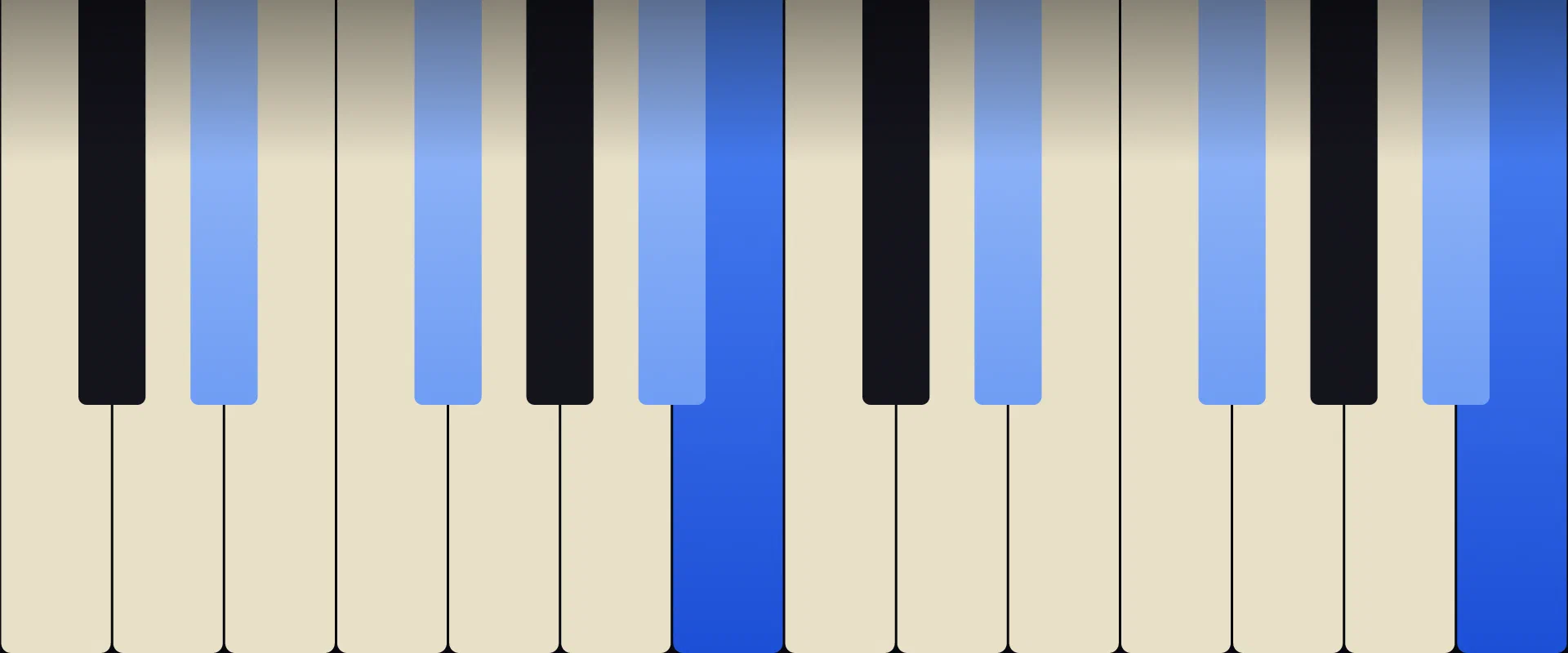
Three black keys and one white. B is the only note here at the front of the keyboard, so the hand sits well forward with only the thumb left behind.
Find one detail with your eyes before your fingers. A♯ is the black key immediately left of B: root and seventh are physical neighbours, nothing between them. Play those two alone and you have the chord in one grab.
For the full shape, right hand, 1 on B, 2 on D♯, 3 on F♯, 5 on A♯. The little finger covers a black key at nearly a full octave of stretch, the hardest part of the grip and the reason many players quietly drop the fifth.
The shell is unusually kind. D♯ and A♯ are both black keys a perfect fifth apart, so the two notes that define the chord come as one comfortable reach on the raised keys. Hold that over a B in the left and you never need a fifth.
Watch the register, though. Since A♯ and B are neighbours, any voicing sounding both close together below middle C turns muddy fast, and the octave B a beginner adds on top causes it.
Bmaj7 on the Guitar
The working grip is the A shape barred at the second fret, x24342: index barre across fret 2 for the root B and the top F♯, ring finger on the fourth string at fret 4 for F♯, middle on the third at fret 3 for A♯, little finger on the second at fret 4 for D♯.
The third string is the trouble. Three different frets must be covered behind the barre, and the finger on the nearest of them is trapped between the two on the furthest, so it has to tuck in under its neighbours. The shape is fussy rather than merely hard to press, and fret 2 is the least forgiving place on the neck to barre anything.
Higher up, the E shape at the seventh fret gives 798877, a comfortable grip. Better still, hold the plain major triad there, 799877, and lift the fourth string from fret 9 to fret 8. One finger, one fret, and that is B falling to A♯: the clearest demonstration on the instrument of what a major seventh chord is.
Two shortcuts help. xx8877 is four strings and two small barres, sounding A♯, D♯, F♯ and B, every note present and no root in the bass. xx4342 is the top of the fret 2 grip, the D♯ minor triad alone, which is how most players comp a maj7 when the bass has the root.
There is also a shape the chord books do not print. Take the open dominant seventh on this root, x21202, and move the third string to fret 3. x21302 sounds B, D♯, A♯, B, F♯, a real Bmaj7 with an open string in it. It comes out crunchy, because the A♯ lands right under that open B in the middle of the voicing rather than safely at the top, which is why it never reaches a beginner chart and why neo soul players reach for it.
Inversions
| Inversion | Notes | Bass Note |
|---|---|---|
| Root position | B D♯ F♯ A♯ | B |
| 1st inversion | D♯ F♯ A♯ B | D♯ |
| 2nd inversion | F♯ A♯ B D♯ | F♯ |
| 3rd inversion | A♯ B D♯ F♯ | A♯ |
First inversion is the D♯ minor triad with B added on top, and it is the mildest of the four, because the semitone is stretched into a major seventh across the whole chord. Third inversion does the opposite. Where A♯ sits is the only variable, and it decides everything.
Voicings
One rule covers most of it: keep A♯ and B apart. Adjacent they buzz; an octave or more apart, the seventh reads as colour.
The best keyboard version splits the hands: B and F♯ low in the left, D♯ and A♯ in the right. For more weight, put a D♯ minor triad in the right hand over a B in the left.
Which Keys Contain Bmaj7
- degree 1 (I) of B major
- degree 4 (IV) of F♯ major
- degree 1 (I) of B lydian
- degree 3 (III) of G♯ natural minor
- degree 5 (V) of E lydian
- degree 6 (VI) of E♭ natural minor
Those six entries are two collections of notes under different names. B major, E lydian and G♯ natural minor share the five sharps of B major; F♯ major and B lydian share the six sharps of F♯ major. This chord’s habitat is narrow.
The last entry needs a warning. E♭ natural minor is written in flats, so the identical four sounds appear on that page as C♭, E♭, G♭ and B♭, a chord labelled C♭maj7. Nothing your fingers do changes; only the letters, since six flats mirrors F♯ major’s six sharps and the key signature insists.
Where Bmaj7 Shows Up
| Progression | Numerals | Chords |
|---|---|---|
| Turnaround into B | ii7, V7, Imaj7 | C♯m7, F♯7, Bmaj7 |
| Subdominant in F♯ | IVmaj7, I | Bmaj7, F♯ |
| Relative minor pair | Imaj7, vi7 | Bmaj7, G♯m7 |
| Lydian shift | Imaj7, II | Bmaj7, C♯ |
The first row is where the chord earns most of its living, and the detail to notice is what precedes it. F♯7 has A♯ as its third, so the note arrives already sounding and stays put while everything around it resolves. The note that caused the spelling argument at the top of this page is the one that makes the cadence smooth.
The second row is a keyboard idiom. A major seventh on the fourth degree is one of the most comfortable sounds in pop harmony, and in F♯ major that chord is this one. Since F♯ major is not a key guitarists volunteer for, Bmaj7 in this role lives under a pianist’s hands.
The third row is these four notes read two ways. Bmaj7 and G♯m7 share B, D♯ and F♯, so moving between them shifts a single voice: A♯ steps down a whole tone to G♯. One finger on a keyboard, ideal for a slow vamp that should breathe without going anywhere. The fourth row brightens instead of settling, since C♯ major carries the E♯ that defines B lydian.
Guitarists with a song in this key have one honest escape route. Capo the fourth fret and play G shapes: the open Gmaj7 form, 320002, sounds as Bmaj7, and its three open strings ring as F♯, B and D♯, all chord tones. It is the only open voiced version available, and a reminder that the barre belongs to the tuning rather than to the harmony.
Related Chords
- B Dominant 7th Chord
- B Major Chord
- B Major 6th Chord
- B Major Scale
- Guitar Chord Shapes: The CAGED System
Learn More
Practice Chords
Drill chord recognition with a metronome, MIDI support, and score tracking.
Start PracticingRelated Articles
A Major 7th Chord: Notes, Voicings, and How to Play It
Aug 29, 2026 · 8 min
A♭ Major 7th Chord: Notes, Voicings, and How to Play It
Aug 29, 2026 · 8 min
B♭ Major 7th Chord: Notes, Voicings, and How to Play It
Aug 29, 2026 · 8 min