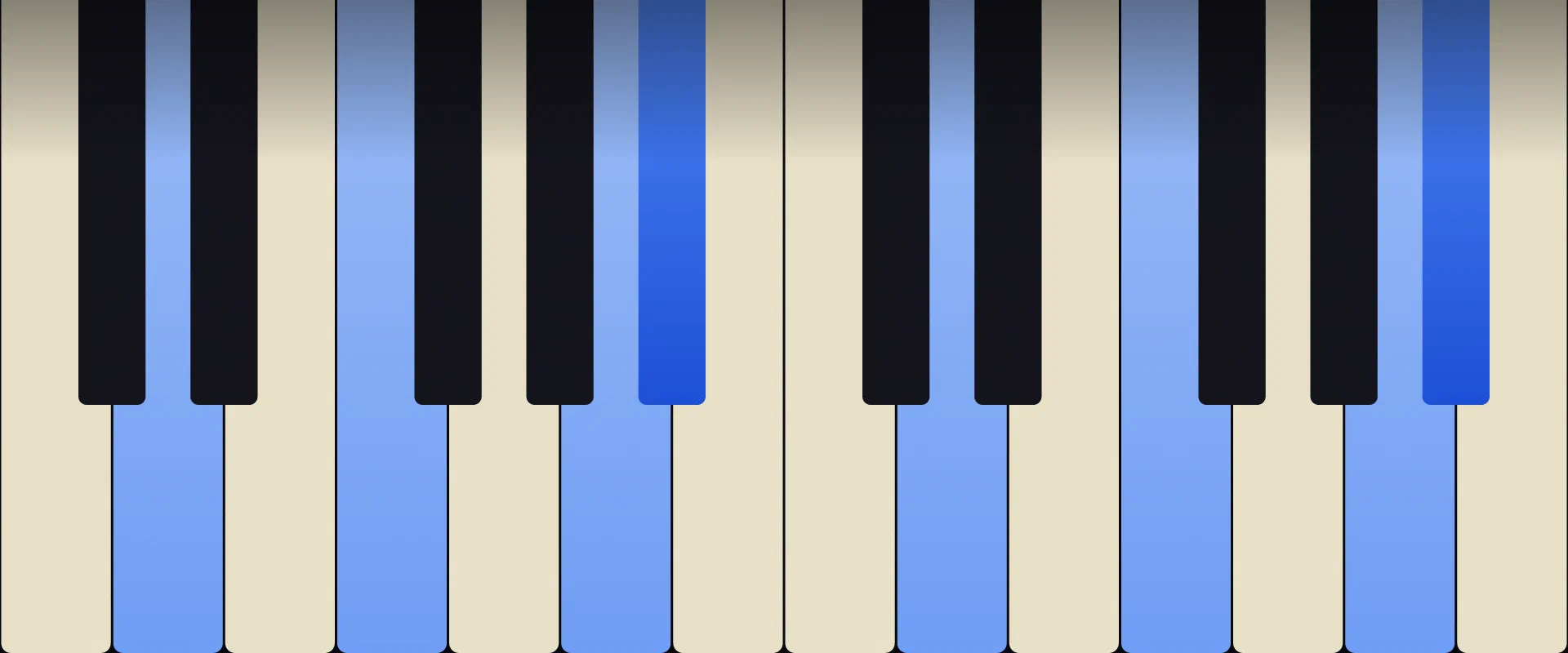
The note that decides this chord is A natural, which in B♭ major is the leading note, the one degree of the scale with somewhere it has to go. Put it inside the tonic chord and you have written a contradiction: the harmony has arrived and one of its four voices is still leaning forward. Swing bands avoided that for thirty years and bebop players built a language on it, and since B♭ is where rhythm changes lives, both camps were arguing over the same bar of the same tune. One white key.
Try It: B♭maj7 in the Chord Finder
Set the root to B♭, sound all four notes, then play A and B♭ side by side.
The Notes of B♭maj7
B♭maj7 has four notes: B♭, D, F and A.
| Degree | Note | Interval from B♭ | Semitones |
|---|---|---|---|
| 1 (root) | B♭ | Perfect unison | 0 |
| 3 | D | Major 3rd | 4 |
| 5 | F | Perfect 5th | 7 |
| 7 | A | Major 7th | 11 |
One black key and three white ones, and the only accidental in the chord is the root itself.
How B♭maj7 Is Built
Start from the B♭ major triad, B♭ D F, and add A a major 7th above the root. Since A is a semitone below B♭, the chord holds a minor 2nd folded out to its widest spacing, and that interval is its whole colour.
Walk the top note downwards and you get the three tonic chords of this key in a row. A gives B♭maj7. Drop it to A♭ and you have B♭7, which is no tonic at all, because A♭ brings a tritone with it and the chord starts pulling towards E♭. Drop it again to G and you have B♭6. Two semitones separate the most restless of the three from the most settled.
Worth saying plainly: B♭maj7 contains no tritone. The A is a rub, not a pull, and the chord will sit under a fermata all night. Remove the root and D, F and A is a D minor triad, all three white keys, which does most of the practical work below.
B♭maj7 on the Piano
The quickest way in is not a fingering, it is a split. Put a single B♭ in the left hand, the one black key in the chord, play a D minor triad with the right, and the whole of B♭maj7 is sounding. Anyone who stumbles over the four note grip gets it at once this way.
Closed, it is right hand 1 on B♭, 2 on D, 3 on F, 5 on A, with the thumb the only finger back among the raised keys, so the hand slopes away from the black keys instead of arching.
Register matters here, and the keyboard shows why. A is the white key immediately to the left of B♭, physically touching it. Root position holds the two as far apart as the chord allows, a major 7th, and the rub reads as warmth. Below middle C, a left hand holding B♭ with A a semitone above it growls instead, so keep the 7th high.
Drop the root altogether, hold D, F and A while the bass supplies B♭, and add C on top: that is Dm7 note for note, sounding as B♭maj9.
B♭maj7 on the Guitar
Nothing rings open, and the first fret version is genuinely awkward. The Amaj7 shape moved up a fret is x 1 3 2 3 1, an index barre plus three separate fingers on three different frets. B♭ major in the same position, x 1 3 3 3 1, lets the ring finger flatten across fret 3 instead. What breaks that barre is the A on the G string at fret 2, the note the chord is named for, so the cost cannot be avoided.
Move to fret 6 and the arithmetic turns. The Emaj7 shape is 6 8 7 7 6 6: index barre at fret 6, ring finger on the A string at fret 8, one finger laid flat across the D and G strings at fret 7, since both land on the same fret. Three fingers, root on the sixth string, and the CAGED system explains how the two positions relate.
The grip that matters at rhythm changes tempo is smaller than either. Play x 1 x 2 3 x: B♭ on the A string at fret 1, A on the G string at fret 2, D on the B string at fret 3. Root, 7th and 3rd on three strings, no barre, and it can be struck on every beat for a chorus without tiring the hand. Or move the piano split to the neck, since x x 3 2 3 1 is a D minor chord on the top four strings and becomes B♭maj7 the moment the bass plays B♭.
Inversions
| Inversion | Notes | Bass note | Symbol |
|---|---|---|---|
| Root position | B♭ D F A | B♭ | B♭maj7 |
| 1st inversion | D F A B♭ | D | B♭maj7/D |
| 2nd inversion | F A B♭ D | F | B♭maj7/F |
| 3rd inversion | A B♭ D F | A | B♭maj7/A |
Third inversion needs care and is also the one worth learning. It puts A directly underneath B♭, adjacent keys on a piano, so low down it sounds crushed. Lift the B♭ an octave and the same inversion becomes the smoothest bass move in the key:
B♭maj7 | B♭maj7/A | Gm7
The bass walks B♭, A, G by step while the upper voices hold still, and that descent opens a great many ballads written here.
First inversion is the mild one, D underneath making the chord sound like D minor with an extra note below. See Chord Inversions and Voice Leading.
Voicings
B♭ D A is the shell: root, 3rd and 7th, the 5th discarded, and nobody hears it missing.
B♭ A D F, with the 7th immediately above the root, is the one to avoid. It drops the semitone to the bottom of the stack, where it flatters least.
B♭ D F A C is B♭maj9, and dropping the root leaves Dm7 again, which is why pianists often say they are playing Dm7 when the chart says B♭maj9. More stacking in Extended Chords and Jazz Harmony.
Which Keys Contain B♭maj7
- I of B♭ major
- IV of F major
- I of B♭ lydian
- III of G natural minor
- VI of D natural minor
- VII of C dorian
The first two cover nearly all of its life, as a tonic and as a IV chord, and the third is what you improvise with in the second of those roles. When B♭maj7 is the IV of F major, the note above its 5th is E natural rather than E♭, so the chord sits in B♭ lydian, and that raised 4th is why a IV chord can carry a solo without turning into a temporary tonic. The last three are where you meet it away from home, most often as the III of G minor.
Where B♭maj7 Shows Up
Rhythm changes is the argument in miniature. Bar one of the A section can be B♭6 or B♭maj7, players have been choosing for ninety years, and each choice buys something.
B♭6 buys blend. Its four notes contain no semitone, so in a loud ensemble with a section holding B♭ nothing rubs and nothing needs tuning, and it is stable enough to end on. B♭maj7 buys motion and definition. The A keeps the bar leaning into what follows, and the chord is unambiguous about its own root: B♭6 is note for note identical to Gm7, so a bass player can turn it into a different chord without anybody above moving, while rearranging B♭, D, F and A produces nothing with another name.
In practice the melody settles it, since an A over bar one makes the chord underneath a maj7 whether the pianist wanted one or not. Soloists face the same fork: B♭ major pentatonic never touches the A, which is the swing sound, and landing on that note is bebop.
The other home is the end of the most played cadence in the music:
Cm7 | F7 | B♭maj7
The ii-V-I lands smoothly here for a reason you can trace note by note. F7 is F, A, C and E♭. The A in it is the 3rd of the dominant, and when B♭maj7 arrives that same A stays exactly where it is and becomes the 7th of the tonic, while E♭ falls a semitone to D. The resolution keeps the dominant’s brightest note, which is why it arrives and shimmers at once. Go to B♭6 and the A has to move, and the ending sounds final rather than open.
Horn players read the chord more plainly than the rhythm section does. Concert B♭maj7 is Cmaj7 for trumpet, clarinet or tenor sax, with no accidental in it whatsoever, and Gmaj7 for alto and baritone sax, with one sharp. Two flats on the rhythm section’s page buys the horns the cleanest one in the book: see how to transpose a song to any key.
Related Chords
- B♭ Major Chord, the triad underneath, before A is added.
- B♭ Major 6th Chord, the other candidate for the tonic and the other half of the argument above.
- B♭ Dominant 7th Chord, the same shape with A♭ instead of A, which turns a resting chord into a moving one.
- Seventh Chords: The Complete Guide, on how the four seventh chord types differ.
Learn More
Practice Chords
Drill chord recognition with a metronome, MIDI support, and score tracking.
Start PracticingRelated Articles
A Major 7th Chord: Notes, Voicings, and How to Play It
Aug 29, 2026 · 8 min
A♭ Major 7th Chord: Notes, Voicings, and How to Play It
Aug 29, 2026 · 8 min
B Major 7th Chord: Notes, Voicings, and How to Play It
Aug 29, 2026 · 8 min