The seventh of this chord is a plain G. No accidental, no argument, sitting on top of a root that cannot be written without a flat. That is the wrong way round. Build a major 7th on D, E, G, A or B and the seventh is precisely where the accidental turns up: C♯, D♯, F♯, G♯, A♯. Here the accidental has already been spent on the root, and the note that usually causes the trouble comes out clean.
The trouble moves instead to how far apart the two are allowed to sit. G is one semitone below A♭, and every decision about voicing this chord comes down to keeping the pair from grinding.
Try It: A♭maj7 in the Chord Finder
The Notes of A♭maj7
| Degree | Note | Interval from root |
|---|---|---|
| 1 | A♭ | Perfect unison |
| 3 | C | Major 3rd, 4 semitones |
| 5 | E♭ | Perfect 5th, 7 semitones |
| 7 | G | Major 7th, 11 semitones |
Written low to high in root position: A♭ C E♭ G.
How A♭maj7 Is Built
Take A♭ major, A♭ C E♭, and add G, the white key immediately below the root. The ear stops hearing a finished triad and starts hearing something held in place and lit from underneath.
Look at the top three notes on their own. C, E♭ and G are a C minor triad, so A♭maj7 is C minor sitting on an A♭ bass, which is also the tidiest explanation of why the chord belongs to C minor as its sixth degree.
One semitone separates all this from A♭7. Drop G to G♭ and the chord stops resting and starts travelling. The two candidates are the two keys directly below the root, white then black, so the difference between a tonic and a dominant here is visible from across a room.
A♭maj7 on the Piano
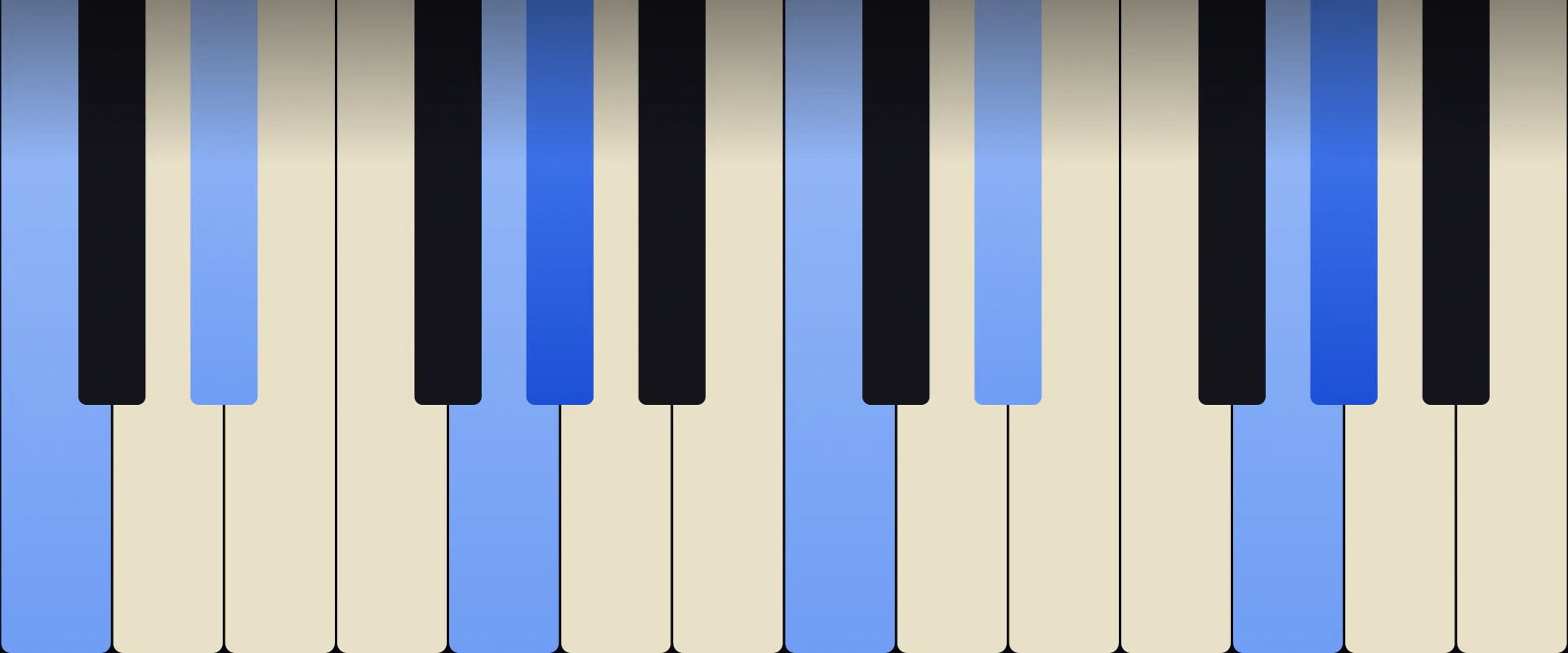
Two black keys and two white, and they pair off by colour rather than alternating. A♭ and E♭ are both black and a perfect fifth apart. C and G are both white and a perfect fifth apart. That hands you the standard voicing without any thought: left hand takes the black fifth, 5 on A♭ and 1 on E♭, right hand the white fifth, 1 on C and 5 on G. Neither hand touches the other’s colour, and G ends up more than an octave above A♭, which is where the semitone stops being a problem and starts being the reason the chord glows.
Squeezed into one hand it is harder work. Right hand root position runs 1 on A♭, 2 on C, 3 on E♭ and 5 on G, thumb pushed deep on to a black key and little finger reaching back out to a white one, so the hand sits at a slant.
What to avoid is easy to demonstrate. Play G and A♭ together low in the left hand, adjacent keys, one white and one black, and the chord turns to gravel. Gospel and soul players never put the two near each other: G goes at the top of the right hand or into the melody, A♭ stays in the bass, and two octaves of daylight separate them.
A♭maj7 on the Guitar
A♭ major asks for three notes a guitar cannot give you open: A♭, C and E♭ have to be fretted wherever on the neck you find them. Add the major 7th and you get G, the open third string, the only note in the chord the instrument will sound for nothing.
There is a voicing that uses it: 4 x x 0 1 4. Low E at the 4th fret gives A♭, the G string rings open, the B string at the 1st gives C, the top E at the 4th gives A♭ again. Three fingers, no fifth, the A and D strings muted, and the seventh a comfortable major 7th above the bass instead of a semitone under it. Nothing else in this key rings like that.
The barre is the E shape at the 4th fret, 4 6 5 5 4 4, and what makes it worth learning is the D string. At the 6th fret that string gives A♭ and the chord is plain A♭ major; at the 5th it gives G and the chord is A♭maj7; at the 4th it gives G♭ and the chord is A♭7. One finger, one string, three frets, and the descending inner line that soul arrangements are built on lives inside a shape you are already holding. The A shape version, x 11 13 12 13 11, is a stretch that fights back, and up there the seventh muddies rather than shines.
Capo at the 1st fret with the Gmaj7 shape, 3 2 0 0 0 2, sounds A♭maj7 on three fingers with three strings ringing behind them. Unlike A♭sus4, which is easy enough at the 4th fret to overturn the usual capo position for this key, the major 7th is content where the music already is.
Inversions
| Inversion | Notes low to high | Bass note |
|---|---|---|
| Root position | A♭ C E♭ G | A♭ |
| 1st inversion | C E♭ G A♭ | C |
| 2nd inversion | E♭ G A♭ C | E♭ |
| 3rd inversion | G A♭ C E♭ | G |
Third inversion is the one arrangement of these four notes to think twice about. With G at the bottom, A♭ is a semitone directly above the bass, and the chord no longer sounds held in place, it sounds like a G chord that has gone wrong.
First inversion is the useful one, that C minor triad again with A♭ resting on top. Sit the bass on C and the only thing separating A♭maj7 from Cm is whether A♭ sounds at all, so a piece can cross between the two without the bass moving.
Voicings
Drop the fifth. A♭, C and G are root, third and seventh, the notes that decide what the chord is called, and E♭ contributes nothing a listener would miss.
Leave out the root instead and the right hand is holding a plain C minor triad, the easiest way to comp this behind a bass player. Add B♭ and it becomes Cm7, C E♭ G B♭, which over an A♭ bass is A♭maj9. A pianist who can find Cm7 already knows the richest version of this chord.
On guitar the four note voicing without a barre is 4 x 5 5 4 x: A♭ on the low E string, G on the D, C on the G string, E♭ on the B, with the seventh buried safely in the middle of the chord instead of rubbing against the root.
Which Keys Contain A♭maj7
- I of A♭ major
- IV of E♭ major
- III of F natural minor
- VI of C natural minor
- VI of C harmonic minor
- VII of B♭ dorian
The two C minor entries make a point worth noticing. Harmonic minor raises the seventh degree of C minor from B♭ to B, and this chord contains neither note, so it survives the change untouched and works without anybody having to settle which minor scale is in force. C melodic minor is missing for a blunter reason: it raises the sixth degree to A natural and removes the root of the chord altogether.
B♭ dorian is the modal entry, where A♭maj7 is the flat seventh, a chord a whole tone below the tonic that never resolves anywhere.
Where A♭maj7 Shows Up
| Progression | In letters | Where it lives |
|---|---|---|
| Imaj7, IVmaj7 | A♭maj7, D♭maj7 | Two chord float, soul and bossa |
| IVmaj7, iii7, ii7, Imaj7 | A♭maj7, Gm7, Fm7, E♭maj7 | Descending ballad line in E♭ |
| ♭VImaj7, V7, i | A♭maj7, G7, Cm | C minor, gospel and film scoring |
Row one barely moves. A♭ and C belong to both chords and stay where they are, E♭ falls a whole tone to D♭ and G falls a whole tone to F. Two voices step, two hold, and the pair can be rocked back and forth as long as the groove needs without ever sounding like a cadence.
Row two is why so many ballads in E♭ open on this chord rather than on the tonic. A♭maj7 is the fourth degree there, and from it the harmony walks down the scale in sevenths while the top voice does the same, G to F to E♭ to D.
Row three is where the plain G earns its keep. Move to G7 and the seventh does not move at all: it is already the root of the next chord, and the other three slide down a semitone past it, A♭ to G, C to B, E♭ to D. Borrow the same chord into C major instead of C minor and you have one of the most recognisable sounds in film scoring, a warm major chord arriving from outside the key.
Related Chords
- A♭ Major Chord the triad underneath, and the capo argument for this key in full
- A♭ Dominant 7th Chord the same shape with the seventh a semitone lower
- A♭ Major 6th Chord the other way to add a fourth note, chosen when the chord has to stop rather than glow
- C Minor Chord the triad sitting on top of this one
- A♭ Major Scale the key this chord is the tonic of
Learn More
Practice Chords
Drill chord recognition with a metronome, MIDI support, and score tracking.
Start PracticingRelated Articles

A Major 7th Chord: Notes, Voicings, and How to Play It
Aug 29, 2026 · 8 min
B Major 7th Chord: Notes, Voicings, and How to Play It
Aug 29, 2026 · 8 min
B♭ Major 7th Chord: Notes, Voicings, and How to Play It
Aug 29, 2026 · 8 min