The key of G major has exactly one sharp and it is F♯. Build a seventh chord on the tonic from what the key signature hands you and the result is G, B, D and F♯, so Gmaj7 is the seventh chord the key of G actually contains. G7, with its F natural, is the visitor: an accidental, a chord on loan from C major.
Practically nobody meets them in that order. G7 belongs to the key beginners are taught in, so it arrives in week three, while Gmaj7 waits until somebody puts a bossa nova or a soul ballad on the stand. One semitone separates the two, and almost every player learns the guest before the resident.
Try It: Gmaj7 in the Chord Finder
The Notes of Gmaj7
| Degree | Note | Interval from Root | Semitones |
|---|---|---|---|
| 1 (Root) | G | Perfect unison | 0 |
| 3 | B | Major 3rd | 4 |
| 5 | D | Perfect 5th | 7 |
| 7 | F♯ | Major 7th | 11 |
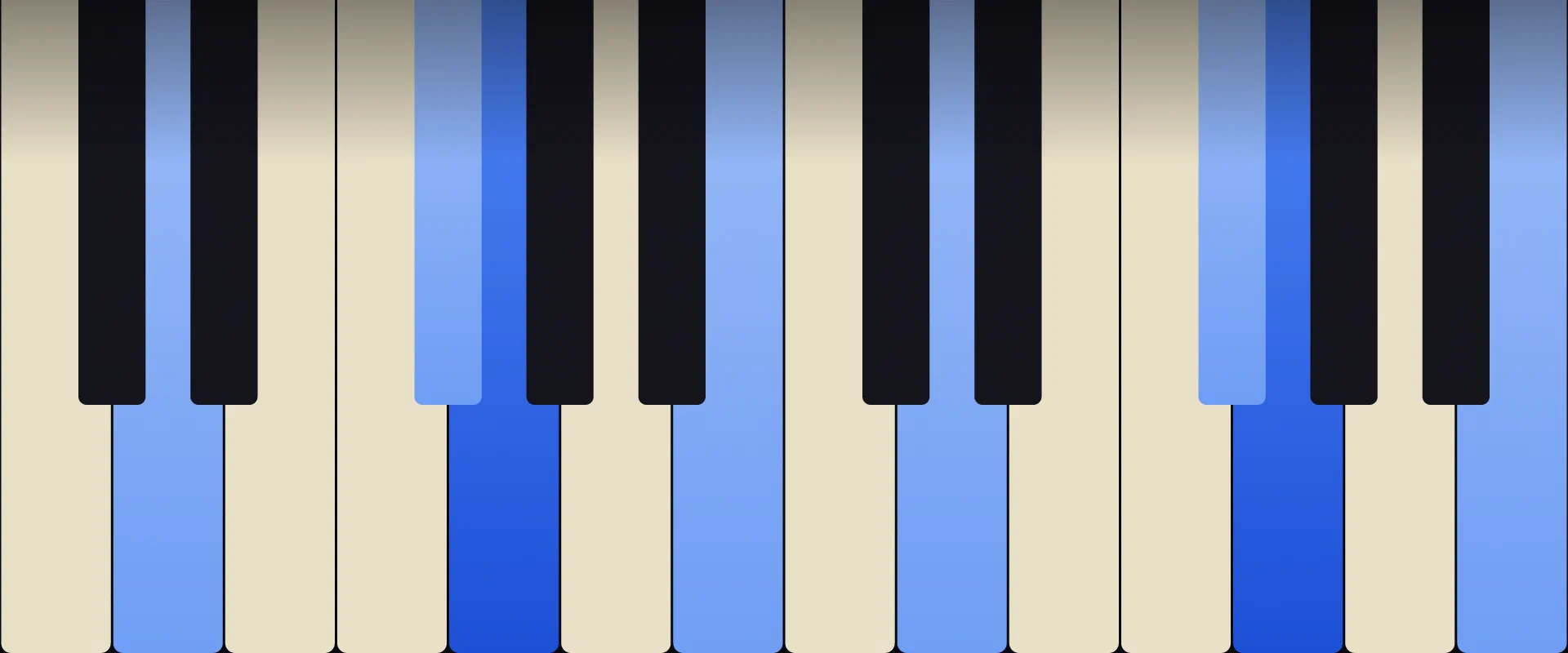
Written Gmaj7, GM7 or GΔ7 depending on the publisher. Three white keys and one black one, and the black one is F♯, the first of the group of three, immediately to the left of the root.
How Gmaj7 Is Built
G major with a fourth note eleven semitones above the root, one semitone short of the octave. That near miss is the character of the chord: the top note is not a colour added at a safe distance, it is the root itself pushed down a half step and left there.
Look at what the chord does not contain. B to F♯ is seven semitones, so the chord is two interlocking perfect fifths, G to D and B to F♯, with no tritone in it anywhere. One semitone below that F♯ sits a chord that travels; this one stays.
Read the upper three notes alone and they spell B, D, F♯. Gmaj7 is a B minor chord standing on a G, which is why it sounds part bright, part shadowed.
Gmaj7 on the Piano
Finding it is trivial: thumb on G, note the black key immediately to its left, and take that same key an octave higher. Root position is less comfortable than it looks. The right hand takes 1 on G, 2 on B, 3 on D and 5 on F♯, which sends the weakest finger onto a black key set back into the keyboard while the thumb stays at the front edge on a white one. The hand tilts across that diagonal and the little finger arrives late and quiet, which is the wrong note to under play.
Spacing is the real skill, and here the two awkward notes are neighbours. Strike F♯ and G together in one octave and they beat, sour and unpleasant. Put an octave between them and the same two pitches turn glossy. On paper the interval is a major 7th; under your hands it is a minor 2nd if you let it be.
The reliable arrangement is G alone in the left hand with B, D and F♯ in the right. Jazz pianists take G and F♯ together in the left as a wide interval, leaving the right hand free.
For voice leading, aim the F♯ downward. A semitone takes it to F natural and the chord turns into a dominant seventh; another semitone gives G6. A great deal of writing in G is that descent, one voice moving while the other three sit still.
Gmaj7 on the Guitar
The open form is 3 2 0 0 0 2: ring finger on the 6th string at the 3rd fret, middle on the 5th at the 2nd, and the little finger on the top string at the 2nd fret for the F♯. Anyone who fingers open G major with the little finger on top gets here by moving it one fret towards the nut.
That single string gives you four chords in a straight line. Hold 3 2 on the bottom two strings, leave the middle three open, and walk one finger down the top string: the 3rd fret is G, the 2nd is Gmaj7, the 1st is G7 and the open string is G6. Four harmonies, one finger, no repositioning.
The open shape also solves the spacing problem for you. The F♯ on the top string is a major 7th above the open G string and almost two octaves above the bass G, so the semitone that sours the piano version never appears as a semitone here. Hence lush on an acoustic guitar, merely correct on a badly voiced keyboard.
Two more grips are worth having. x x 0 0 0 2 is Gmaj7 with D in the bass, three open strings and one finger. And x x 5 4 3 2 is a staircase, one fret lower on each string as you climb: G on the D string, B on the G, D on the B and F♯ on top. It looks like a diagonal, which makes it easy to remember, and it comps well behind a singer.
Barred, the Emaj7 shape at the 3rd fret gives 3 5 4 4 3 3, which is fiddly: the barre, the ring finger on the 5th string, then two fingers crowded onto the 4th fret. Most players use 3 x 4 4 3 x instead, root on the 6th string and no barre. The Amaj7 shape at the 10th fret is cramped and thin.
Inversions
| Inversion | Notes | Bass | Symbol |
|---|---|---|---|
| Root position | G B D F♯ | G | Gmaj7 |
| 1st inversion | B D F♯ G | B | Gmaj7/B |
| 2nd inversion | D F♯ G B | D | Gmaj7/D |
| 3rd inversion | F♯ G B D | F♯ | Gmaj7/F♯ |
Turning this chord over moves the problem rather than solving it. First inversion puts F♯ and G next to each other at the top of the stack, third inversion puts them together at the bottom, and in close position both sound like a mistake. Spread them and the third inversion earns its keep as a passing chord: F♯ in the bass sits between G and the E of an Em7.
Second inversion is the guitarist’s one: the open 4th, 3rd and 2nd strings supply D, G and B, leaving only the F♯ to find.
Voicings
Drop the fifth. G, B and F♯ is the standard shell, stronger than the full chord in a band because the D adds nothing the ear was missing. Drop the root instead and you are playing B minor, which becomes Gmaj7 the moment a bass player supplies the G.
Add A on top and the chord becomes Gmaj9, G B D F♯ A, whose upper four notes spell Bm7. The relationship holds all the way up: this family in G is a stack of B minor sonorities over a G in the bass, and pianists often think of it that way.
Avoid putting the seventh low. F♯ under a G below middle C beats slowly and loudly.
Which Keys Contain Gmaj7
- I of G major
- IV of D major
- III of E natural minor
- VI of B natural minor
- I of G lydian
- III of E dorian
Adding the seventh narrows the chord’s citizenship. A plain G major triad belongs to three major keys, C, G and D. Gmaj7 belongs to only two, because in C major the seventh above G is F natural, so C gets the dominant instead. The extra note tells you more about where you are than the triad could.
The pairing with D major is the useful one. There Gmaj7 is the IV chord and Dmaj7 the I, so the two major sevenths sit a fourth apart and swap back and forth for bars at a time.
Where Gmaj7 Shows Up
| Progression | Chords | Typical use |
|---|---|---|
| ii7, V7, Imaj7 in G | Am7, D7, Gmaj7 | Jazz standards landing in G |
| Imaj7, IVmaj7 in D | Dmaj7, Gmaj7 | Bossa nova and soul vamps |
| Imaj7, vi7, ii7, V7 in G | Gmaj7, Em7, Am7, D7 | Ballad turnarounds |
| Imaj7, Imaj7/F♯, vi7 in G | Gmaj7, Gmaj7/F♯, Em7 | Descending bass intros |
| i7, ♭IIImaj7 in E minor | Em7, Gmaj7 | Folk rock and modal vamps |
| IVmaj7, V, I in D | Gmaj7, A, D | Country soul and gospel |
Row two is where most listeners have heard this chord without naming it, and on a nylon string guitar it is almost free. Play Dmaj7 as x x 0 2 2 2 and Gmaj7 as x x 0 0 0 2: the open D string holds underneath both, the F♯ on top never moves, and the change costs two fingers. Soul arrangers borrowed the pair wholesale.
Row four is the one to practise slowly. Hold the open shape and take the bass from G down to F♯ and on to E, changing nothing above it. The F♯ is the 2nd fret of the bottom string, where a hooked thumb naturally lands, and the open low E turns the same grip into Em9. Drop the top string to its open E as well and you have a plain Em7.
A period marker hides in the last chord of a chart. Ending on Gmaj7 rather than plain G is a post war habit that earlier dance band writing refused, because the seventh leaves the leading tone of the key sitting on top of the tonic chord, audible and unresolved. Hence the sound: arrival with a question mark.
Related Chords
- G Dominant 7th Chord, a semitone below on the same string
- G Major Chord, the triad underneath
- G Major 6th Chord, the same idea with E instead of F♯
- G Sus2 Chord, the other open sounding chord on this root
- Extended Chords and Jazz Harmony for Gmaj9 and Gmaj7♯11
- The G Major Scale
- The G Lydian Scale
- Guitar Chord Shapes: The CAGED System
Learn More
Practice Chords
Drill chord recognition with a metronome, MIDI support, and score tracking.
Start PracticingRelated Articles
A Major 7th Chord: Notes, Voicings, and How to Play It
Aug 29, 2026 · 8 min
A♭ Major 7th Chord: Notes, Voicings, and How to Play It
Aug 29, 2026 · 8 min
B Major 7th Chord: Notes, Voicings, and How to Play It
Aug 29, 2026 · 8 min