The F♯ major scale carries six sharps and only one of them looks wrong on the page. Five land on black keys where a reader expects them. The sixth is E♯, played on the white key F, and every chord on this root before this one dodges it: not the triad, not the suspensions, not the sixth, not F♯7. F♯maj7 is where a player finally presses it.
The note is worth settling first. Count the letters up from the root, F, G, A, B, C, D, E: the seventh is E, so whatever accidental it carries, the top note of an F♯ chord has to be some form of E. Eleven semitones above F♯ is the pitch you know as F natural, and written as a form of E that pitch is E♯. Calling it F would put two Fs in one four note chord, which is unreadable. The spelling is not a flourish, it is the only option the alphabet leaves.
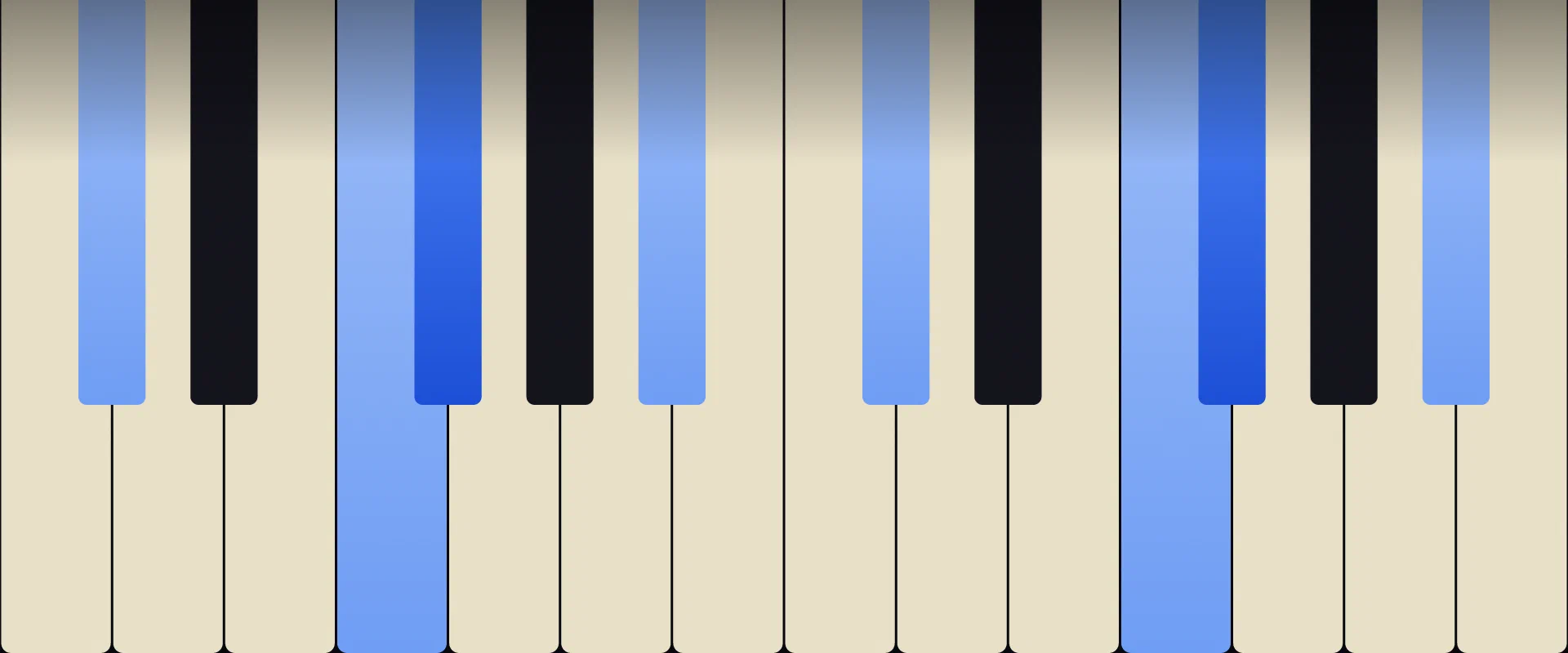
Try It: F♯maj7 in the Chord Finder
The Notes of F♯maj7
F♯maj7 contains four notes.
F♯, A♯, C♯, E♯
| Degree | Note | Interval from root | Semitones |
|---|---|---|---|
| 1 | F♯ | Root | 0 |
| 3 | A♯ | Major 3rd | 4 |
| 5 | C♯ | Perfect 5th | 7 |
| 7 | E♯ | Major 7th | 11 |
In plain terms: E♯ sounds exactly like F natural and is played on the white key F. On a guitar it is the 1st fret of either E string. An ordinary note, with a name that makes sense only once you know which letter it was obliged to be.
How F♯maj7 Is Built
Stack F♯, A♯ and C♯ and put E♯ eleven semitones above the root, one semitone under the octave. That semitone is the whole character of the chord: close enough to the F♯ above it to rub, far enough below to read as colour, and it forms a tritone with nothing.
F♯7 puts E natural on top, and that E makes a tritone with A♯, which is why it leans hard on B. Raise the E a semitone and the tritone goes, the lean goes, and so does the key: the fifth degree of B major is F♯, A♯, C♯ and E, so F♯maj7 is not diatonic there at all. One semitone converts the dominant of B into the tonic of F♯.
Take the root away and what is left, A♯, C♯ and E♯, is an A♯ minor triad. Every major seventh contains the minor triad built on its own third, the most useful fact on this page for anyone voicing with two hands.
F♯maj7 on the Piano
The top note is the white key immediately below the octave root, which gives a way of finding it that never fails: put the little finger on the F♯ an octave above your thumb and slide it left onto the white key it is already touching. That is E♯, a note that looks alien in the score and is found by feel.
The hand spans eleven semitones, the widest reach of the seventh chords on this root. Right hand 1 on F♯, 2 on A♯, 3 on C♯, 5 on E♯, and keep the wrist level: E♯ has F♯ directly behind it, and a tilted little finger catches that black key on the way down.
Hear the rub on its own. Play E♯ and then the F♯ above it, two adjacent keys sounding together, and the harshness is why pianists almost never double the root above a major seventh. Spread instead: root low, A♯, C♯ and E♯ in the right hand, and E♯ has air under it.
F♯maj7 on the Guitar
E♯ is the note under the index finger of a first fret F barre, the chord that defeats more beginners than any other. The hardest note to reach in week one is the sweetest note in this one.
The full grip is the Emaj7 shape barred at the 2nd fret, 2 4 3 3 2 2, and it is genuinely awkward. Against the F♯ major barre, 2 4 4 3 2 2, only the 4th string moves, dropping one fret, but that ruins the hand: in F♯ major the ring finger lies flat across the 5th and 4th strings at fret 4, and here it cannot, because those two strings no longer share a fret. Three fingers work behind a barre that is already fighting the stiffest part of the neck, and most players give up the 6th string and take x 4 3 3 2 2.
Two easier voicings carry the chord in practice. x x 4 6 6 6 puts the index on the 4th string at fret 4 and one finger flat across the top three at fret 6, setting the seventh inside the voicing where it warms rather than grinds. The shell is x x 4 3 6 x: root, third, seventh.
The A shape barres at the 9th fret, x 9 11 10 11 9, and commits every finger: index barred at 9, ring on the 4th at 11, middle on the 3rd at 10, little finger on the 2nd at 11. The dominant seventh there needs only two fingers behind the barre, since its fretted notes share a fret.
Inversions
| Inversion | Notes | Bass note |
|---|---|---|
| Root position | F♯ A♯ C♯ E♯ | F♯ |
| 1st inversion | A♯ C♯ E♯ F♯ | A♯ |
| 2nd inversion | C♯ E♯ F♯ A♯ | C♯ |
| 3rd inversion | E♯ F♯ A♯ C♯ | E♯ |
Third inversion is the one arrangers avoid: with E♯ in the bass the root sits a semitone above the lowest voice, and that interval low down growls instead of glowing. First inversion is the opposite, A♯ underneath turning the chord into an A♯ minor triad with F♯ on top, and a listener hears it that way until the bass moves. Second inversion is the polite one, floating over the dominant of the key. Chord Inversions and Voice Leading covers how a bass line settles the argument.
Voicings
Split it between the hands: F♯ alone at the bottom, A♯, C♯ and E♯ above. The left hand states the root, the right hand plays A♯ minor, and on this root that shape is two black keys and one white one in a row.
Drop the fifth when the texture is busy: F♯, A♯ and E♯ says everything and C♯ only adds weight. To open the sound right up, put E♯ below A♯ instead of above it, so the semitone spreads across a seventh and the harshness goes.
Which Keys Contain F♯maj7
| Degree | Key |
|---|---|
| I | F♯ major |
| V | B lydian |
| IV | C♯ mixolydian |
| IV | D♭ major |
| VI | B♭ natural minor |
| III | E♭ natural minor |
The bottom three spell it the other way. In D♭ major, B♭ minor and E♭ minor the same four sounds are written G♭, B♭, D♭ and F, because the seventh above G♭ has to be a form of F and F natural is already the right letter. That spelling is the commoner of the two by a wide margin, so a player who knows the sound well may rarely have seen it written this way at all.
Where F♯maj7 Shows Up
F♯maj7, D♯m7, G♯m7, C♯7. The I, vi, ii, V turnaround in F♯ major, and the first move is the interesting one: D♯m7 is D♯, F♯, A♯ and C♯, so three notes hold and only the top voice shifts, E♯ down a whole tone to D♯. From x x 4 6 6 6 that is the 2nd string alone dropping from fret 6 to fret 4.
D♭maj7 to G♭maj7. Two major sevenths a fourth apart, the I and IV of D♭ major, with this chord wearing its flat name. That pair opens a great deal of bossa nova and 1970s soul, both of which favour D♭ because it suits singers. Nobody there has ever called it F♯maj7.
F♯maj7 over a B bass. Put B underneath and the four notes become the 5th, 7th, 9th and ♯11 of B, with no third anywhere: the B lydian sound in one grip, the floating major chord film composers reach for when something must feel vast. The raised fourth doing the work is E♯ again, the note that looked like a misprint at the top of this page.
A guitarist finds this chord by moving an Emaj7 shape two frets and never thinks about the name. A pianist meets it as G♭maj7 in a chart, plays the identical four keys, and may go years without seeing the sharp spelling. The ii, V, I it lands in works the same either way.
Related Chords
- F♯ Dominant 7th Chord, E natural in place of E♯
- F♯ Major Chord, the triad underneath, with no white key at all
- F♯ Major 6th Chord, D♯ in place of E♯, restful where this one shimmers
- G♭ Augmented Chord, the other forced spelling on this root, forced the opposite way
Learn More
- Seventh Chords: The Complete Guide
- What Are Intervals and How to Identify Them, and why an interval’s name is fixed by its letters before any accidental is added
- The F♯ Major Scale, the key that supplies the E♯
Practice Chords
Drill chord recognition with a metronome, MIDI support, and score tracking.
Start PracticingRelated Articles

A Major 7th Chord: Notes, Voicings, and How to Play It
Aug 29, 2026 · 8 min
A♭ Major 7th Chord: Notes, Voicings, and How to Play It
Aug 29, 2026 · 8 min
B Major 7th Chord: Notes, Voicings, and How to Play It
Aug 29, 2026 · 8 min