Read the four spaces of the treble staff from the bottom and they spell FACE. Stack those four notes and you have Fmaj7. Every space, no lines, nothing left over. The mnemonic that teaches a child to read music is a chord, and this is it.
Guitarists arrive from the other direction. Around the fourth lesson a chart asks for F, the barre at the 1st fret refuses to speak, and someone suggests leaving the top string open: x x 3 2 1 0, three fingers, no barre, and it rings. That shape is Fmaj7, and a fair proportion of the people playing it have no idea.
It is not free, though the cost is not the one usually quoted. The lowest note of x x 3 2 1 0 is F, on the 4th string at fret 3, so the chord is in root position with its root underneath. What it lacks is anything below that F: the barred version reaches an octave lower and anchors a mix, while this one floats in the singer’s own register.
Try It: Fmaj7 in the Chord Finder
Set F as the root, then compare the plain triad with Fmaj7. One note joins, and the chord’s whole sense of weight changes with it.
The Notes of Fmaj7
| Degree | Note | Interval from Root | Semitones |
|---|---|---|---|
| 1 (Root) | F | Perfect unison | 0 |
| 3 | A | Major 3rd | 4 |
| 5 | C | Perfect 5th | 7 |
| 7 | E | Major 7th | 11 |
Eleven semitones from F up to E, one short of an octave. That shortfall is the whole character of the chord: near enough to the root to shimmer against it, far enough away to stay consonant. Shorten it to ten and E becomes E♭, at which point the shimmer turns into a pull.
How Fmaj7 Is Built
Add E above the F major triad. Nothing is replaced and nothing altered, which is why Fmaj7 stands in for F in most places and why it cannot stand in everywhere.
E is the 7th degree of the F major scale, so the chord is diatonic to its own key and to C major alike. Lower it to E♭ and you have F7, which leaves both keys and pulls towards B♭. Take D instead and you have F6, which adds weight and no lean. Three notes on one triad, three different amounts of obligation.
Fmaj7 on the Piano
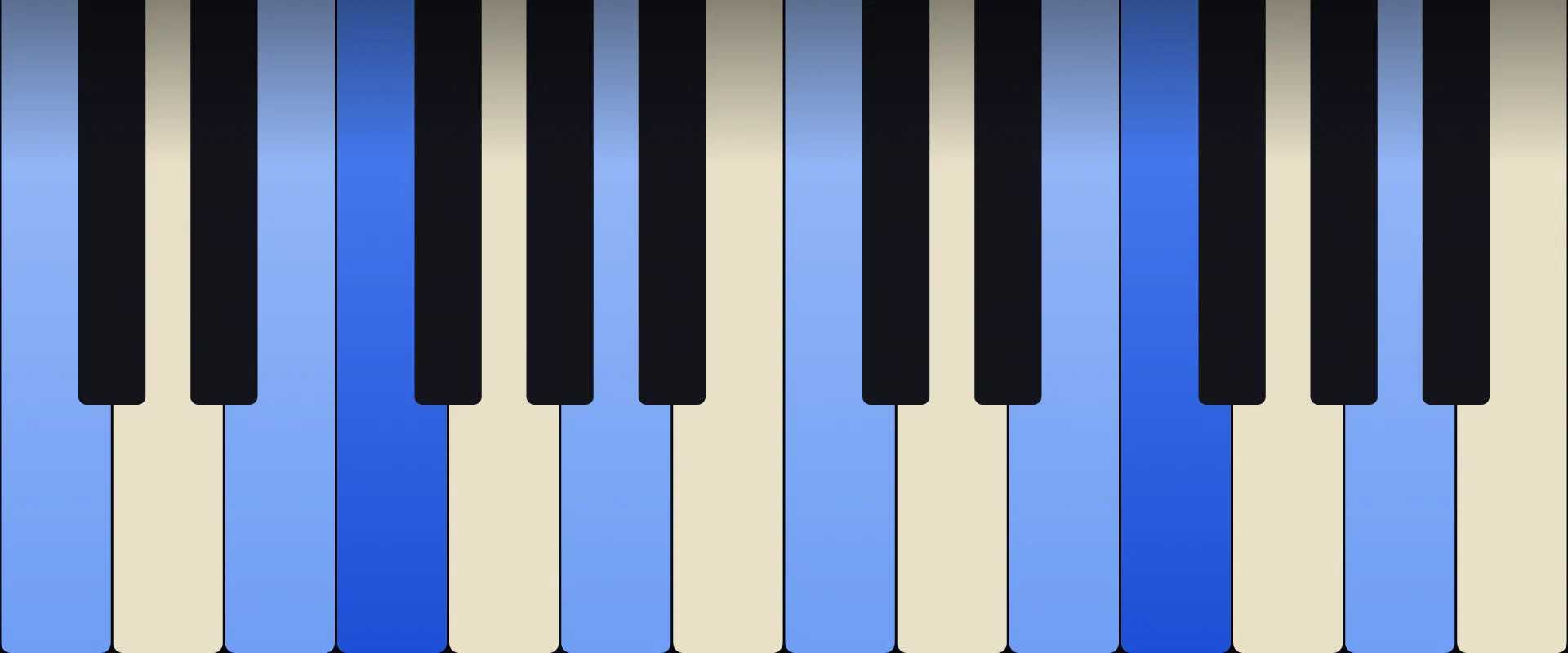
Four notes, four white keys, no accidental anywhere. Only two of the twelve major 7th chords manage that, Fmaj7 and Cmaj7, neighbours on the circle of fifths for the obvious reason. This is therefore the cheapest available introduction to what a 7th sounds like.
Root position is thumb on F, index on A, middle on C, little finger on E, and the little finger travels only as far as one white key short of the octave. The span is a 7th, not an octave, so the hand stays relaxed.
Everything that can go wrong is a question of where E sits. Above C it is colour. Below F it is a collision: play E in the left hand under an F triad in the right and the minor 9th grinds. E stays in the right hand, F stays in the left.
One thing the keyboard shows and no other instrument does: Cmaj7 to Fmaj7 and back uses seven white keys and nothing else, so the first jazz sound a beginner finds by accident is nearly always this pair.
Fmaj7 on the Guitar
Ring finger on the 4th string at fret 3, middle on the 3rd at fret 2, index on the 2nd at fret 1, top string open. Low to high the notes are F, A, C and E, textbook root position, and the open string supplies the note the fretting hand would find hardest to reach.
That accident is the reason the shape exists. On this root the note the instrument gives away for nothing happens to be exactly the 7th, because both E strings are tuned to it already. The hardest chord in the beginner’s book turns into a three finger grip because of how the guitar is tuned rather than anything musical.
Strum four strings and you have root position. Let the open 5th ring, x 0 3 2 1 0, and A goes underneath for a first inversion that works almost anywhere. Let the open 6th ring too and E goes under the root, a minor 9th below it, which is a different chord rather than a sloppy one.
Barre forms are for later. The Emaj7 shape at fret 1, 1 3 2 2 1 1, is harder than the F major barre it would replace, since the two fingers at fret 2 sit on adjacent strings. The Amaj7 shape at fret 8, x 8 10 9 10 8, is the one that gets played.
Inversions
| Inversion | Notes | Bass Note | Symbol |
|---|---|---|---|
| Root position | F, A, C, E | F | Fmaj7 |
| 1st inversion | A, C, E, F | A | Fmaj7/A |
| 2nd inversion | C, E, F, A | C | Fmaj7/C |
| 3rd inversion | E, F, A, C | E | Fmaj7/E |
Fmaj7/A is the diplomatic one. A, C and E form an A minor triad with F on top, so in C major the chord follows Am with hardly a voice moving, and a bass walking A, B, C carries it into the tonic by step.
Fmaj7/C belongs over a held C: keep the bass still while the upper voices move from C, E, G out to C, E, F, A and back.
Fmaj7/E is the row a guitarist reaches by strumming one string too many. In C major it sounds like an error. Elsewhere it is the whole point, as the last section explains.
Voicings
Dropping the 5th costs nothing, since C is the least informative note here: F in the left hand with A and E in the right is already complete, and adding G on top makes it Fmaj9. Adding B instead, diatonic to C major but not to F major, gives Fmaj7♯11 and the lydian colour this chord is most often hired for.
| Shape | Frets, low to high | Sounding notes |
|---|---|---|
| Open form, no barre | x x 3 2 1 0 | F, A, C, E |
| Emaj7 shape barre, fret 1 | 1 3 2 2 1 1 | F, C, E, A, C, F |
| Amaj7 shape barre, fret 8 | x 8 10 9 10 8 | F, C, E, A, F |
| Four strings, root lowest | x 8 10 9 10 x | F, C, E, A |
| Shell, no 5th | 1 x 2 2 x x | F, E, A |
Which Keys Contain Fmaj7
- IV of C major
- I of F major
- I of F lydian
- VI of A natural minor
- III of D dorian
- II of E phrygian
The first line is why so many people meet this chord early and by accident: C major is where everybody starts, Fmaj7 is its IV, and the whole thing is white keys.
The third line explains what it sounds like. F lydian and C major hold the same seven notes, so whenever the chord works inside C the 4th above its root is B rather than B♭, and that raised 4th is the open quality people hear in it. Its own key, F major, supplies B♭ instead.
Where Fmaj7 Shows Up
| Progression | Chords | Where it lives |
|---|---|---|
| Imaj7, IVmaj7 | Cmaj7, Fmaj7 | Bossa nova and soft pop in C |
| vi7, IVmaj7, Imaj7, V | Am7, Fmaj7, Cmaj7, G | Pop ballads in C |
| ii7, V7, Imaj7 | Gm7, C7, Fmaj7 | Standards ending in F |
| ♭II over a pedal | E, Fmaj7/E | Flamenco and metal in E phrygian |
The first row is the chord doing nothing at all and doing it beautifully. Cmaj7 to Fmaj7 and back rocks between two centres with no leading note anywhere and nothing obliged to resolve. Much of bossa nova is built on that refusal.
The second row is where the substitution question bites. In a pop ballad in C the IV bar is where an arranger chooses between F and Fmaj7, and the vocal decides. Melody on F, and the chord’s own E sits a semitone underneath and the two fight. Melody on A or C, and Fmaj7 is simply warmer.
The third row hides a nice piece of voice leading. C7 already contains E, so the note that gives the target chord its colour is the one note that does not move. B♭ falls to A, G falls to F, E stays put, which is why this cadence sounds settled rather than sweetened.
The fourth row leaves tonal harmony behind. Put F, A, C and E over a low E and the mildest chord in C major becomes the darkest thing in E: not a subdominant now but the ♭II behind flamenco and a good deal of metal. It is no longer an inversion either, since E is the bass because E is the key. Guitarists find it by letting the 6th string ring on the shape at the top of this page.
Both instruments get this chord more cheaply than they get plain F major, the pianist because it adds no black key and the guitarist because it removes the barre. A four note chord easier than its own triad is not normal.
Related Chords
- F Major Chord is the triad this is built from, and usually the chord it is standing in for.
- F Dominant 7th Chord swaps E for E♭ and turns colour into pull.
- C Major Chord is the tonic of the key Fmaj7 serves as often as it serves its own.
- Chord Inversions and Voice Leading goes further into Fmaj7/A and Fmaj7/E.
Learn More
For Fmaj9 and Fmaj7♯11 see Extended Chords. For why the IV chord of a major key takes a major 7th more readily than any other degree, see Diatonic Chords: A Beginner’s Guide, while Seventh Chords: A Complete Guide sets maj7 against the other seventh chord types. For every scale containing this chord, see Scales for Piano and Guitar: The Complete Reference Guide.
Practice Chords
Drill chord recognition with a metronome, MIDI support, and score tracking.
Start PracticingRelated Articles
A Major 7th Chord: Notes, Voicings, and How to Play It
Aug 29, 2026 · 8 min
A♭ Major 7th Chord: Notes, Voicings, and How to Play It
Aug 29, 2026 · 8 min
B Major 7th Chord: Notes, Voicings, and How to Play It
Aug 29, 2026 · 8 min