One finger on the fourth string decides which of three chords you are playing. Hold it at the 2nd fret and the guitar gives you E major; lift it and you have E7, the chord every blues in this key runs on; pull it back to the 1st fret and you get Emaj7, which cannot appear in a blues at all. Three consecutive positions of a single fingertip, and the last of them turns the most idiomatic sound on the instrument into one that would stop a shuffle dead. The note doing the damage is D♯, a semitone below the open bass string the chord is sitting on.
Try It: Emaj7 in the Chord Finder
Choose E as the root and compare E major with E Lydian. The chord is identical in both; only the fourth degree moves, and that is the note deciding what you can play over it.
The Notes of Emaj7
Emaj7 is the E major triad with a major 7th on top:
E, G♯, B and D♯
| Degree | Note | Interval from Root |
|---|---|---|
| 1 (Root) | E | Perfect unison |
| 3 | G♯ | Major 3rd |
| 5 | B | Perfect 5th |
| 7 | D♯ | Major 7th |
Two black keys and two white ones, evenly spaced through the shape. The seventh is written D♯ rather than E♭ because stacking thirds from E gives the letters E, G, B and D in order, and sharpening the D keeps that sequence intact. E♭ would put two E’s in a four note chord.
How Emaj7 Is Built
From the bottom: a major 3rd, E to G♯, a minor 3rd up to B, another major 3rd up to D♯. The wide intervals are the outer two, which is what gives the chord its unhurried quality.
Measure every pair of notes and there is no tritone in it anywhere, and that absence is the whole story. A dominant seventh puts six semitones between its third and its seventh, and that interval demands somewhere to go. This chord demands nothing. It arrives rather than travels.
Name the top three notes separately and the character explains itself: G♯, B and D♯ form a G♯ minor triad, so Emaj7 is a minor chord floating above an E bass. Hence the faint melancholy, and hence how readily it slides towards C♯ minor. Drop that D♯ to D and the triad on top turns diminished, which is exactly what makes E7 restless where this chord is calm.
Emaj7 on the Piano
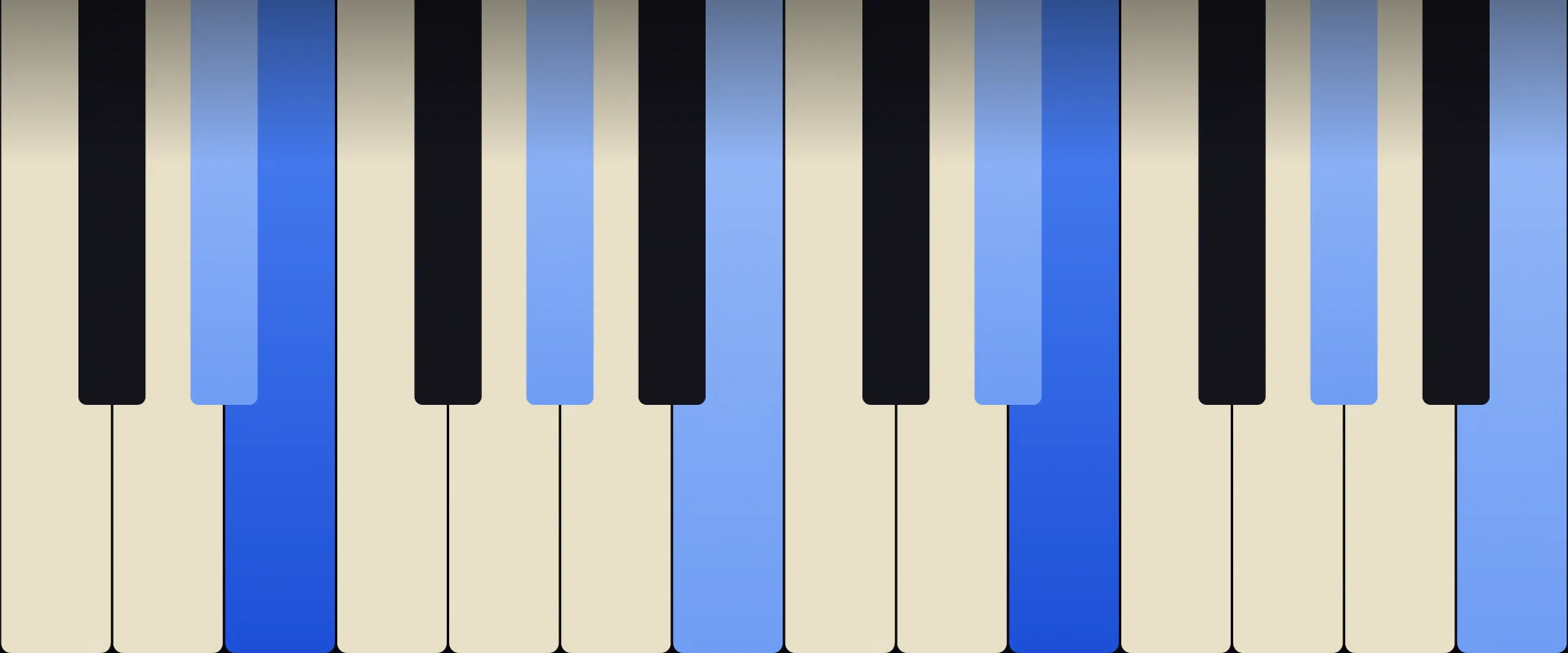
Both black keys are easy landmarks: G♯ in the middle of the group of three, D♯ at the top of the group of two. They alternate with the white E and B, so the fingers step in and out instead of crowding to one side of the hand.
Right hand: thumb on E, second finger on G♯, fourth finger on B, fifth finger on D♯.
Left hand: fifth finger on E, third finger on G♯, second finger on B, thumb on D♯.
Root position is comfortable, which surprises people who expect a major seventh to fight them. D♯ sits eleven semitones above the E it rubs against, not one, so the dissonance is spread across most of an octave and reads as colour. It bites only when the two notes end up side by side, and there is one common way to arrange that: third inversion, D♯ at the bottom with E directly above.
Keep root and seventh in opposite hands. The left takes E and D♯ as a wide major seventh, a smaller stretch than an octave; the right adds G♯, and B if there is room, since the fifth carries no information here. Avoid doubling the root above the seventh, which manufactures the semitone the spread was meant to hide.
Emaj7 on the Guitar
There is an open form, 0 2 1 1 0 0, and it is easier than the plain E major it comes from. Sounding from the bottom: E, B, D♯, G♯, B, E. Play it as the open E shape with the ring finger pulled back a fret to sit beside the index, or as a small index barre across the first fret of the fourth and third strings.
That voicing behaves better than expected. The D♯ sits on the fourth string, so the nearest E above it is the open top string, thirteen semitones away, and nothing is adjacent to anything. Three strings ring open, the low E anchors the chord, and the result is the brightest thing in first position that still has a full bass.
Trouble starts when the seventh climbs onto the second string. Fret D♯ there at the 4th fret with the top string open and the two notes are a semitone apart on adjacent strings, both ringing, with no way to damp either. x x 2 1 4 0 sounds E, G♯, D♯, E: no fifth at all and a hard minor 2nd across the top. On a clean electric with delay that is a real sound and some players want it, but it will not sit under a vocal. The rule for this root: if you want the open top E, keep the D♯ below the second string.
Most guitarists end up on x x 2 4 4 4, sounding E, B, D♯, G♯. Index on the fourth string at the 2nd fret, top three strings at the 4th. The seventh has G♯ above it rather than E, so the rub disappears and the chord stops when you let go. The Amaj7 shape barred at the 7th fret gives x 7 9 8 9 7, four fingers across three frets and considerably harder than the open form.
Inversions
| Voicing | Notes | Bass note |
|---|---|---|
| Root position | E G♯ B D♯ | E |
| 1st inversion | G♯ B D♯ E | G♯ |
| 2nd inversion | B D♯ E G♯ | B |
| 3rd inversion | D♯ E G♯ B | D♯ |
First inversion is the useful one. With G♯ underneath, the ear takes the G♯ minor triad first and hears E as a note added above it, which is how the chord tends to function in a piece in C♯ minor. Second inversion sets D♯ and E side by side in the middle of the texture, tolerable if the voicing is wide. Third inversion sets them side by side at the bottom, where the interval does the most harm.
Guitar barely offers the choice, since the low open E insists on root position and D♯ does not appear on the fifth string until the 6th fret. In an ensemble it is quicker to let the bass player take the D♯ and keep playing 0 2 1 1 0 0 on top.
Voicings
- Open form, 0 2 1 1 0 0, three open strings, seventh kept low in the voicing.
- Compact, x x 2 4 4 4, no open strings, seventh under the third.
- Barre, x 7 9 8 9 7, the Amaj7 shape at the 7th fret, four fingers, three frets.
- Deliberate clash, x x 2 1 4 0, no fifth, D♯ and E adjacent at the top.
- Piano split, E and D♯ in the left hand, G♯ and B above middle C.
The fifth is the first note to drop when space runs short. E, G♯ and D♯ still say everything, and losing the B makes room to move the seventh somewhere it is not fighting the root.
Which Keys Contain Emaj7
Major sevenths are diatonic only to the first and fourth degrees of a major scale, so the list is short:
- degree 1 (I) of E major
- degree 4 (IV) of B major
- degree 3 (III) of C♯ natural minor
- degree 6 (VI) of G♯ natural minor
- degree 1 (I) of E lydian
- degree 7 (VII) of F♯ dorian
Every entry there is E major or B major wearing a different hat. C♯ natural minor is the relative minor of the first, G♯ natural minor the relative minor of the second, F♯ Dorian starts on the second degree of E major and E Lydian on the fourth degree of B major. Four sharps or five, and nothing else.
The pairing worth internalising is E major with C♯ natural minor. Those two share a key signature and this chord is at home in both, tonic in the first and the bright III in the second, so a song can pivot between them without Emaj7 changing a note.
Improvisers should still prefer E Lydian. A natural, the fourth degree of E major, sits a semitone above G♯ and sounds wrong almost every time it is held over this chord. Lydian raises it to A♯ and changes nothing else, so it is the safer scale even when the piece is plainly in E major.
Where Emaj7 Shows Up
Closing a ballad in E. F♯m7, B7, Emaj7. The last chord is a major seventh rather than a triad partly because a plain E sounds abrupt at slow tempo, and partly because the D♯ that has just been the leading note of B7 stays exactly where it is while everything else moves. That common tone is why the cadence sounds smooth though the bass leaps a fourth. The same three chords are unusable in a blues, where the tonic has to be E7 and a D♯ in the final bar sounds like a misfingering.
Vamping into C♯ minor. Emaj7 and C♯m7 share E, G♯ and B, so the bass drops a minor third and the upper voices need not move at all. That makes the pair useful wherever harmony is wanted without motion: intros, fades, film cues, long instrumental beds. On guitar the top of the open form can be held through both.
As III in a C♯ minor loop. C♯m7, Emaj7, Amaj7, B7. Emaj7 is the moment the key brightens without leaving, and since its root is an open string it tends to be the loudest chord in the cycle unless the player holds it back. Guitar-led soul favours C♯ minor for this progression because E, A and B are all open string roots.
The chord asks one thing in return for its colour. Having no tritone, it does not push, so put it where the music arrives, never where a phrase needs momentum.
Related Chords
- E Dominant 7th Chord: Notes, Voicings, and How to Play It is one semitone away and behaves like the opposite chord.
- E Major Chord: Notes, Voicings, and How to Play It is the triad underneath, unchanged.
- E Major 6th Chord: Notes, Voicings, and How to Play It offers the same brightness with none of the semitone friction.
- E Minor Chord: Notes, Voicings, and How to Play It is what the G♯ falling would give you, which turns the chord towards Em(maj7).
Learn More
- Seventh Chords: A Complete Guide to maj7, min7, dom7, and More compares all four sevenths built on E.
- The ii V I Progression in Jazz: Theory and Application works through the cadence that lands here.
- Chord Inversions and Voice Leading covers why third inversion is the one to avoid.
- The Circle of Fifths Explained puts the four sharps of E major in context.
- E Lydian Scale: Notes, Chords, and How to Play It is the scale that removes the avoid note over this chord.
Practice Chords
Drill chord recognition with a metronome, MIDI support, and score tracking.
Start PracticingRelated Articles

A Major 7th Chord: Notes, Voicings, and How to Play It
Aug 29, 2026 · 8 min
A♭ Major 7th Chord: Notes, Voicings, and How to Play It
Aug 29, 2026 · 8 min
B Major 7th Chord: Notes, Voicings, and How to Play It
Aug 29, 2026 · 8 min