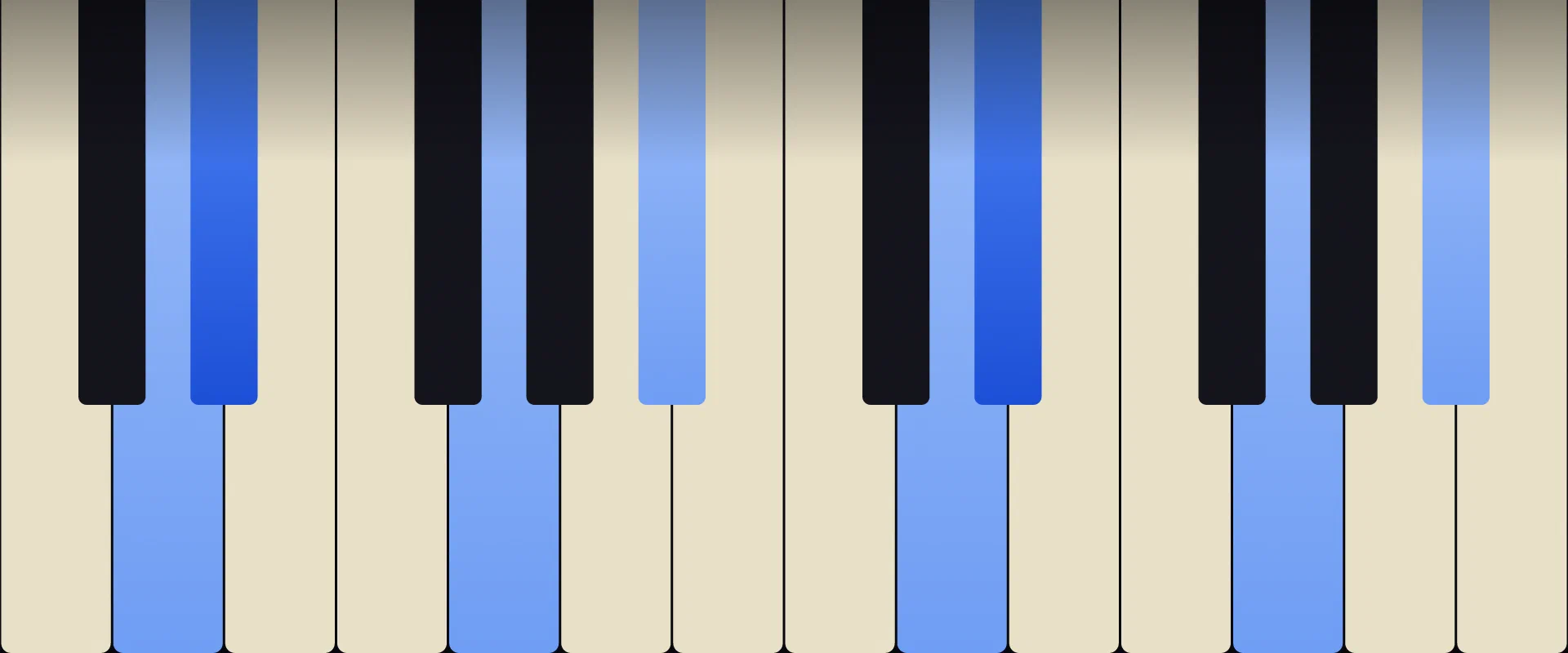
E♭maj7 holds a semitone that you will not hear as a semitone unless you arrange for it. In root position the D sits eleven semitones above the E♭, spread as wide as it can go, and the chord sounds like a lit window. Put that same D directly beneath an E♭ instead and the four pitches turn into a growl. Nothing has changed except distance. Almost every practical question about this chord, at a keyboard or on a fretboard, turns out to be a question about where the D goes and what is sitting next to it.
Try It: E♭maj7 in the Chord Finder
The Notes of E♭maj7
The chord contains four notes: E♭, G, B♭ and D.
| Degree | Note | Interval from root | Semitones |
|---|---|---|---|
| 1 | E♭ | Root | 0 |
| 3 | G | Major 3rd | 4 |
| 5 | B♭ | Perfect 5th | 7 |
| 7 | D | Major 7th | 11 |
Written E♭maj7, and also E♭M7 or E♭Δ7. The one spelling that means something else entirely is E♭7, which takes D♭ instead.
How E♭maj7 Is Built
Stack a major third, a minor third and another major third on E♭: G, then B♭, then D. That last third is what puts the seventh eleven semitones up rather than ten, and it carries the chord’s character.
Underneath sits the plain E♭ major triad, E♭ G B♭, which holds no interval smaller than a minor third. Adding D introduces the only friction the chord owns, and it introduces it against a note that is not even being played in root position: the E♭ an octave up. The tension in E♭maj7 is with an implied upper root, so it appears and disappears depending on whether you voice one.
E♭maj7 on the Piano
Two black keys and two white ones, alternating: E♭ black, G white, B♭ black, D white. The right hand takes 1 on E♭, 2 on G, 3 on B♭ and 5 on D, with thumb and third finger sitting back among the raised keys.
Look at where D lands. It is the white key immediately to the left of the E♭ an octave above your thumb, touching it. That is the whole lesson: in root position you play the note next door to the root without playing the root itself, and the chord stays clear because the neighbour is absent.
Now break it. Take the chord in both hands and put an E♭ above the D. The two keys are adjacent. In the octave above middle C that reads as a deliberate crunch, bright and modern. Two octaves lower it is unusable, which is also what goes wrong when a beginner voices all four notes low in the left hand. Down there, keep the left hand to root and seventh, E♭ with D a major seventh above, and let the right hand supply G and B♭.
For comping, the rootless voicing is G B♭ D F, third, fifth, seventh and ninth, with the bass player on E♭. It contains no semitone at all, because the E♭ that D would rub against is gone, and that is why pianists rarely finger the root of this chord in an ensemble.
E♭maj7 on the Guitar
No open form exists, and the practical home is the 6th fret. Barre the Amaj7 shape there: x 6 8 7 8 6, sounding E♭, B♭, D, G and B♭ from the 5th string up. Check what that gives you. Exactly one E♭, at the bottom, with D a major seventh above it and G and B♭ stacked over. Nothing is adjacent to anything, and it is open by accident of where the strings fall.
The Emaj7 shape at the 11th fret, 11 13 12 12 11 11, sounds E♭, B♭, D, G, B♭ and E♭. The last note is the difference. That top E♭ sits thirteen semitones above the D, a minor ninth, the harshest interval in the shape and the reason this grip rings denser than the one at the 6th fret. Not muddy, since both notes are high, but not neutral either. Use it for a low root under a held chord, not for comping behind a singer.
The fullest version is neither of those barres. Move the open Cmaj7 shape up three frets: x 6 5 3 3 3, giving E♭, G, B♭, D and G. The D is a major seventh above the single root, the doubled note on top is the third rather than the root, and it costs a pinky, a ring finger and an index barre across the 3rd fret.
Smallest of all: 11 x 12 12 x x, three notes giving E♭, D and G, root then seventh then third. Index at the 11th fret on the 6th string, a two string barre at the marked 12th. Lower the D string note by one fret to 11 x 11 12 x x and the chord becomes E♭7. One fret is the entire distance between the two.
Inversions
| Inversion | Notes | Lowest note |
|---|---|---|
| Root position | E♭ G B♭ D | E♭ |
| 1st inversion | G B♭ D E♭ | G |
| 2nd inversion | B♭ D E♭ G | B♭ |
| 3rd inversion | D E♭ G B♭ | D |
Three of the four put D and E♭ next to each other, which is the whole difficulty with inverting this chord. First inversion has the semitone at the top, where it reads as sparkle. Second inversion buries it in the middle, where it just sounds vague. Third inversion, D E♭ G B♭, puts it at the bottom, and below middle C that is genuinely muddy: the two lowest notes beat against each other while everything above sounds fine. The fix is always the same, move one of the pair an octave so the interval becomes a major seventh or a major ninth.
Voicings
Drop the fifth before anything else. E♭, G and D alone is a complete statement of the chord, and losing B♭ costs nothing, since a fifth is the one degree the ear supplies unprompted.
Put A♭ in the bass under E♭ G B♭ D and the result is A♭ with its fifth, seventh, ninth and sharp eleventh, the lydian colour, without a note changing above the bass line. Put C underneath and the same four notes become Cm9. Worth knowing before you write E♭maj7 on a chart and discover the bass player heard something else.
For the sharpest version of the chord’s own colour, add A natural rather than A♭, giving E♭maj7♯11. That note belongs to E♭ lydian and not to E♭ major, and it is what film composers reach for when a cue needs to sound wide open rather than warm.
Which Keys Contain E♭maj7
- I of E♭ major
- IV of B♭ major
- III of C natural minor
- VI of G harmonic minor
- I of E♭ lydian
- III of C dorian
The function changes more than the notes do. As I of E♭ major the chord is home and the D leads nowhere. As III of C natural minor it is the bright chord inside a dark key, and the same four pitches feel like a departure rather than an arrival. In G harmonic minor it sits as VI beside a raised leading note, so what follows is usually built on F♯ and the contrast is stark.
Where E♭maj7 Shows Up
E♭maj7, Cm7, Fm7, B♭7. The I vi ii V loop, four bars, repeated until the melody runs out. This is the harmonic floor of the flat key ballad repertoire, and E♭ is where a great many of those songs sit, because a horn section reads it easily and a singer can usually reach the top of it.
Fm7, B♭7, E♭maj7. The ii V I arriving home. Watch the last move: B♭7 contains A♭, which falls to G, the third of the tonic. The D has been absent from both earlier chords and appears only on arrival, which is why a maj7 tonic sounds like a landing rather than a stop.
Cm7, E♭maj7, A♭maj7, D♭maj7. Descending fourths out of C minor with E♭maj7 as the III. Modal jazz and neo soul lean on this, and this chord is the pivot: heard from C minor it is the relative major, heard from what follows it is the first link in a chain.
B♭maj7, E♭maj7. Two major sevenths a fourth apart, the plagal move with both chords coloured. B♭ and D are common to both, so only two notes shift, and a guitarist plays the pair around the 6th fret without moving the fretting hand more than a fret or two. That ease is part of why it recurs in flat key soul.
Related Chords
- E♭ Dominant 7th Chord
- E♭ Major Chord
- E♭ Major 6th Chord
- E♭ Minor Chord
- Guitar Chord Shapes: The CAGED System
Learn More
Practice Chords
Drill chord recognition with a metronome, MIDI support, and score tracking.
Start PracticingRelated Articles

A Major 7th Chord: Notes, Voicings, and How to Play It
Aug 29, 2026 · 8 min
A♭ Major 7th Chord: Notes, Voicings, and How to Play It
Aug 29, 2026 · 8 min
B Major 7th Chord: Notes, Voicings, and How to Play It
Aug 29, 2026 · 8 min