Lay one finger flat across the third, second and first strings at the 2nd fret, let the open fourth string ring underneath, and you are holding a complete major seventh chord. x x 0 2 2 2 gives D, A, C♯ and F♯. No barre worth the name, no stretch, nothing to memorise beyond a straight line. Very few four note chords on any instrument cost that little.
The tuning is doing the work. From the G string to the B string is a major third and from the B string to the top string is a perfect fourth, which is exactly the shape A to C♯ to F♯ needs. Stop those three strings at any single fret and the same stack appears. At the 2nd fret the note sitting underneath it, free, on an open string, happens to be D.
Try It: Dmaj7 in the Chord Finder
The Notes of Dmaj7
Dmaj7 is four notes: D, F♯, A and C♯.
| Degree | Note | Interval from Root | Semitones |
|---|---|---|---|
| 1 (Root) | D | Perfect unison | 0 |
| 3 | F♯ | Major 3rd | 4 |
| 5 | A | Perfect 5th | 7 |
| 7 | C♯ | Major 7th | 11 |
Only the C♯ separates this from a plain D major triad, and it sits eleven semitones above the root, one short of the octave.
How Dmaj7 Is Built
Take D major, D F♯ A, and add the seventh degree of the scale on top. Nothing is borrowed: all four notes come from the key, and the chord is the tonic of D major in four parts rather than three.
What makes it interesting is which note got added. C♯ is the leading note of D, the note whose whole job in the key is to point at the tonic. Put it inside the tonic chord and the chord carries its own unfinished business. It is home and restless at once, which is why it reads as wistful rather than triumphant.
Compare it with D7, the same triad with C natural on top. A semitone lower and the chord stops belonging to D and starts pulling towards G. The gap between a tonic and a dominant, here, is one fret.
There is a shortcut hiding in the upper three notes. F♯, A and C♯ spell F♯ minor, the vi chord of this key. Put an F♯ minor triad over a D bass, in any inversion, and Dmaj7 is what comes out.
Dmaj7 on the Piano
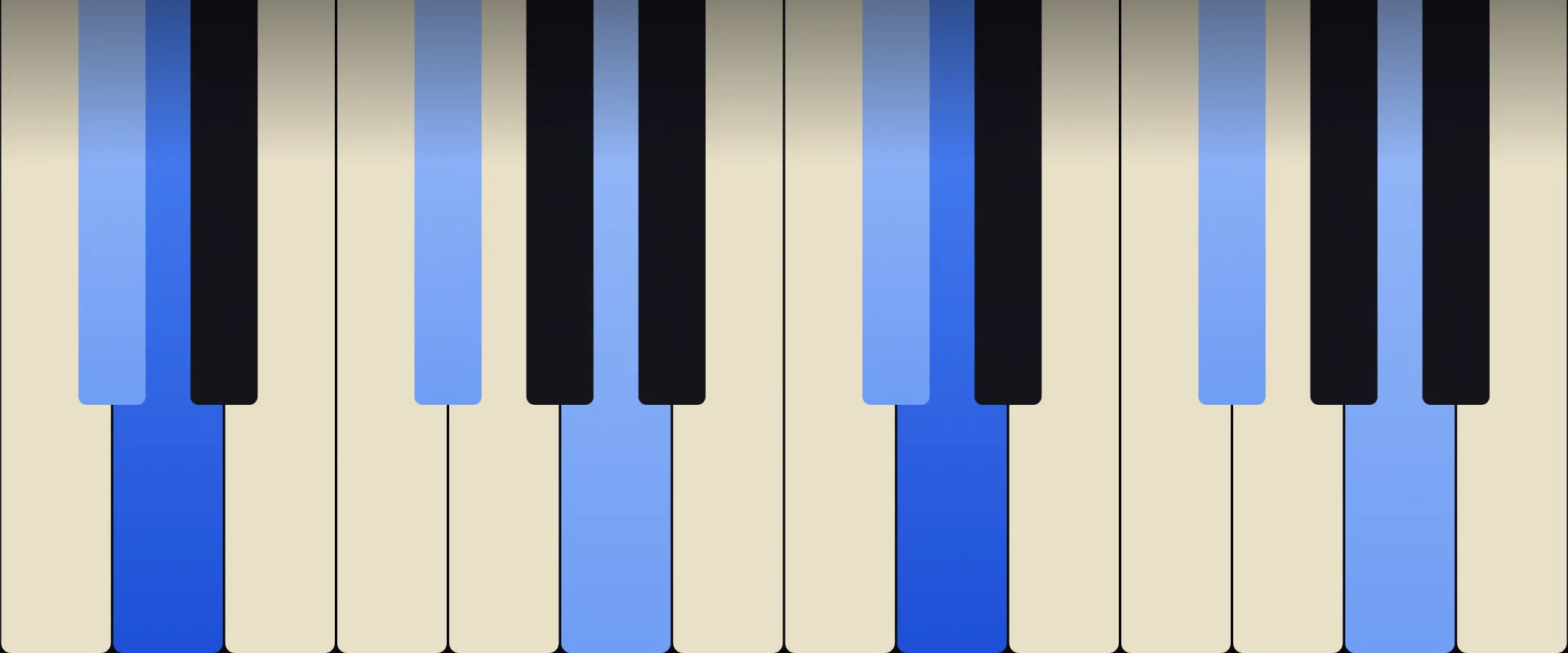
Two black keys and two white, strictly alternating: D, F♯, A, C♯. Right hand 1, 2, 3, 5 covers root position, and the little finger, the shortest one, has to reach furthest back to a black key. That C♯ sits immediately left of the D an octave above the thumb, so the hand spans almost an octave while its weakest finger stands on a narrow key.
Most players stop fighting that and give the root to the left hand. What remains for the right is F♯, A and C♯, an ordinary F♯ minor triad, which falls under the fingers in any inversion and moves around freely while the left hand holds D.
Register matters more here than with any other chord on this root. D and C♯ are consonant eleven semitones apart and unpleasant one semitone apart, so the seventh has to stay high. Keep C♯ above the D and it glows. Drop it underneath, low in the left hand, and the same two notes grind.
Dmaj7 on the Guitar
x x 0 2 2 2, low to high, is D, A, C♯, F♯. The index finger lies flat at the 2nd fret across the top three strings while the fourth string sounds open beneath it. The one thing that goes wrong is the tip of that finger. It points down towards the thicker strings, and if it flattens too far it damps the open D, which removes the root of the chord and leaves a bare F♯ minor triad ringing. Roll the finger slightly onto its side and the D speaks.
The shape has two neighbours a fret away in each direction, and only the second string moves between them:
| 2nd string | Note | Chord |
|---|---|---|
| 3rd fret | D | D |
| 2nd fret | C♯ | Dmaj7 |
| 1st fret | C | D7 |
| open | B | D6 |
Hold the third and first strings at the 2nd fret and walk the second string down from the 3rd fret to the open string. That descent, D to C♯ to C to B, is the major key line cliché, and here it ends on an open string. Learn it as one gesture rather than four grips: it is the reason most guitarists ever play a major seventh chord at all.
For more body, add the open fifth string, x 0 0 2 2 2, which puts A in the bass. Up the neck the Amaj7 shape barres at the 5th fret, x 5 7 6 7 5, where the frets are wide and the grip is comfortable. The Emaj7 shape at the 10th fret, 10 12 11 11 10 10, finally gets a low D underneath, at the price of a full barre in the cramped end of the neck.
One more shape is worth knowing. An F♯ minor barre at the 2nd fret, 2 4 4 2 2 2, already has this chord’s top three notes under the index finger, which is part of why the F♯ minor to D loop is so easy to play in this key.
Inversions
| Inversion | Bass Note | Notes | Symbol |
|---|---|---|---|
| Root position | D | D, F♯, A, C♯ | Dmaj7 |
| 1st inversion | F♯ | F♯, A, C♯, D | Dmaj7/F♯ |
| 2nd inversion | A | A, C♯, D, F♯ | Dmaj7/A |
| 3rd inversion | C♯ | C♯, D, F♯, A | Dmaj7/C♯ |
Third inversion needs care. With C♯ in the bass the root sits a semitone above it, and low down that is muddy. Used deliberately it is excellent: write a bass line stepping D, C♯, B, A and the second chord is Dmaj7/C♯, on its way to a B minor. Countless songs in D descend like that.
Voicings
Guitar, open (x x 0 2 2 2). One finger, four notes, third on top.
Guitar, with open A bass (x 0 0 2 2 2). Same grip, fifth in the bass, fuller under a fingerpicked part.
Guitar, Amaj7 shape at fret 5 (x 5 7 6 7 5). Movable, five strings, root on the fifth string.
Piano, left hand root and right hand F♯ minor. The standard working voicing.
Piano, spread (D and A low, C♯ and F♯ high). Seventh kept well clear of the bass, which is where this chord wants it.
Which Keys Contain Dmaj7
Six keys where Dmaj7 arrives as a diatonic chord:
- I of D major
- IV of A major
- III of B natural minor
- VI of F♯ natural minor
- I of D lydian
- VII of E dorian
Two of those make it the tonic. D lydian differs from D major only in its fourth degree, G♯ rather than G, and this chord contains no fourth degree at all, so it cannot tell you which of the two you are in. What it does rule out is D mixolydian, whose C natural produces a dominant seventh on the same root instead.
Where Dmaj7 Shows Up
Bossa nova. Jobim’s “Wave” is written in D major, and in that idiom a tonic is never a bare triad. The guitar part is a thumb on the root with the upper strings clipped short on the offbeats, which suits a shape whose fingers are already in a straight line and easy to mute.
IV in A major: A, Dmaj7. A plagal move between two of the cheapest positions on the guitar. In A the full turn is Bm7, E7, Amaj7, and this chord is the IV in the bars between. Where a rock band plays a plain D, a soul or R&B arrangement adds the C♯ and the harmony stops sounding like three chords.
VI in F♯ minor: F♯m, D, A, E. One of the most recorded loops in pop, and whether it sounds like a stadium or a bedroom is largely decided by that second chord. Play it as D and the loop is rock. Play it as Dmaj7, with the C♯ carried over from the F♯ minor before it, and the same four chords turn introspective. Nothing has to move to make that happen: C♯ is a chord tone in both.
III in B minor. Coming from a B minor tonic, this chord is the relative major arriving as relief. It shares three notes with B minor, so the change is soft rather than declarative, which is why minor key ballads use it to open a chorus.
Most of what gets written in D, a key the guitar and the fiddle already resonate with, is folk, dance music or plain rock. Dmaj7 is what happens when somebody takes that comfortable key and adds the one note in it that will not settle.
Related Chords
- D Major Chord, the triad underneath the added seventh.
- D Dominant 7th Chord, the same chord with C natural instead of C♯.
- D Major 6th Chord, the next step down that second string.
- F♯ Minor Chord, the triad that sits on top of it.
- The D Major Scale, where this chord is the tonic.
Learn More
Practice Chords
Drill chord recognition with a metronome, MIDI support, and score tracking.
Start PracticingRelated Articles

A Major 7th Chord: Notes, Voicings, and How to Play It
Aug 29, 2026 · 8 min
A♭ Major 7th Chord: Notes, Voicings, and How to Play It
Aug 29, 2026 · 8 min
B Major 7th Chord: Notes, Voicings, and How to Play It
Aug 29, 2026 · 8 min