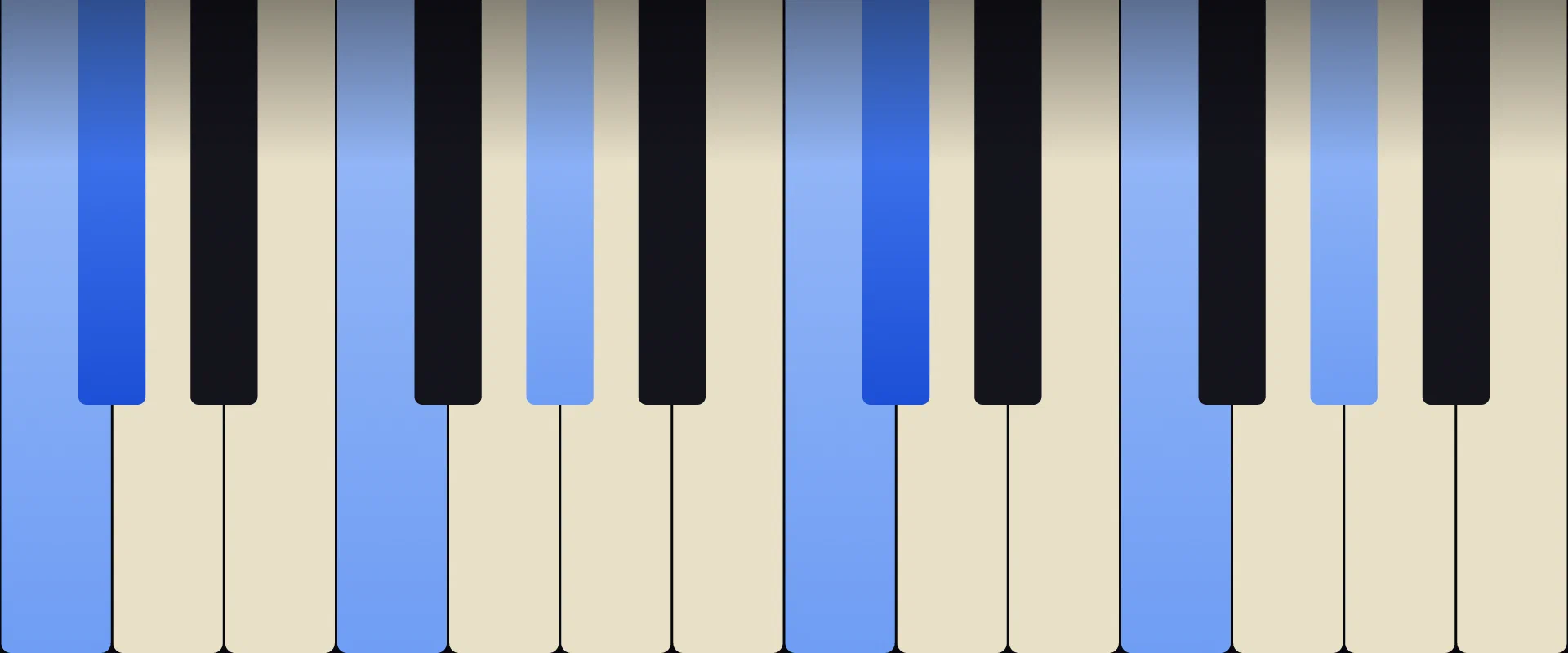
Play C♯maj7 on a piano and your right hand is holding F minor. Not something like it: the top three notes, E♯, G♯ and B♯, sound as F, A♭ and C, one of the first minor triads anyone learns. Put C♯ underneath and the chord is finished. That gap is what this page is about. On paper C♯maj7 is about as forbidding as a symbol gets, two of its four notes carrying sharps that land on white keys. Under the hands it is a beginner’s triad with a black key added below.
Try It: C♯maj7 in the Chord Finder
The Notes of C♯maj7
| Degree | Note | Interval from root | Semitones |
|---|---|---|---|
| 1 | C♯ | Root | 0 |
| 3 | E♯ | Major 3rd | 4 |
| 5 | G♯ | Perfect 5th | 7 |
| 7 | B♯ | Major 7th | 11 |
Eleven semitones is one short of the octave, so the top note sits a semitone below the root an octave up. On a keyboard that is literal: B♯ is the key immediately left of C♯.
How C♯maj7 Is Built
The C♯ major chord page works through why the third of this triad has to be written E♯ rather than F. The seventh follows the same rule and deserves its own look, because it is the note that makes this chord what it is. Counting letters from C gives C, D, E, F, G, A, B, so the seventh of a chord rooted on any kind of C is some kind of B. Eleven semitones above C♯ is the pitch we usually call C. As a seventh above C♯, it is B♯.
Call it C and the interval reads as C♯ up to C, one letter name wide, a mangled unison rather than a seventh, and the symbol carries two notes both named C. B♯ is the only spelling that keeps four notes on four letters, which is what lets a staff draw them as an even stack.
B♯ to the C♯ above is one semitone, adjacent keys, as close as two notes get. That rub is the whole point of a major seventh chord. Drop B♯ one more semitone to B natural and you have C♯7, a dominant with a tritone that must move. Leave B♯ alone and nothing has to move at all.
C♯maj7 on the Piano
Two black keys and two white ones, and the white ones are the two that begin a group. F starts the group of three, C starts the group of two, and each has a broad rear section running back alongside the black key above it, so neither forces the hand forward. Line the four up in pitch order from B♯ and the colours alternate: C, C♯, F, G♯, white, black, white, black.
Right hand, root position from C♯: 1 on C♯, 2 on F, 4 on G♯, 5 on C. The thumb takes a black key, the only thing here a beginner resists, and the little finger lands on the plainest key on the instrument.
Better still, do not play it that way. Hold C♯ alone in the left hand, put F, A♭ and C in the right, and the chord becomes a bass note under an F minor triad. The third, fifth and seventh of any major seventh chord make a minor triad, and on this root that triad happens to be one of the most familiar shapes on the keyboard. Strictly it is E♯, G♯, B♯, an E♯ minor triad, a spelling nobody prints and nobody needs.
The reading difficulty is real and separate from the playing difficulty. Any score in flats prints D♭maj7: D♭, F, A♭, C, with no note whose name fights its key.
C♯maj7 on the Guitar
Root and seventh are one fret apart on a string, so they cannot share one. In both usable forms B♯ lands two strings above C♯ and one fret further along: root on the fifth string at the 4th fret puts it on the third string at the 5th, root on the sixth at the 9th puts it on the fourth at the 10th.
The Amaj7 form barred at the 4th fret is x 4 6 5 6 4, sounding C♯, G♯, B♯, E♯, G♯: index barre at the 4th, middle on the third string at the 5th, ring on the fourth at the 6th, little finger on the second at the 6th. Three fingers packed into two frets across three adjacent strings, over a barre, low enough that the strings are still stiff. Harder than the plain major barre here, and harder than the dominant seventh, which needs one finger fewer.
So drop the outer strings. Play x 4 6 5 6 x and the barre disappears: the index takes the fifth string at the 4th on its own, the other fingers stay put. Same four notes, nothing doing double duty.
The Emaj7 form at the 9th fret, 9, 11, 10, 10, 9, 9, gives a low root and all six strings, but asks the index to barre while three fingers crowd frets 10 and 11 above it. Narrow frets make that possible, and make it thin.
The chord never gets an open string. Its pitches are C♯, F, G♯ and C; the guitar offers E, A, D, G and B. No overlap, no drone, no half open shortcut.
Inversions
| Inversion | Notes | Lowest note |
|---|---|---|
| Root position | C♯ E♯ G♯ B♯ | C♯ |
| 1st inversion | E♯ G♯ B♯ C♯ | E♯ |
| 2nd inversion | G♯ B♯ C♯ E♯ | G♯ |
| 3rd inversion | B♯ C♯ E♯ G♯ | B♯ |
Third inversion carries the warning. B♯ underneath puts the semitone at the bottom with C♯ directly above it, and low semitones turn to mud faster than any other interval. High up it shimmers; below middle C it growls. First inversion is the gentlest, since E♯ in the bass makes the chord sound like a triad with a colour note rather than a seventh.
Voicings
Keep the root and seventh apart. The two notes that define the chord, E♯ and B♯, are F and C, a perfect fifth of ordinary white keys, and holding those over a left hand C♯ gives the cleanest shell available: three notes, one black key, no crowding. G♯ can go entirely.
Add D♯ on top for C♯maj9, which most jazz pianists prefer because the ninth softens the rub. Add G natural instead for C♯maj7♯11, the lydian colouring, less exotic under the fingers than on the page since G is just another white key. Charts print both in flats.
Which Keys Contain C♯maj7
- I of D♭ major
- IV of A♭ major
- III of B♭ natural minor
- VI of F natural minor
- I of D♭ lydian
- II of C phrygian
Every one of those pages spells this chord D♭, F, A♭ and C, and that is not a sample of convenience. No scale on this site produces it as C♯, E♯, G♯ and B♯, because a key that spells it that way needs seven sharps or more. The sharp version is musically correct and diatonically homeless.
The list divides by function. In D♭ major the chord is the tonic and goes nowhere. In A♭ major it is the subdominant and leans home. In B♭ minor and F minor it is a bright chord inside a dark key. C phrygian is the strangest and the most useful: there it sits on the flattened second degree, a semitone above the tonic, which is the sound flamenco and metal both live on.
Where C♯maj7 Shows Up
| Progression | Chords | Turns up in |
|---|---|---|
| Imaj7 ii7 V7 in D♭ major | D♭maj7, E♭m7, A♭7 | Standards and ballads |
| ♭VImaj7 in F minor | Fm, D♭maj7, A♭, E♭ | Pop, soul, film cues |
| ♭IImaj7 over a C pedal | C, D♭maj7, C | Flamenco, metal, suspense |
| Imaj7♯11 vamp in D♭ lydian | D♭maj7, E♭, D♭maj7 | Modal jazz, scoring |
The first row is where the chord earns its living and where it is never called C♯maj7. D♭ major suits singers and pianists alike, and a ballad settling onto its tonic seventh is a well worn path.
Row two is the one most listeners could hum. In F minor the flattened sixth degree carries a major seventh, so a minor verse can open onto D♭maj7 without changing key. Three of its notes are F, A♭ and C, the tonic triad of that key, so the move widens the harmony rather than leaving it.
Row three is the chord at its most physical. Hold C in the bass, shift everything above it up a semitone, and the D♭maj7 grinding against that pedal is the Phrygian sound: one shape slid a single fret while the bass refuses to follow.
The sharp spelling survives in one habitat: instruments and tools that name chords by position rather than by key. A guitarist barring the 4th fret counts up from the fifth string and says C♯. The music on the stand still says D♭.
Related Chords
- C♯ Dominant 7th Chord, the same shape with B natural in place of B♯, which swaps stillness for a tritone
- C♯ Major Chord, the triad underneath, and the page that works through the E♯ spelling
- C♯ Major 6th Chord, the older way of decorating this triad, using A♯ instead of a seventh
- Seventh Chords: The Complete Guide for how the four seventh chord qualities differ
- Chord Inversions and Voice Leading for keeping B♯ out of the bass
Learn More
- Diatonic Chords: A Beginner’s Guide
- Extended Chords and Jazz Harmony
- The Circle of Fifths Explained
- D♭ Major Scale, the key that prints this chord
- D♭ Lydian Scale
Practice Chords
Drill chord recognition with a metronome, MIDI support, and score tracking.
Start PracticingRelated Articles

A Major 7th Chord: Notes, Voicings, and How to Play It
Aug 29, 2026 · 8 min
A♭ Major 7th Chord: Notes, Voicings, and How to Play It
Aug 29, 2026 · 8 min
B Major 7th Chord: Notes, Voicings, and How to Play It
Aug 29, 2026 · 8 min