One semitone separates this chord from C7: B here, B♭ there. That single key decides whether the chord has to move or is allowed to stop. Count the intervals and no pair of notes in Cmaj7 is six semitones apart. C to E is four, E to G three, G to B four, C to G seven, E to B seven, C to B eleven. There is no tritone here at all, nothing pending and nothing owed, which is why a piece can end on this chord and can never end on C7. What tension it carries comes from somewhere quieter, the semitone between the B and the C above it, and that rub is placed rather than resolved. Almost everything a player does with Cmaj7 is a decision about where to put it.
Try It: Cmaj7 in the Chord Finder
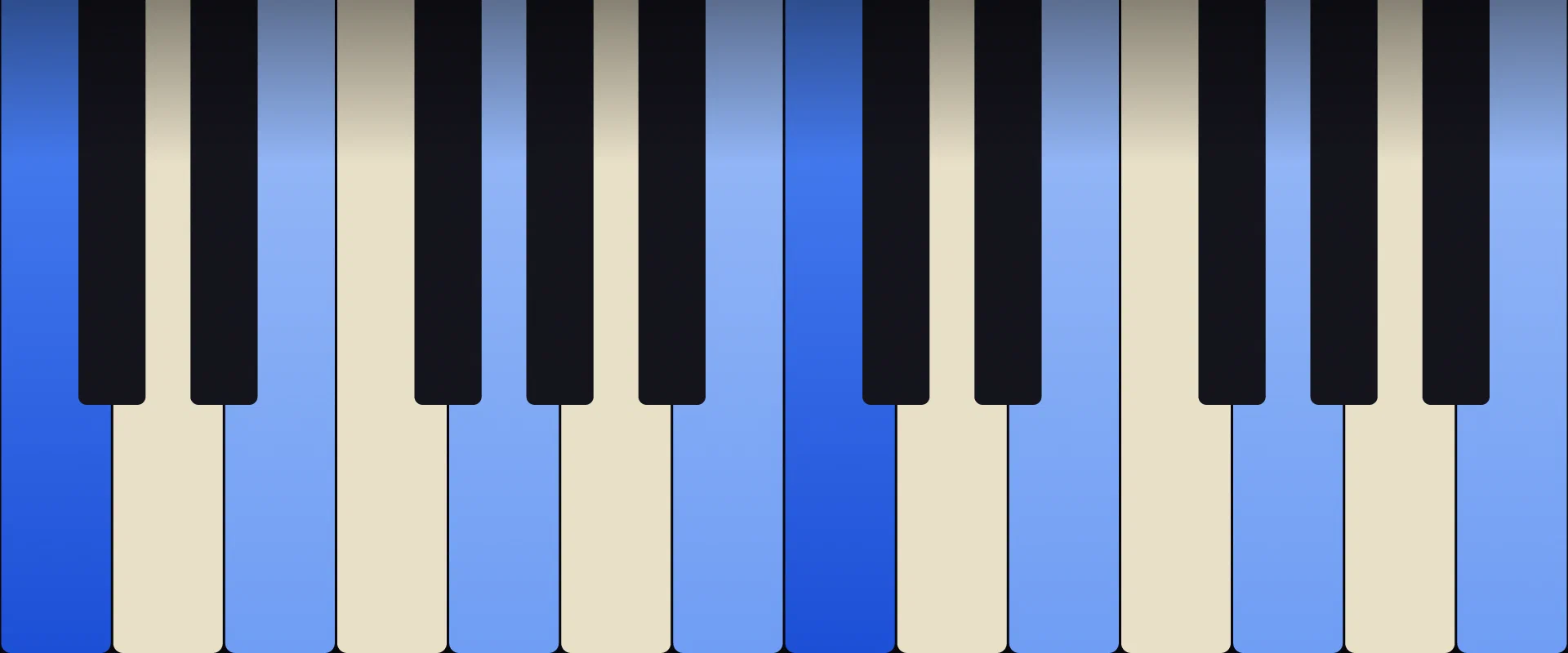
Set the root to C and look at the keyboard. Every lit key is white.
The Notes of Cmaj7
| Degree | Note | Interval from root | Semitones |
|---|---|---|---|
| 1 (root) | C | Perfect unison | 0 |
| 3 | E | Major 3rd | 4 |
| 5 | G | Perfect 5th | 7 |
| 7 | B | Major 7th | 11 |
Written out: C, E, G, B. Four white keys, no accidentals and no enharmonic decision to make. Only one other common four note chord on this root manages that, and it is C6, which trades the B for an A.
How Cmaj7 Is Built
Stack the thirds and the sizes alternate: major, minor, major. That final major third on top is what separates the chord from every other seventh built on C, and it lands the B one semitone under the octave.
Two useful triads live inside the four notes. Remove the root and E, G and B are an E minor triad, so Cmaj7 is E minor sitting on a C, which is how most pianists voice it. Add a D above and G, B and D become a G major triad, so Cmaj9 is G major over the same bass.
Change the top note and the chord changes job: B to B♭ gives C7 and its tritone. Change the third, E to E♭, and you get Cm(maj7), which keeps the semitone at the top and puts minor underneath.
Cmaj7 on the Piano
Four white keys and the hand never leaves the flat plane. Thumb on C, second finger on E, third on G, fifth on B, and nothing reaches forward between the black keys at any point. The span is a major 7th, one white key short of an octave, which is the fastest way to find the chord by touch: set the octave shape you already know, then pull the little finger back one white key.
Register is where it goes wrong. B and C are adjacent white keys, so any voicing that puts them side by side holds a minor 2nd, and low down that interval turns to porridge. The worst case is the third inversion, B under C under E under G, played beneath middle C: the two beat against each other and the chord loses its shape. The same four notes with the B on top are transparent.
That is why the split voicing is standard. Left hand takes C on its own, low; right hand takes E, G and B. The semitone is now stretched across most of an octave and reads as colour rather than clash.
Cmaj7 on the Guitar
The open form is x 3 2 0 0 0, and it is genuinely easier than the plain C major triad it comes from. Take the usual x 3 2 0 1 0 and lift the index finger off the 2nd string: the open B that appears is the major 7th. Two fretted notes and three open strings makes this one of the very few chords on the instrument that costs less than its own triad, and one reason beginners play it before knowing its name.
Those open strings change the sound as well. C major has only two, so it is a short, thin chord; Cmaj7 rings for as long as the guitar will let it. The 6th string stops being a problem too: let the low E sound and you get Cmaj7/E, which is perfectly usable, because the semitone stays high up where it belongs.
Moving up the neck costs far more. The Amaj7 shape at the 3rd fret, x 3 5 4 5 3, is manageable: index barre, ring on the 4th string, little finger on the 2nd. The Emaj7 shape at the 8th fret, 8 10 9 9 8 8, is a real handful, with the middle finger flattened across two strings at the 9th while the ring finger stretches to the 10th. Most players use x 3 x 4 5 x instead: C on the 5th string, B on the 3rd, E on the 2nd, three notes and no barre, which fits under a horn line without crowding it.
Inversions
| Inversion | Notes | Bass | Symbol |
|---|---|---|---|
| Root position | C E G B | C | Cmaj7 |
| 1st inversion | E G B C | E | Cmaj7/E |
| 2nd inversion | G B C E | G | Cmaj7/G |
| 3rd inversion | B C E G | B | Cmaj7/B |
Three of these are ordinary and one is a liability. Cmaj7/E is the useful one, putting the Em triad at the bottom and the C on top, which suits a descending bass line and keeps the semitone at the extremes of the chord. Cmaj7/G works as a pedal. Cmaj7/B is the awkward one: the bass note sits a semitone below the note directly above it, and unless that B is genuinely walking down from C towards A it sounds like a mistake. For the general case, see Chord Inversions and Voice Leading.
Voicings
Spacing decides almost everything here. Keep the B well away from any C in the texture and the chord is warm and open; let them sit together low down and it is muddy. That is the whole subject.
Adding a note on top changes the colour without changing the function. A D gives Cmaj9; an F♯ gives Cmaj7♯11, which introduces the first tritone the chord has ever had, C against F♯, and with it the Lydian sound. Change the bass instead and the name changes: put an A under C, E, G and B and the five notes read as Am9, which is why a Cmaj7 grip over an A bass is a standard soul keyboard move.
| Shape | Frets | Result |
|---|---|---|
| Cmaj7 | x 3 2 0 0 0 | Open, three ringing strings |
| Cmaj7 | x 3 5 4 5 3 | A shape at the 3rd fret |
| Cmaj7 | 8 10 9 9 8 8 | E shape at the 8th fret |
| Cmaj7 | x 3 x 4 5 x | Shell: root, 7th, 3rd |
| Cmaj9 | x 3 2 4 3 x | Adds D, no 5th |
| Cmaj7/E | 0 3 2 0 0 0 | Open form with the low E ringing |
Which Keys Contain Cmaj7
- I of C major
- IV of G major
- I of C lydian
- III of A natural minor
- VI of E natural minor
- VI of E harmonic minor
The minor entries explain most of the chord’s appearances in pop. As the third degree of A minor it is the bright chord in a dark key, and over an A bass it becomes the Am9 above, so one shape serves both. The last two rows are worth comparing at the keyboard: E harmonic minor differs from E natural minor by one note, D raised to D♯, and Cmaj7 contains no D of either kind, so the chord on the sixth degree crosses between the two scales untouched while the first, third and fifth degrees all change quality.
Where Cmaj7 Shows Up
| Progression | Chords | Context |
|---|---|---|
| ii V I (C major) | Dm7, G7, Cmaj7 | The arrival chord |
| Imaj7 IVmaj7 (C major) | Cmaj7, Fmaj7 | Bossa nova vamp |
| I Imaj7 I7 IV (C major) | C, Cmaj7, C7, F | Descending inner line |
| IV in G major | G, Cmaj7, Em, D | Folk and pop guitar |
The third row is where this chord and C7 meet. Hold a C major triad, drop the top C to B, then to B♭, then let the whole chord fall to F. The inner voice walks down by semitone and the harmony follows it, so the Cmaj7 in the middle is a passing chord rather than a destination. Countless ballads run that line, and nothing shows more plainly that the two chords are one note apart.
The fourth row follows straight from the fingering. In G major, Cmaj7 is the IV chord, and x 3 2 0 0 0 leaves the top three strings open, exactly as open Em does and almost as open G does. Moving between those shapes barely disturbs the ringing top of the instrument, so a fingerpicked part in G drifts into Cmaj7 whether or not the writer intended a seventh chord.
Ending on it is a modern habit. Classical cadences finish on the bare triad, and a B sustained over a final C would have been heard as a suspension somebody forgot to resolve. Bossa nova and cool jazz made the tonic major 7th an ordinary last chord, and on an electric piano it is close to the default sound of the genre: C in the left hand, E, G and B in the right, sustain pedal down.
Related Chords
- C Dominant 7th Chord, one semitone away and the opposite temperament
- C Major Chord, the triad the B is added to
- C Major 6th Chord, the other all white four note chord on this root
- C Sus2 Chord, what happens when a note is taken away instead
- Extended Chords and Jazz Harmony for Cmaj9 and Cmaj13
- Guitar Chord Shapes: The CAGED System for moving the barre shapes around
Learn More
Practice Chords
Drill chord recognition with a metronome, MIDI support, and score tracking.
Start PracticingRelated Articles
A Major 7th Chord: Notes, Voicings, and How to Play It
Aug 29, 2026 · 8 min
A♭ Major 7th Chord: Notes, Voicings, and How to Play It
Aug 29, 2026 · 8 min
B Major 7th Chord: Notes, Voicings, and How to Play It
Aug 29, 2026 · 8 min