Frets one and two, four fingers, no barre. The open B7, written x21202, is the only chord on this root that the standard books give as an open shape. The plain major triad has none. The minor has none. Add a fourth note to the major and the instrument suddenly relents.
The reason is one note. B7 is B, D♯, F♯ and A, and A is a pitch the guitar leaves lying about. It is the open fifth string, and on the third string it sits at fret 2, exactly where the hand already is. The hardest root on the instrument hands over its dominant seventh cheaper than its triad.
Try It: B7 in the Chord Finder
The Notes of B7
| Degree | Note | Interval from Root | Semitones |
|---|---|---|---|
| 1 (Root) | B | Perfect unison | 0 |
| 3 | D♯ | Major 3rd | 4 |
| 5 | F♯ | Perfect 5th | 7 |
| ♭7 | A | Minor 7th | 10 |
Four notes and only two accidentals. The seventh is a plain A, odd company for a chord whose third and fifth are both sharpened, and that bare A does all the work: it is the one note here outside B major.
How B7 Is Built
Take the B major triad, B D♯ F♯, and put A on top. Nothing already there moves.
What arrives with the A is a tritone. D♯ up to A is six semitones, the interval that splits the octave in half and refuses to sit still. It is why a dominant seventh sounds like a question rather than an answer, and on this root the two notes asking it are D♯ and A.
There is a key signature trap worth naming. B major carries five sharps and one of them is A♯, so B7 with its A natural is not a chord of B major at all. Its home is E major, four sharps, where it sits on the fifth degree. Raise that A a semitone and the chord becomes the major seventh on B, which belongs to a different key entirely: one semitone on the top note moves it a full step round the circle of fifths.
B7 on the Piano
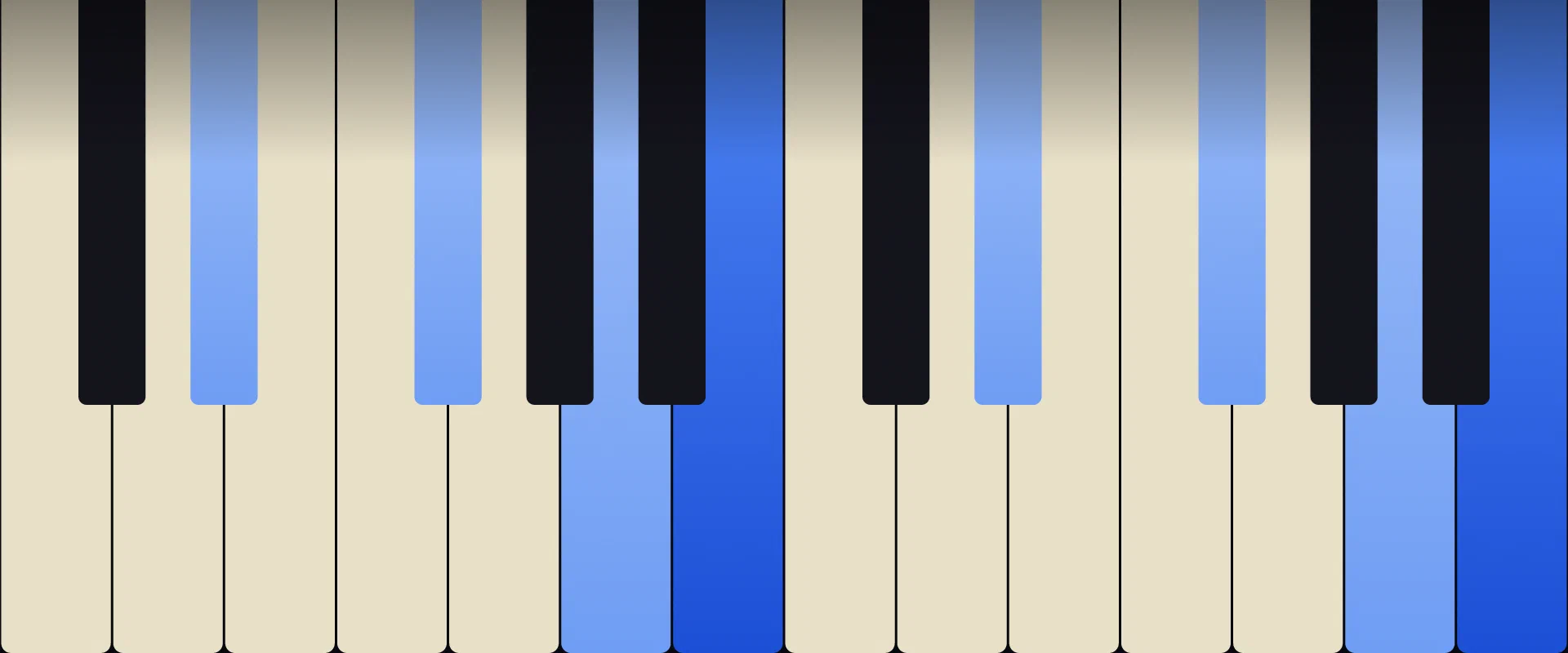
The hand goes out and comes back. B and A are white, D♯ and F♯ are black, so the shape starts at the front of the keyboard, climbs onto the raised keys in the middle and drops back to white for the seventh. Most sharp side chords push the hand forward and keep it there. This one returns, and that is what makes it feel unfamiliar even though the stretch is modest.
Right hand, put 1 on B, 2 on D♯, 3 on F♯ and 5 on A. The little finger gets a white key at the front, the kindest thing you can hand it, so the awkward reach falls to the second finger, pushing in behind the thumb to reach D♯. Left hand, 5 on B and 1 on A, with 3 and 2 covering the black keys between.
Strip it to two notes and you keep the chord. D♯ and A alone, one black key and one white a tritone apart, say B7 to any listener. Drop a B underneath in the left hand and you have a complete jazz shell voicing in three fingers. Nobody misses the F♯.
Third inversion is the one to watch. A B D♯ F♯ puts A directly under B, and below middle C that whole tone turns to sludge.
B7 on the Guitar
x21202 is worth reading string by string. Fifth string fret 2 gives the root B, fourth string fret 1 gives D♯, third string fret 2 gives A, the second string rings open on another B, and the first string at fret 2 gives F♯. Index on the fourth string, middle on the fifth, ring on the third, little finger on the first. The whole grip lives inside two frets.
Now try to keep that shape for B major. The third string cannot stop at fret 2, since A is not in the triad, so it climbs to fret 4 for another B and you get x21402, spread over four frets and taught by nobody. The seventh sits two frets closer to the hand than the note it replaces. That is the whole mechanical reason this is a beginner chord and the plain triad on the same root is not.
Watch what happens on the way to E. Play x21202, then open E at 022100. The fifth string stays at fret 2 and the second string stays open, so half the chord does not move. The fourth string goes up one fret, D♯ to E. The third comes down one fret, A to G♯. Two adjacent strings, one fret each, in opposite directions: that is the tritone resolving, and here you can watch it with two fingers.
Higher up, the A7 shape barred at fret 2 gives x24242 and the E7 shape at fret 7 gives 797877. Both matter for funk chops, where an open second string would ring on through a rest, but neither improves on the open shape musically. A three string version, x212xx, drops the fifth and comps well under a vocal.
Inversions
| Inversion | Notes | Bass Note |
|---|---|---|
| Root position | B D♯ F♯ A | B |
| 1st inversion | D♯ F♯ A B | D♯ |
| 2nd inversion | F♯ A B D♯ | F♯ |
| 3rd inversion | A B D♯ F♯ | A |
As slash chords these read B7/D♯, B7/F♯ and B7/A. The first earns its place in E major, where E, B7/D♯, C♯m walks the bass down by step instead of throwing it about. B7/A is the descending line chord: park the bass on A and the harmony above it can shift freely.
Voicings
The fifth is expendable and the third is not. Drop F♯ and you still have B, D♯ and A, which is the chord. Drop D♯ instead and B, F♯, A is a hollow shell with no tritone in it and no pull at all.
At the keyboard, separate the tritone across the hands. B and F♯ low in the left, D♯ and A in the right, puts the two restless notes in the clear register where the ear can follow each one to wherever it goes.
Which Keys Contain B7
- degree 5 (V) of E major
- degree 5 (V) of E harmonic minor
- degree 1 (I) of B mixolydian
- degree 7 (VII) of C♯ natural minor
- degree 2 (II) of A lydian
- degree 4 (IV) of F♯ dorian
The first and third entries are the same seven notes read from different ends. B mixolydian is E major started on B, so a static B7 groove and a V chord in E use identical material and are told apart only by the bass. The harmonic minor entry matters for minor key writing: E natural minor has a D natural and puts Bm7 on its fifth degree, which resolves nowhere. Sharpen that D and you get this chord.
Where B7 Shows Up
| Progression | Numerals | Chords |
|---|---|---|
| Twelve bar in E | I7, IV7, V7 | E7, A7, B7 |
| Cadence into E minor | i, iv, V7 | Em, Am, B7 |
| Secondary dominant in A | I, V7/V, V | A, B7, E |
| Mixolydian vamp | I7, ♭VII | B7, A |
The first row is the chord’s day job. A blues in E can be played entirely in open position, because E7, A7 and B7 all have open shapes, while the same song written with plain triads needs a barre for its V chord. Sevenths make a twelve bar in E easier to play than the major key version of itself, and very little else in guitar harmony works that way round.
The second row splits the chord in half. A natural is diatonic to E minor and D♯ is not, so B7 arrives at that cadence with one foot inside the key and one outside. The A keeps it sounding native while the D♯ leans on the E above and forces the resolution. Take the D♯ away and you have Bm7, which drifts back to Em without anything happening.
The third row is how players who never go near five sharps still use this chord constantly. In A major it is the dominant of the dominant, so A to B7 to E makes the arrival at E feel like a landing rather than a passing chord. The fourth row asks it to resolve nowhere at all: a B7 groove rocking against A major is a mixolydian vamp, and the tritone simply grinds.
Jazz players have a shortcut here. F7 is F, A, C and E♭, and E♭ is the same sound as D♯, so F7 and B7 share both notes of the tritone. F7 will therefore substitute for B7 into E, with a bass sliding down a semitone instead of leaping a fourth. Two chords with nothing in common on paper, one engine.
Related Chords
- B Major Chord
- B Major 6th Chord
- B Mixolydian Scale
- Secondary Dominants and Borrowed Chords
- Guitar Chord Shapes: The CAGED System
Learn More
Practice Chords
Drill chord recognition with a metronome, MIDI support, and score tracking.
Start PracticingRelated Articles
A Dominant 7th Chord: Notes, Voicings, and How to Play It
Aug 28, 2026 · 8 min
A♭ Dominant 7th Chord: Notes, Voicings, and How to Play It
Aug 28, 2026 · 8 min
B♭ Dominant 7th Chord: Notes, Voicings, and How to Play It
Aug 28, 2026 · 8 min