Play the tonic chord of a blues in B♭ and you have already left B♭ major. The key signature carries two flats, B♭ and E♭. The chord carries three, because the A♭ on top is not in the key it claims to be the home of, and it arrives on the first beat of bar one rather than as a late decoration. That is the whole difference between a blues in this key and a hymn in it.
It is also the dominant 7th a wind player meets more than any other. Trumpets, clarinets and tenor saxophones are pitched in B♭, so the jam key, the head key and the warm-up key all converge on this root.
Try It: B♭7 in the Chord Finder
Set the root to B♭ and add the 7th, then listen to D and A♭ on their own.
The Notes of B♭7
B♭7 has four notes: B♭, D, F and A♭.
| Degree | Note | Interval from B♭ | Semitones |
|---|---|---|---|
| 1 (root) | B♭ | Perfect unison | 0 |
| 3 | D | Major 3rd | 4 |
| 5 | F | Perfect 5th | 7 |
| ♭7 | A♭ | Minor 7th | 10 |
Two black keys and two white ones. The seven notes surrounding the chord, B♭ C D E♭ F G A♭, are the notes of E♭ major rearranged, which is B♭ mixolydian.
How B♭7 Is Built
Take the B♭ major triad, B♭ D F, and put A♭ a minor 7th above the root. Nothing in the triad changes, so the major 3rd stays, but the A♭ introduces something the triad never had. D up to A♭ is a tritone, three whole tones, the one interval in tonal music that will not sit still.
That pair does the work. D wants to rise to E♭ and A♭ wants to fall to G, both of which belong to E♭ major, which is why B♭7 pulls towards E♭ so hard. Play D and A♭ alone over a bass B♭ and a listener hears the whole chord.
The pair has a second owner. Respell A♭ as G♯ and it belongs to E7, which is E G♯ B D, so either chord can replace the other: B♭7 falls a fifth to E♭, E7 slides a semitone to the same place. See Secondary Dominants and Borrowed Chords.
B♭7 on the Piano
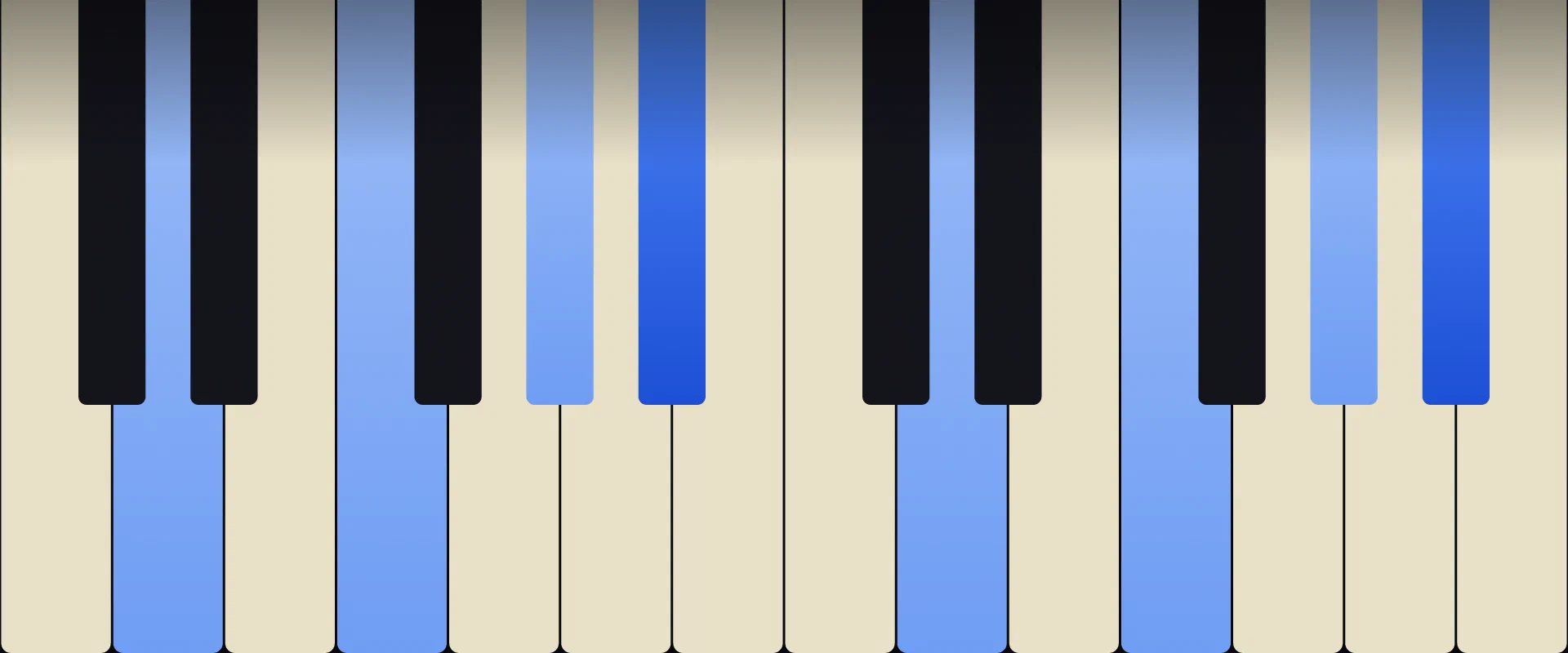
Of the twelve dominant 7th chords, this is the only one whose black keys are both on the outside. B♭ at the bottom, A♭ at the top, D and F between them on white. Nothing else in the set reads black, white, white, black, and once you have seen it you can find B♭7 on a dark stage without looking down.
The shape decides the hand. Right hand 1 on B♭, 2 on D, 3 on F, 5 on A♭. Thumb and little finger reach back among the raised keys while the middle two stay forward, so the hand arches instead of lying flat, and the black keys stop the outer fingers sliding the way they do in an all white dominant 7th such as G7.
Left hand takes 5 on B♭, 3 on D, 2 on F, 1 on A♭, and the outer pair is what matters. B♭ and A♭ are neighbouring black keys a whole tone apart, so a left hand holding just those two is the simplest honest version of the chord. Add D, drop F, and you have the shell.
B♭7 on the Guitar
There is no open form, but the first fret treats this chord far better than it treats most things in B♭. The A7 shape moved up one fret is x 1 3 1 3 1: index barred across five strings at fret 1, ring finger on the D string at fret 3, little finger on the B string at fret 3, and that is all. Two fingers work above the barre, and the G string is left on the barre itself, where it sounds A♭.
B♭ major in the same position asks the ring finger to flatten across three strings and B♭m asks for three separate fingers on top of the barre, so at the stiffest end of the neck the dominant 7th is the cheap one, which is rare luck in this key.
Higher up, the E7 shape at fret 6 is 6 8 6 7 6 6: barre at fret 6, ring finger on the A string at fret 8, middle finger on the G string at fret 7. Three fingers, a barre that behaves, root on the sixth string.
For a shuffle, work the fifth and fourth strings. B♭ sits on the A string at fret 1, and on the D string fret 3 is F, fret 5 is G, fret 6 is A♭. Rocking between frets 3 and 5 is the boogie figure, and one more fret puts the 7th into it. The CAGED system locates the other positions.
Inversions
| Inversion | Notes | Bass note | Symbol |
|---|---|---|---|
| Root position | B♭ D F A♭ | B♭ | B♭7 |
| 1st inversion | D F A♭ B♭ | D | B♭7/D |
| 2nd inversion | F A♭ B♭ D | F | B♭7/F |
| 3rd inversion | A♭ B♭ D F | A♭ | B♭7/A♭ |
Third inversion earns its keep here more than any other. Put A♭ in the bass and it falls a semitone to G, the 3rd of E♭, so B♭7/A♭ moving to E♭/G steps the bass down by one fret while the harmony resolves properly. Classical writing and gospel piano both run on it.
First inversion does the opposite: D rises to E♭, so B♭7/D walks upward instead of dropping a fifth. Second inversion is the weak one, F underneath making the chord sound like something passing through. See Chord Inversions and Voice Leading.
Voicings
B♭ D A♭ is the shell: root, 3rd and 7th, the 5th thrown away because it says nothing the other three do not.
D F A♭ over a bass B♭ is the rootless version, a diminished triad, neat under one hand.
B♭ D A♭ E adds the ♯11, an E natural borrowed from F melodic minor. Adding C instead gives B♭9. See Extended Chords and Jazz Harmony.
Which Keys Contain B♭7
- I of B♭ mixolydian
- V of E♭ major
- VII of C natural minor
- V of E♭ harmonic minor
- IV of F dorian
- IV of F melodic minor
The first two are the chord’s day job, tonic in a blues and dominant in E♭, and the fact that E♭ major and E♭ harmonic minor both produce it is the point of a dominant: it does not care whether the key it lands in is major or minor. The F melodic minor entry is the improviser’s. Run that scale from B♭ and you get B♭ C D E F G A♭, this chord with an E natural inside it.
Where B♭7 Shows Up
Start with the twelve bar frame, since that is where most players first hold this chord for a full bar:
| Bars | Chords |
|---|---|
| 1 to 4 | B♭7 / E♭7 / B♭7 / Fm7 B♭7 |
| 5 to 8 | E♭7 / E♭7 / B♭7 / G7 |
| 9 to 12 | Cm7 / F7 / B♭7 G7 / Cm7 F7 |
Read bar 1 and bar 4 together and the oddity of blues harmony is right there. In bar 1, B♭7 is the tonic, the chord everything returns to. In bar 4 the same four notes are a dominant in the ordinary sense, the V of the E♭7 landing in bar 5, with Fm7 in front making a two chord approach to it. One chord, two jobs, inside twelve bars, which is why a blues cannot be analysed as a major key with borrowings.
The second home has nothing to do with the blues. In C major, B♭7 is borrowed from C minor, and it approaches the tonic from below:
Fm7 | B♭7 | Cmaj7
That is the backdoor cadence, and it is why the C natural minor entry above matters. Set it against the ordinary G7 to Cmaj7 and the difference is audible. G7 pushes its B upward into C. B♭7 lets A♭ fall to G and B♭ rise to B, so it arrives sideways, which is much of why soul and gospel writing leans on it.
Then there is the reading question. Concert B♭7 is written C7 for trumpet, clarinet and tenor sax, and G7 for alto and baritone sax, and what matters is the scale each then improvises with. The alto’s G mixolydian has no accidental at all, the tenor’s C mixolydian carries a single B♭. The rhythm section takes the flats so the horns take almost none, and that trade, rather than tradition, is why bands call tunes here. The arithmetic is in How to Transpose a Song to Any Key.
Related Chords
- B♭ Major Chord, the triad this is built on, before A♭ arrives.
- B♭ Major 6th Chord, the same triad with G on top instead of A♭, one semitone and a completely different job.
- B♭ Sus4 Chord, which becomes B♭7sus4 once A♭ is added and is the usual way of delaying this chord.
- Seventh Chords: The Complete Guide, on how a dominant 7th differs from the other seventh chord types.
Learn More
Practice Chords
Drill chord recognition with a metronome, MIDI support, and score tracking.
Start PracticingRelated Articles
A Dominant 7th Chord: Notes, Voicings, and How to Play It
Aug 28, 2026 · 8 min
A♭ Dominant 7th Chord: Notes, Voicings, and How to Play It
Aug 28, 2026 · 8 min
B Dominant 7th Chord: Notes, Voicings, and How to Play It
Aug 28, 2026 · 8 min