Two dominant sevenths a tritone apart are made out of the same tritone. A♭7 takes C for its 3rd and G♭ for its 7th. D7 takes F♯ for its 3rd and C for its 7th, and F♯ and G♭ are one key on the instrument. The two chords hand each other the same pair of notes with the jobs reversed, and agree about nothing else.
That is the whole mechanism of tritone substitution, and it drops this chord into an argument between two instruments. A♭ belongs to horn players and keyboard players; D7 is the first seventh chord most guitarists ever fingered. A player who would never choose four flats still meets A♭7 the first time somebody writes a chromatic approach into G.
Try It: A♭7 in the Chord Finder
The Notes of A♭7
| Degree | Note | Interval from root |
|---|---|---|
| 1 | A♭ | Perfect unison |
| 3 | C | Major 3rd, 4 semitones |
| 5 | E♭ | Perfect 5th, 7 semitones |
| ♭7 | G♭ | Minor 7th, 10 semitones |
Written low to high in root position: A♭ C E♭ G♭.
How A♭7 Is Built
A♭ major is A♭ C E♭. Put G♭ above it and the triad gains the one note that refuses to sit still. G♭ is the black key immediately left of A♭, so root and seventh are neighbours under the hand even though they sound a minor 7th apart.
C up to G♭ is six semitones. Move the whole chord up by that same six semitones and A♭ becomes D, C becomes F♯, E♭ becomes A and G♭ becomes C: the chord is now D7. Look at what happened to the pair. The C that was the 3rd is now the 7th, and the G♭ that was the 7th has come back as F♯, the 3rd. The tritone survived the transposition intact and simply turned over.
Spelling decides where the chord then goes. Write the same four keys as A♭ C E♭ F♯ and you have the German augmented sixth of C minor: F♯ is a raised note, so it climbs to G while A♭ drops to G, and the chord opens outwards on to the dominant. Written with G♭ the seventh falls instead and the chord lands on D♭. One handful of keys, two names, two exits.
A♭7 on the Piano
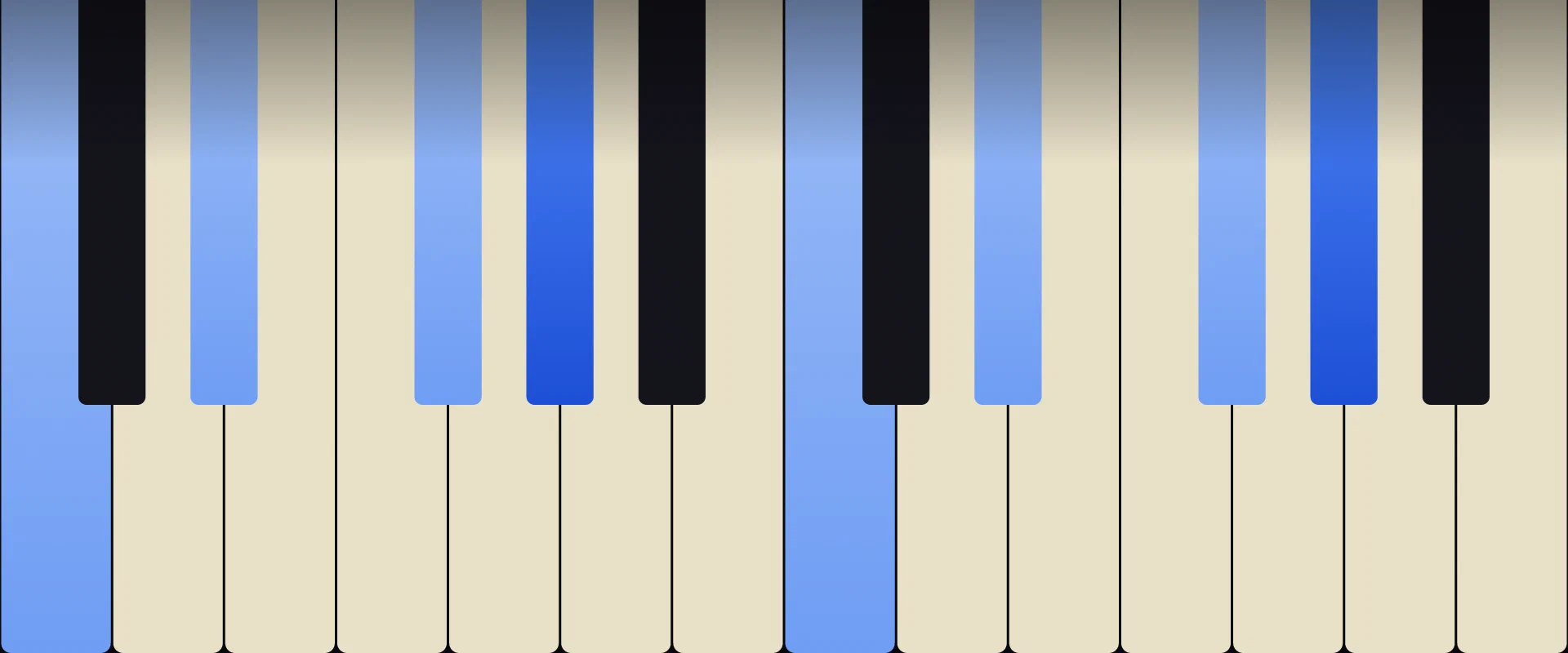
Three black keys and one white, and the lone white note is C, the 3rd, which carries the chord’s quality. Right hand root position is 1 on A♭, 2 on C, 3 on E♭ and 5 on G♭, with the index the only finger coming forward off the black keys.
The grip worth building everything on is much smaller. Take C with the thumb and G♭ with the little finger and you are holding the tritone by itself, white key to black key. Put A♭ underneath in the other hand and the chord is A♭7. Put D underneath instead and those same two notes are the 3rd and 7th of D7. Nothing in the pair moves; the bass note alone decides which chord has been played, which is how a comping left hand covers two chords a tritone apart without learning a second shape.
The upper three notes, C E♭ G♭, form a diminished triad on C, which over a bass player’s A♭ states the chord completely.
A♭7 on the Guitar
No open form exists and not one of the four notes is an open string, so both routes go through a barre. The E shape at the 4th fret is 4 6 4 5 4 4, the kindest dominant barre below the 5th fret, since only two fingers ever leave the index. Those two are the interesting ones: G♭ on the D string at the 4th fret and C on the G string at the 5th, the tritone sitting side by side in the middle of the grip. The A shape at the 11th fret holds the same four notes as x 11 13 11 13 11, where the frets are too close to let them speak.
The open D7 everybody learns first, x x 0 2 1 2, hides the identical pair on its top two strings: C at the 1st fret of the B string, F♯ at the 2nd of the top E.
Here is the reason to bother with the barre. In movable shapes a cadence in G runs Am7 at the 5th fret, 5 7 5 5 5 5, then A♭7 at the 4th, 4 6 4 5 4 4, then Gmaj7 at the 3rd, 3 5 4 4 3 3. The hand walks down one fret at a time and never leaves the region. Play the unsubstituted version and D7 sends you to the 10th fret and straight back. For a guitarist this is a fingering decision as much as a harmonic one, which is the honest reason the instrument took to it.
Capo at the 1st fret and the open G7 shape, 3 2 0 0 0 1, sounds A♭7 with three strings ringing off the capo. That helps in D♭ and A♭ and not at all in the key of G, where the capo has already swallowed the open G the music is heading for.
Inversions
| Inversion | Notes low to high | Bass note |
|---|---|---|
| Root position | A♭ C E♭ G♭ | A♭ |
| 1st inversion | C E♭ G♭ A♭ | C |
| 2nd inversion | E♭ G♭ A♭ C | E♭ |
| 3rd inversion | G♭ A♭ C E♭ | G♭ |
Third inversion is the workhorse of the plain resolution. With G♭ lowest, the seventh falls a semitone to F and D♭ arrives with its third in the bass, the pair every harmony textbook writes as V4/2 to I6.
Root position is not optional when the chord is standing in for another one. The entire gain is a bass line stepping A, A♭, G by semitone, and C or E♭ underneath throws that away.
Voicings
Leave out the fifth. A♭ C G♭ says everything the four note chord says, and on a bandstand E♭ is somebody else’s problem.
Add B♭ for A♭9, A♭ C E♭ G♭ B♭, the default sound of this chord in soul rather than an embellishment of it. Two altered relatives are worth knowing by shape: A♭7♯5, A♭ C E G♭, which sharpens the pull towards D♭, and A♭7sus4, A♭ D♭ E♭ G♭, which removes the tritone entirely and lets the chord vamp without needing to resolve.
Which Keys Contain A♭7
- V of D♭ major
- I of A♭ mixolydian
- VII of B♭ natural minor
- IV of E♭ melodic minor
- IV of E♭ dorian
- V of C♯ harmonic minor
The E♭ melodic minor entry is the one improvisers care about. Its fourth degree gives A♭ B♭ C D E♭ F G♭, a dominant scale with a raised fourth, and that raised fourth is D. When A♭7 substitutes for D7, the scale played over it contains the root of the chord just thrown away.
The C♯ harmonic minor page spells these sounds G♯ B♯ D♯ F♯, with the B♯ played on C. A rock band in C♯ minor writes G♯7 and never thinks the letter A.
Where A♭7 Shows Up
| Progression | In letters | Where it lives |
|---|---|---|
| ii7, ♭II7, Imaj7 | Am7, A♭7, Gmaj7 | The tritone substitution, jazz in G |
| V7, I | A♭7, D♭ | Standards and gospel in D♭ |
| iv7, ♭VII7, Imaj7 | E♭m7, A♭7, B♭maj7 | The backdoor cadence into B♭ |
Row one repays being played slowly. Going into Gmaj7, A♭ falls a semitone to G, C falls to B and E♭ falls to D, while G♭ does not move at all: it is already F♯, the major third the target chord wants. Three voices step down together, the fourth stays put and changes its name, and the bass walks A, A♭, G. Nobody adopted this for the theory; they adopted it because it sounds inevitable.
Row two is the day job, and the mirror of row one. Resolving to D♭, C rises a semitone to D♭ while G♭ falls to F, so the tritone squeezes inwards instead of leaning sideways. Put D7 here and the same thing happens with the roles exchanged: each chord is the other one’s substitute, and which is which depends only on where the music is going.
Row three ends up somewhere neither of the others would predict. Approach B♭ from a whole tone below instead of from its own dominant and the ear still accepts it, because G♭ falls to F and C rises to D, filling the tonic chord in from both sides. Jazz players call it the backdoor, and it is borrowed from B♭ minor, the key that lists A♭7 as its seventh degree.
Related Chords
- A♭ Major Chord the triad this chord adds one note to
- A♭ Augmented Chord for the A♭7♯5 version and its pull into D♭
- A♭ Sus4 Chord for A♭7sus4, the same chord with no tritone
- The ii, V, I Progression the cadence the substitution is applied to
- A♭ Mixolydian Scale the mode this chord is the tonic of
Raise the seventh a semitone, G♭ to G, and the chord becomes A♭maj7, a place to stop rather than a place to leave.
Learn More
Practice Chords
Drill chord recognition with a metronome, MIDI support, and score tracking.
Start PracticingRelated Articles
A Dominant 7th Chord: Notes, Voicings, and How to Play It
Aug 28, 2026 · 8 min
B Dominant 7th Chord: Notes, Voicings, and How to Play It
Aug 28, 2026 · 8 min
B♭ Dominant 7th Chord: Notes, Voicings, and How to Play It
Aug 28, 2026 · 8 min