B minor does not contain this chord. The fifth degree of B natural minor gives F♯, A and C♯, a minor triad, so a minor key wanting a real dominant has to fetch one. Sharpening that A to A♯ is the fetch, the note arrives from B harmonic minor, and what it produces is F♯7. Every dominant seventh standing in a minor key is an import, and here you can point at the note that was imported.
The borrowing pays because of where B minor sits. It is the relative minor of D major, the key guitar music treats as home, so this chord turns up constantly in repertoire whose players have never willingly read a sharp.
Try It: F♯7 in the Chord Finder
The Notes of F♯7
F♯7 contains four notes.
F♯, A♯, C♯, E
| Degree | Note | Interval from root | Semitones |
|---|---|---|---|
| 1 | F♯ | Root | 0 |
| 3 | A♯ | Major 3rd | 4 |
| 5 | C♯ | Perfect 5th | 7 |
| ♭7 | E | Minor 7th | 10 |
Three sharps on black keys, then one plain E carrying no accidental at all. That E is all that separates this chord from the F♯ major triad, and it is also the note that turns A♯ into half of a tritone.
How F♯7 Is Built
Take F♯, A♯ and C♯ and set E ten semitones above the root. Inside that frame sits the interval doing all the work: A♯ up to E is six semitones, exactly half an octave.
The tritone has a second identity. A♯ is the same sound as B♭, so A♯ and E are also E and B♭ turned over, and that pair is the third and seventh of C7. Two chords whose roots lie a tritone apart share one tritone, which is where the substitution below comes from.
The near neighbour on this root is F♯6, which puts D♯ where this chord puts E. A whole tone lower, and the tritone goes, and the pull with it. Push the E the other way instead, to E♯, and the chord becomes F♯maj7, which belongs to F♯ major rather than to B and leans nowhere at all.
F♯7 on the Piano
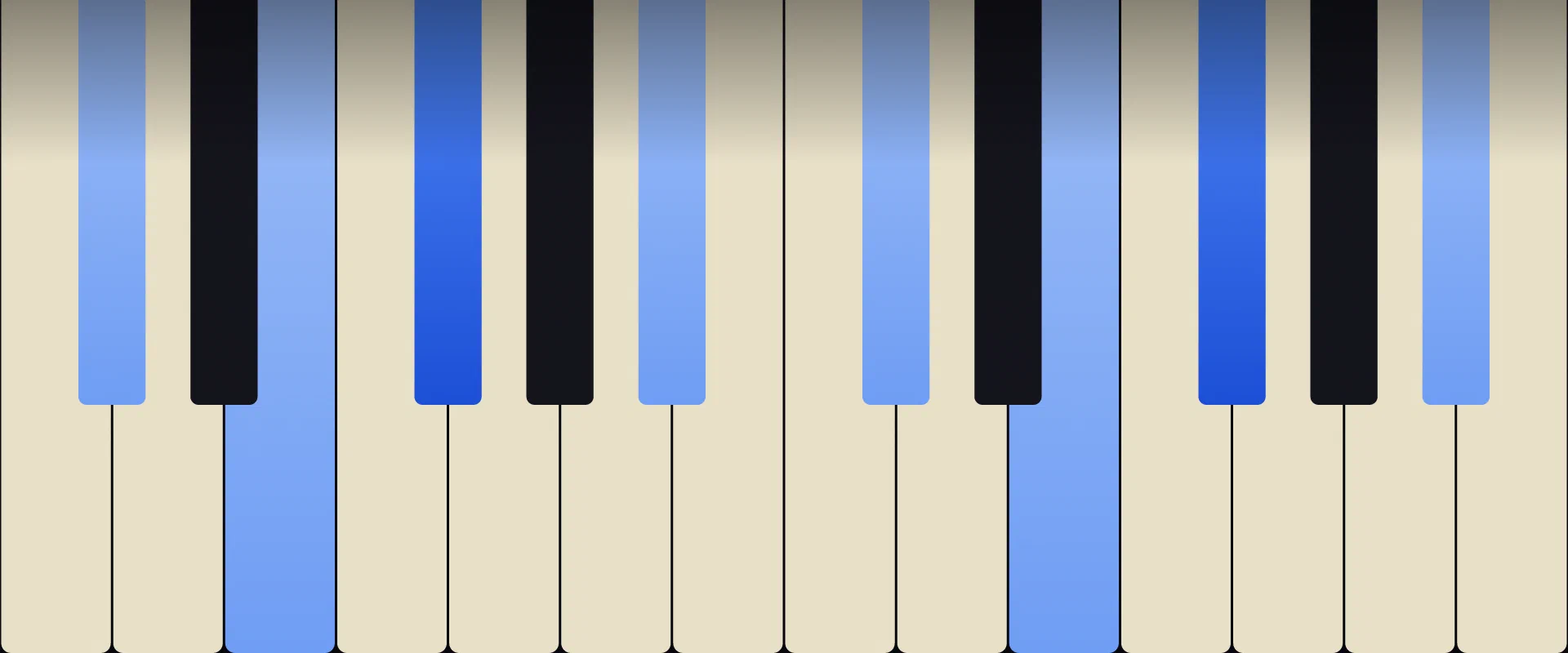
E is one of the few white keys with a black key on one side only. D♯ sits behind its left shoulder and nothing sits behind its right, since E and F are a semitone apart with no key between them. So the E can be taken at the back of the keyboard, level with the three sharps, and the whole chord lies in one plane. Right hand 1, 2, 3, 5; left hand 5, 3, 2, 1; the wrist never has to drop forward.
The exercise worth doing needs two fingers. Hold A♯ and E alone, the third and the seventh. Move A♯ up a semitone to B and let E fall. If it falls one semitone onto the black key D♯, you have landed in B major. If it carries on a whole tone to the white key D, you have landed in B minor. Same two fingers, and the entire difference between the two destinations is whether the upper note stops on a raised key or on the white one beside it.
F♯7 on the Guitar
Both E strings are chord tones. The F♯ major triad has nothing free on the instrument, since not one of the six open strings belongs to it, and the flat seventh changes that at once: E natural is the thickest and the thinnest string on the guitar.
Fret x x 4 3 2 0 and the whole chord is there. Ring finger on the 4th string at fret 4, middle on the 3rd at fret 3, index on the 2nd at fret 2, top string open. Three fingers on a descending diagonal, no barre, all four notes present and none doubled.
The full barre is the E7 shape at the 2nd fret, 2 4 2 3 2 2. Set it beside the F♯ major barre, 2 4 4 3 2 2: one note moves, the 4th string dropping from fret 4 to fret 2, and in dropping it vanishes into the index barre. The seventh chord needs one finger fewer behind the barre than the plain major does, which is not what a beginner expects from a chord with an extra note in it.
Higher up, the A7 shape barres at the 9th fret, x 9 11 9 11 9. That region holds the altered version too: put A above the A♯ and you have F♯7♯9, x 9 8 9 10 x, the grip Hendrix built “Foxy Lady” on. Tuning supplies the rest. Drop the guitar a semitone and the ordinary open G7 fingering, 3 2 0 0 0 1, sounds F♯7 with four strings ringing.
Inversions
| Inversion | Notes | Bass note |
|---|---|---|
| Root position | F♯ A♯ C♯ E | F♯ |
| 1st inversion | A♯ C♯ E F♯ | A♯ |
| 2nd inversion | C♯ E F♯ A♯ | C♯ |
| 3rd inversion | E F♯ A♯ C♯ | E |
Third inversion is the working one. With E lowest the seventh has to fall, and it falls to D♯, delivering B major in first inversion with the bass moving only a semitone. First inversion puts A♯ underneath, where it behaves as a leading note and climbs to B. If nothing resolves at all, those same four notes over an E bass read as root, 9th, ♯11 and 13, the E lydian colour. See Chord Inversions and Voice Leading.
Voicings
The fifth is the note to lose. F♯, A♯ and E holds the root, the third and the seventh, and gives up nothing. Put F♯ and E low as a bare minor 7th with A♯ and C♯ above them, or drop the root as well and play A♯ and E over a bass F♯, which is what a pianist in a trio actually does. On guitar the same shell is x x 4 3 5 x: thin on its own, exact against a bass line, and movable anywhere without a barre.
Which Keys Contain F♯7
| Degree | Key |
|---|---|
| I | F♯ mixolydian |
| V | B major |
| V | B harmonic minor |
| V | B melodic minor |
| VII | G♯ natural minor |
| IV | C♯ melodic minor |
Three of the six sit on B, and the absentee is the point of the page: B natural minor cannot appear, because its seventh degree is A natural. The C♯ melodic minor row is the jazz reading: as a IV chord the 11th comes out raised, so the scale that fits is F♯ lydian dominant rather than plain mixolydian.
Where F♯7 Shows Up
Bm, Em, F♯7, Bm. The i, iv, V7, i of B minor, and the reason this chord exists. Its A♯ is B minor’s raised seventh, borrowed for one bar and dropped the moment the tonic lands. On guitar the hand barely moves: Bm is x 2 4 4 3 2, F♯7 is 2 4 2 3 2 2, and the index holds fret 2 through both. Baroque writing, tango and metal all cadence this way. Modern pop in B minor mostly does not, preferring to walk down to A major and skip the borrowed note, so a dominant seventh in a minor key now reads as a period marker.
C♯7, F♯7, B7, E. Four dominant sevenths in a row, each a fifth above the next, landing in E major. F♯7 is the dominant of the dominant, and the detail worth noticing is that it contains E natural, the tonic of the key it is temporarily leaving. Ragtime, western swing and blues in E run this chain. See Secondary Dominants and Borrowed Chords.
F♯7 falling to F. Sharing its tritone with C7, it can stand in for C7 wherever C7 would resolve to F, and it makes the move by sliding down one semitone. Every voice travels the same short distance, which is what makes the substitution sound inevitable rather than clever. At the keyboard it is three black keys and a white one collapsing onto three white keys.
Horn players usually meet this chord as G♭7, since a flat signature is kinder to them. Guitarists meet it at the second fret and never look at the signature at all.
Related Chords
- F♯ Major Chord, the triad underneath
- F♯ Major 6th Chord, D♯ in place of E, and no tritone left
- B Minor Chord, the chord this one exists to resolve into
- Guitar Chord Shapes: The CAGED System, for the shapes behind both barres
Learn More
- Seventh Chords: The Complete Guide
- Minor Scales: Natural, Harmonic and Melodic, and why B minor raises its seventh to make this chord
- The F♯ Mixolydian Scale, the mode that treats it as home
Practice Chords
Drill chord recognition with a metronome, MIDI support, and score tracking.
Start PracticingRelated Articles
A Dominant 7th Chord: Notes, Voicings, and How to Play It
Aug 28, 2026 · 8 min
A♭ Dominant 7th Chord: Notes, Voicings, and How to Play It
Aug 28, 2026 · 8 min
B Dominant 7th Chord: Notes, Voicings, and How to Play It
Aug 28, 2026 · 8 min