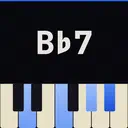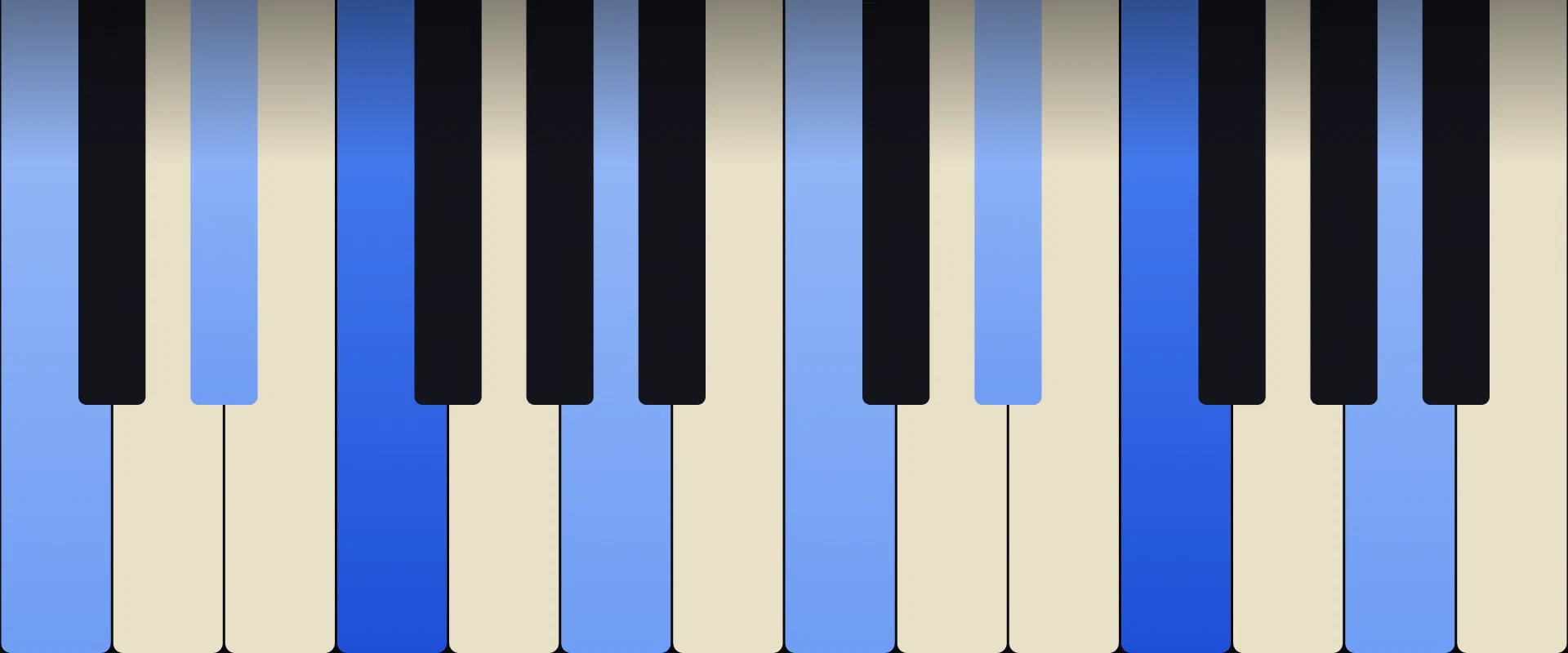
Bar five of a blues in C is where the tune drops. Four bars of C7, which contains E natural, give way to F7, which contains E♭, and that E♭ is the blue third of C, the note the singer has been bending towards from the top. Going to the four is one semitone falling, and F7 catches it.
That is one of two jobs. On a horn chart or in a hymnal, F7 is the dominant of B♭: it exists in order to fall onto B♭, it is never the last chord of anything, and it is gone inside a bar. The blues version parks for two bars and strolls home.
The chord itself is nearly the plainest thing on a keyboard. F, A and C are white keys, and E♭ is the only accidental in it.
Try It: F7 in the Chord Finder
Set F as the root and switch the seventh chords on. Play the F triad, then F7, and the single note between them is easy to isolate by ear.
The Notes of F7
| Degree | Note | Interval from Root | Semitones |
|---|---|---|---|
| 1 (Root) | F | Perfect unison | 0 |
| 3 | A | Major 3rd | 4 |
| 5 | C | Perfect 5th | 7 |
| ♭7 | E♭ | Minor 7th | 10 |
A up to E♭ is six semitones, a tritone, and the only unstable interval here. It is also the pair doing the work: A pulls up to B♭, E♭ pulls down to D, and B♭ major waits underneath both. Remove them, and what is left, F and C, is a power chord with no opinion at all.
How F7 Is Built
Start from the F major triad and add E♭, a whole tone below the octave F. Nothing is replaced, which is why F7 still sounds like an F chord.
The spelling repays a look. Written F, A, C, E♭ the letters run every second one from F, which is what makes the top interval a 7th. Respell the black key as D♯ and the letters read F, A, C, D, so the interval becomes an augmented 6th and the chord is a German sixth. Identical sound, different obligation: a minor 7th above F leans towards B♭, an augmented 6th spreads outwards onto E.
Raise E♭ to E and the chord is Fmaj7; lower A to A♭ and it is Fm7. Only F7 holds a tritone, and that interval is the whole difference.
F7 on the Piano
One black key out of four, and the little finger was already heading that way. Thumb on F, index on A, middle on C, then stretch the little finger past C to the black key nearest the octave F, leaving E untouched between them. The hand barely changes shape from the triad.
Below middle C, play F alone. All four notes stacked down there put a major 3rd and a tritone into the register where the ear separates least. Better still, drop the C. A and E♭ identify this chord on their own, so a left hand on F under a right hand playing only those two is complete enough for any rhythm section.
That pair has a second life. The tritone inverts to itself, so written as D♯ and A the same two keys are the 3rd and 7th of B7. One grip, two chords a tritone apart, which is the machinery behind tritone substitution.
Resolving is almost motionless. F stays put as the 5th of B♭, A rises a semitone to B♭, E♭ falls a semitone to D, and only C has a decision to make.
F7 on the Guitar
The full chord is the E7 shape barred at the 1st fret: index flat across all six strings, middle finger on the 3rd string at fret 2, ring finger on the 5th at fret 3, and the 4th string left to the barre. Low to high, 1 3 1 2 1 1.
That is one finger fewer than F major, and what matters is where the saving comes from. The 4th string at fret 1 now sounds E♭, the note that makes this a seventh chord, and it sounds under the barre rather than under a fingertip. A barre that does not quite reach it produces F, A and C: no buzz, no wrong chord, just a plain F major triad where a seventh was written. The mistake is inaudible as a mistake, which is how F7 gets played badly for years.
Two fingers suffice when the bass is covered. Barre the top four strings at fret 1, middle finger on the 3rd string at fret 2, and x x 1 2 1 1 sounds E♭, A, C and F: a complete F7 with its 7th at the bottom.
Up the neck the A7 shape at fret 8, x 8 10 8 10 8, puts the root on the 5th string with none of the fight of the nut. Blues sessions get called in F and B♭ wherever horns are involved, so both ends of this neck earn their keep.
Inversions
| Inversion | Notes | Bass Note | Symbol |
|---|---|---|---|
| Root position | F, A, C, E♭ | F | F7 |
| 1st inversion | A, C, E♭, F | A | F7/A |
| 2nd inversion | C, E♭, F, A | C | F7/C |
| 3rd inversion | E♭, F, A, C | E♭ | F7/E♭ |
The outer rows approach B♭ from opposite sides. F7/A puts the leading note in the bass, so the bass steps up, A to B♭. F7/E♭ puts the 7th there, and a 7th falls, so the bass steps down to D and lands on B♭/D. Neither has to leap.
The second inversion is awkward for a nameable reason: C with E♭ directly above it is the bottom of a C minor chord, and in a flat key the ear takes that reading first. The third row is what the two finger guitar shape produces. A 7th in the bass sounds unfinished, and halfway through a blues chorus unfinished is correct.
Voicings
The rule here is vertical. Keep F and C low and A and E♭ high, because the tritone between them needs room. E♭ voiced immediately above a low F gives a minor 7th in the bass register, which reads as thick rather than dark. On the guitar, the third shape below omits nothing: every chord tone sits on four strings.
| Shape | Frets, low to high | Sounding notes |
|---|---|---|
| E7 shape barre, fret 1 | 1 3 1 2 1 1 | F, C, E♭, A, C, F |
| A7 shape barre, fret 8 | x 8 10 8 10 8 | F, C, E♭, A, F |
| Four strings, two fingers | x x 1 2 1 1 | E♭, A, C, F |
| Shell, no 5th | 1 x 1 2 x x | F, E♭, A |
Which Keys Contain F7
- V of B♭ major
- I of F mixolydian
- VII of G natural minor
- V of B♭ harmonic minor
- IV of C dorian
- IV of C melodic minor
The first two lines are the opening argument as scale degrees. In B♭ major F7 is the dominant and cannot stay; in F mixolydian it is the tonic and cannot leave, and neither reading alters a note. Line three gives it a third career as the ♭VII of G minor, and line four means one F7 serves a tune whether it ends in B♭ major or B♭ minor.
Where F7 Shows Up
| Progression | Chords | Where it lives |
|---|---|---|
| I7, IV7, I7, V7 | C7, F7, C7, G7 | Twelve bar blues in C |
| ii7, V7, I | Cm7, F7, B♭ | Cadence into B♭ |
| I7, ♭VII, I7 | F7, E♭, F7 | Mixolydian vamps in F |
The blues row is where most people meet the chord, and the weight of the arrival is the point made at the top. A soloist leaning on E♭ against C7, where it is a blue note fighting that chord’s E natural, suddenly finds the same pitch consonant. The melody has not moved. The ground has.
The second row is F7 behaving conventionally. Cm7, F7, B♭ is the commonest four bars in concert band and big band writing, and the chord passes through without ever being allowed to settle.
The third row refuses to resolve at all. Rocking between F7 and E♭, both drawn from F mixolydian, makes the chord a texture rather than a function: the sound of a funk vamp, and of an F blues where F7 is home.
One route belongs to this root in particular. F7 sits a semitone above E, so it drops onto an E chord as a ♭II7 approach, and respelled F, A, C, D♯ it is the German sixth of A minor, F falling to E and D♯ rising to E. Two theories, the same four keys, and a destination that is not B♭.
Related Chords
- F Major Chord is the triad underneath, and the harder of the two to fret at the 1st fret.
- F Major 6th Chord adds D where this chord adds E♭, and asks for nothing in return.
- B♭ Major Chord is where F7 spends its life trying to go.
- Secondary Dominants and Borrowed Chords explains the F7 that turns up in C major without belonging to it.
Learn More
F is one step anticlockwise from C on the circle of fifths and B♭ is the next, which is the shortest account of where this chord points. Seventh Chords: A Complete Guide sets it beside the other seventh chord types, and Extended Chords covers F9 and F13. For Cm7 to F7 to B♭ in detail see the ii V I progression, and for every scale containing this chord, see Scales for Piano and Guitar: The Complete Reference Guide.
Practice Chords
Drill chord recognition with a metronome, MIDI support, and score tracking.
Start PracticingRelated Articles
A Dominant 7th Chord: Notes, Voicings, and How to Play It
Aug 28, 2026 · 8 min
A♭ Dominant 7th Chord: Notes, Voicings, and How to Play It
Aug 28, 2026 · 8 min
B Dominant 7th Chord: Notes, Voicings, and How to Play It
Aug 28, 2026 · 8 min