Take the open E shape, lift the ring finger off the fourth string, and the note that was E becomes an open D underneath everything. That is the entire cost of E7: one finger removed from the chord with the guitar’s lowest root and its longest sustain. No dominant seventh on the instrument is cheaper to play or bigger to hear, and since a twelve bar blues runs on dominant sevenths from end to end, a key that hands you one for nothing has a real practical advantage. That, rather than any argument about tone, is why the blues in E became the jam session default.
Try It: E7 in the Chord Finder
Pick E as the root and Mixolydian as the scale to see this chord on the first degree, then switch to A major and watch the same four notes land on the fifth.
The Notes of E7
E7 is the E major triad with a minor 7th stacked above it:
E, G♯, B and D
| Degree | Note | Interval from Root |
|---|---|---|
| 1 (Root) | E | Perfect unison |
| 3 | G♯ | Major 3rd |
| 5 | B | Perfect 5th |
| ♭7 | D | Minor 7th |
Three white keys and one black one. G♯ is the only accidental and it sits where you expect it, in the middle of the group of three. The seventh is D natural, not D♯, and that single letter is what separates this chord from E major 7th.
How E7 Is Built
Four semitones up to G♯, three more to B, three more to D. On paper the chord is E major with a note added; on a fretboard it is E major with a finger taken away, and the two descriptions rarely meet in the same head.
The interval worth measuring is not from the root at all. G♯ up to D is six semitones, a tritone, and it is the only dissonance in the chord. Left alone it resolves outwards and inwards at once: G♯ rises a semitone to A, D falls a semitone to C♯, and both land inside A major. That is why E7 is the dominant of A, and why the chord heard cold sounds like something in transit.
Lower the G♯ to G and you get Em7. Raise the D to D♯ and you get E major 7th, which contains no tritone at all and consequently goes nowhere.
E7 on the Piano
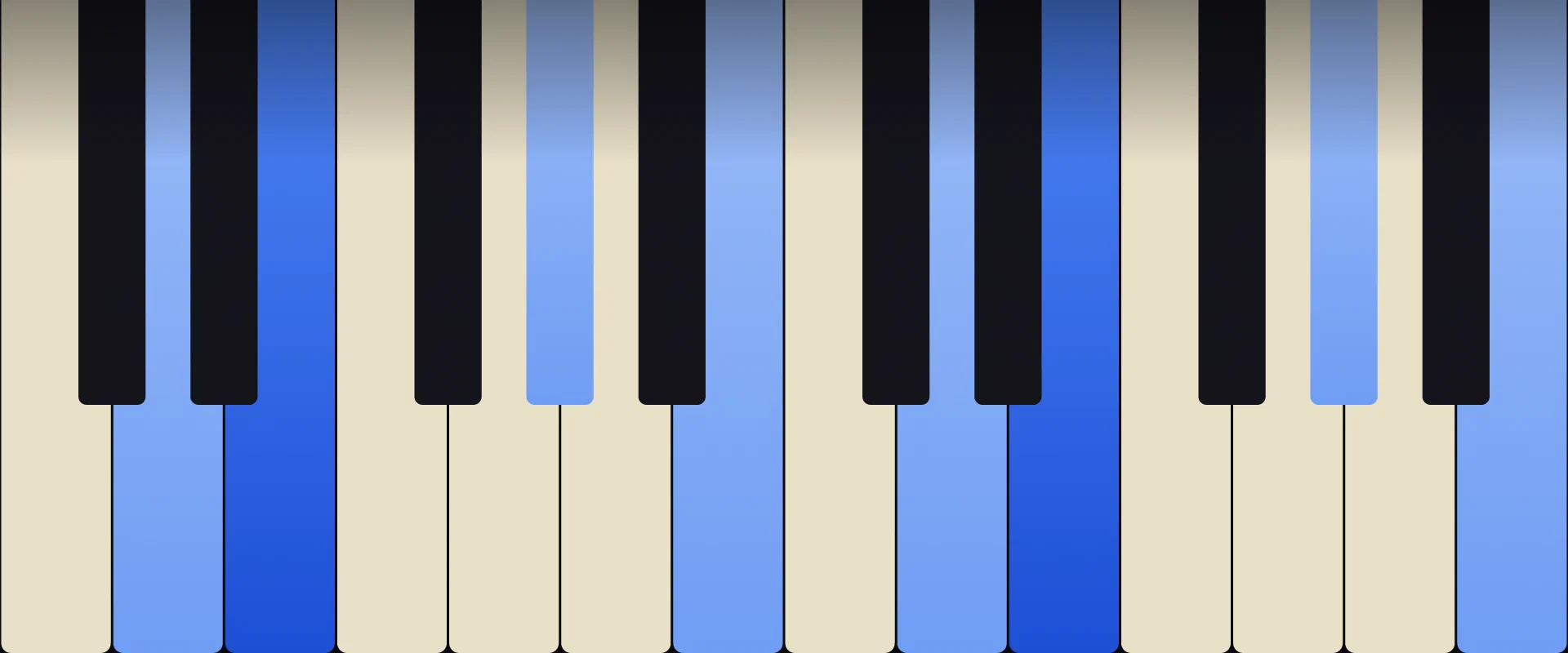
The shape is nearly flat: E, B and D are white, and only the second finger travels back to a black key.
Right hand: thumb on E, second finger on G♯, third finger on B, fifth finger on D.
Left hand: fifth finger on E, fourth finger on G♯, second finger on B, thumb on D.
Pianists rarely arrive at this chord from the key of E. They arrive from A, where E7 is the V, and the hand is usually already thinking in three sharps rather than four.
Two facts make it easy to voice. Take the root away and G♯, B and D form a diminished triad, so the right hand can play those three over a bass E and the chord is complete. Keep only E and D and you have the standard left hand shell, which leaves the right free for the melody and the third.
The arrangement to avoid is third inversion played low, D with E immediately above it. A whole step at the bottom of the texture turns to mud below middle C.
E7 on the Guitar
The open form, 0 2 0 1 0 0, sounds E, B, D, G♯, B, E from the bottom up. Look at where the tritone falls: D on the open fourth string with G♯ directly above it on the third, adjacent strings, nothing in between to soften them. That bare interval in the middle of the voicing is why the open E7 sounds restless where the open E major sounds settled, and it is audible even through heavy distortion.
A second full form, 0 2 2 1 3 0, keeps the fourth string E and moves the D up to the second string. Three E’s make the root heavier and put the seventh near the top instead of the bottom. It costs a little finger, and strummers tend to save it for the last chord of a phrase.
The cheap form has one catch. Its seventh is an open string, so every strum of 0 2 0 1 0 0 carries the D whether the bar wants it or not, and getting back to a plain E means putting a finger down rather than taking one off.
Away from the nut, the A7 shape barred at the 7th fret gives x 7 9 7 9 7, sounding E, B, D, G♯, B. It stops the moment you release it, which is the point: the open form rings on through the next chord, and at speed that smears. For comping, the shell x 7 6 7 x x gives E, G♯ and D and nothing else.
Two extensions sit one finger away. Fret the top string at the 2nd fret and 0 2 0 1 0 2 adds F♯, making E9, the standard funk upgrade. Move up to 0 7 6 7 8 x and you get E, G♯, D and G together, an E7♯9, which works this well because the low open E is still ringing underneath it.
Inversions
| Voicing | Notes | Bass note |
|---|---|---|
| Root position | E G♯ B D | E |
| 1st inversion | G♯ B D E | G♯ |
| 2nd inversion | B D E G♯ | B |
| 3rd inversion | D E G♯ B | D |
Third inversion earns its keep here. Put D in the bass and the chord’s own tritone is now its lowest note, leaning down a semitone to C♯. On guitar that costs nothing at all, since D is an open string: x x 0 1 0 0 sounds D, G♯, B, E and resolves to A with C♯ in the bass by moving one finger. For B underneath, x 2 0 1 0 0. G♯ in the bass needs the sixth string at the 4th fret with the fifth muted, and is rarely worth the trouble.
Voicings
- Open form, 0 2 0 1 0 0, two fretted notes and four open strings.
- Full open form, 0 2 2 1 3 0, heavier root, seventh near the top.
- Barre, x 7 9 7 9 7, the A7 shape at the 7th fret, compact and easy to silence.
- Shell, x 7 6 7 x x, root, third and seventh only.
- Piano split, E and D in the left hand with G♯ and B above middle C.
Whatever else you do, keep D and G♯ far enough apart to hear as an interval. A tritone squeezed into the bottom octave stops sounding like tension and starts sounding like a mistake.
Which Keys Contain E7
Four notes, one of them a tritone away from another, narrow the field sharply:
- degree 5 (V) of A major
- degree 5 (V) of A harmonic minor
- degree 5 (V) of A melodic minor
- degree 1 (I) of E mixolydian
- degree 4 (IV) of B melodic minor
- degree 7 (VII) of F♯ natural minor
Three of those six are A in one form or another, so an E7 met without context is probably pointing at A, and whether the destination turns out major or minor is decided by the other instruments, not by this chord.
E Mixolydian is the exception that matters, because it puts E7 on the first degree and makes the chord home rather than departure. B melodic minor is the improviser’s curiosity: it holds all four notes and adds A♯, giving a soloist the sharpened eleventh and the lydian dominant colour without a single chord tone being altered.
Where E7 Shows Up
The twelve bar blues in E. I7, IV7, V7: E7, A7 and B7. The first of those is the strange one. In the harmony most people are taught, a dominant seventh is unstable by definition and must resolve, yet here it is the tonic, the chord the first bar states and the last bar comes home to. The G♯ and D never resolve. They sit inside the home chord for twelve bars and then start again, and no classical account of function survives contact with that. The blues takes the sound of the seventh and declines the obligation that comes with it.
The chord does move once, at bar five, and it is worth watching. E7’s G♯ becomes the G natural inside A7, a single semitone downwards, and that one voice is what makes the change to the IV chord feel inevitable even at a shuffle. This key hands you A7 as an open shape too, x 0 2 0 2 0, so two of the form’s three chords need no barre.
As the V of A major. A, D, E7, A. The tritone does its job properly here: G♯ up to A, D down to C♯, and the progression closes. Guitarists who write in A are usually there because this chord is free, exactly as players who write in E are there because the tonic is.
As the I of a mixolydian riff. E7, D, A, looped rather than cadenced. The seventh belongs to the scale rather than to a resolution, and riff writing often drops the third as well, leaving the vocal to decide whether the piece is major or minor.
Outside those three settings the chord will not sit still. Ending on E7 works only where the style has already agreed, as the blues has, to leave a tritone hanging in the air.
Related Chords
- E Major Chord: Notes, Voicings, and How to Play It is the triad this is built on, minus the D.
- E Major 6th Chord: Notes, Voicings, and How to Play It puts C♯ where the D is, one fret lower on the second string and pulling nowhere.
- E Sus4 Chord: Notes, Voicings, and How to Play It is what the third becomes in E7sus4.
- E Augmented Chord: Notes, Voicings, and How to Play It is where E7♯5 hides.
- E major 7th raises the D by a semitone and removes the tritone altogether, which is a larger change than it looks.
Learn More
- Seventh Chords: A Complete Guide to maj7, min7, dom7, and More sets this chord beside the other three sevenths built on E.
- Extended Chords: Which Tensions Work, and How to Voice Them carries on upwards into E9 and E13.
- Chord Inversions and Voice Leading explains what putting the D in the bass buys you.
- The Circle of Fifths Explained shows why E sits one step clockwise from A.
- E Mixolydian Scale: Notes, Chords, and How to Play It is the scale in which this chord is home.
Practice Chords
Drill chord recognition with a metronome, MIDI support, and score tracking.
Start PracticingRelated Articles
A Dominant 7th Chord: Notes, Voicings, and How to Play It
Aug 28, 2026 · 8 min
A♭ Dominant 7th Chord: Notes, Voicings, and How to Play It
Aug 28, 2026 · 8 min
B Dominant 7th Chord: Notes, Voicings, and How to Play It
Aug 28, 2026 · 8 min