Two of the four notes do all the work. G and D♭ sit six semitones apart, and no other pair in this chord produces that interval. That single tritone is what makes E♭7 lean towards A♭, and almost every practical decision about the chord follows from it. Which note an arranger deletes first. Which two frets a guitarist actually needs. Why the bridge of an A♭ tune parks here for four bars and waits.
Try It: E♭7 in the Chord Finder
The Notes of E♭7
The chord contains four notes: E♭, G, B♭ and D♭.
| Degree | Note | Interval from root | Semitones |
|---|---|---|---|
| 1 | E♭ | Root | 0 |
| 3 | G | Major 3rd | 4 |
| 5 | B♭ | Perfect 5th | 7 |
| ♭7 | D♭ | Minor 7th | 10 |
Written E♭7. A plain 7 after the letter always means the dominant seventh, never the major seventh, which needs maj spelled out.
How E♭7 Is Built
Take E♭ major, E♭ G B♭, and put D♭ on top rather than D. That single alteration turns a chord that can end a piece into one that cannot, because it creates a tritone between the third and the seventh, G up to D♭, a diminished fifth. Two notes then want to move in opposite directions: G rises a semitone to A♭, D♭ falls a semitone to C, and between them they land on the root and third of A♭ major.
A7 is A, C♯, E and G, and C♯ is D♭ under another name, so A7 owns the same tritone. That makes the two chords interchangeable: E♭7 stands in for A7 heading to D, A7 for E♭7 heading to A♭, with the bass sliding a semitone instead of leaping a fourth.
E♭7 on the Piano
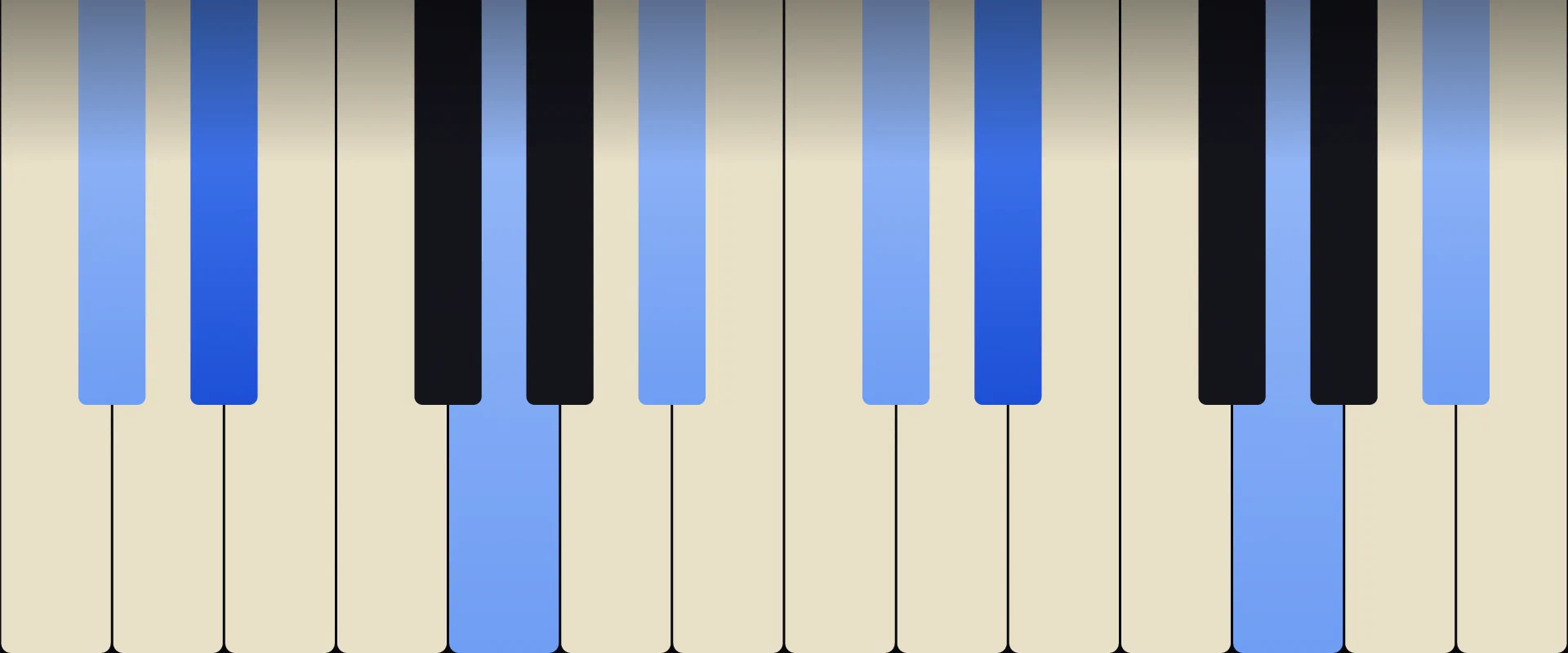
Find the top note by eye rather than by counting. Put your right thumb on E♭, look at the E♭ an octave above, and step one black key to the left: that is D♭. Root and seventh are the two black keys of a group of two, an octave apart, so the interval that defines the chord has a shape you recognise instantly.
Root position takes 1 on E♭, 2 on G, 3 on B♭ and 5 on D♭. G is the only white key, and it is the one hemmed in between F♯ and G♯, so press it at the back in the narrow slot and all four fingers sit at the same height.
Play just the index and little finger, G and D♭. Add E♭ underneath and the chord is unmistakably E♭7. Add B♭ and almost nothing changes, which is the first hint that B♭ is expendable.
In an ensemble the left hand takes a shell, E♭ with D♭ above it or E♭ with G above it, and that is enough. Better still are the rootless voicings pianists use through a ii V I in A♭, which barely move: B♭m7 as D♭ F A♭ C, then E♭7 as D♭ F G B♭, then A♭maj7 as C E♭ G B♭. D♭ and F hold across the first change while A♭ drops to G and C drops to B♭. The bass player has the roots, so nobody wastes a finger on them.
E♭7 on the Guitar
No open form exists. The two barres are the usual pair, the A7 shape at the 6th fret, x 6 8 6 8 6, and the E7 shape at the 11th, 11 13 11 12 11 11. What is interesting is how little of either you need.
Up at the 11th fret the tritone lies on adjacent strings one fret apart: D♭ on the 4th string at the 11th, G on the 3rd at the 12th. Add E♭ on the 6th string at the 11th and you get 11 x 11 12 x x, a three note voicing that comps for a whole chorus. Root, seventh, third, nothing wasted.
The shape most guitarists reach for by instinct is x 6 5 6 6 x, the movable 9th chord grip, which is the open C9 form moved up three frets. It sounds E♭, G, D♭ and F from the 5th string up: root, third, seventh, ninth, no fifth anywhere. That omission is not a compromise, it is the same decision a horn arranger makes, and it is why funk and soul players use this grip for the tonic chord and never miss the B♭. No full barre, no stretch, and it sits where the frets are still wide.
Inversions
| Inversion | Notes | Lowest note |
|---|---|---|
| Root position | E♭ G B♭ D♭ | E♭ |
| 1st inversion | G B♭ D♭ E♭ | G |
| 2nd inversion | B♭ D♭ E♭ G | B♭ |
| 3rd inversion | D♭ E♭ G B♭ | D♭ |
First inversion sounds the most urgent, because G, the note that has to rise, is now the lowest thing in the texture. Third inversion puts D♭ underneath, and D♭ falls to C, so the bass drops a semitone into A♭ in first inversion and the progression slides. Second inversion is the one to avoid: B♭ underneath supports nothing.
Voicings
Four horns and a four note chord ought to be one note each. It is not, because the notes are not equal. G and D♭ are compulsory: remove G and E♭ B♭ D♭ declares itself neither major nor minor, remove D♭ and there is no dominant left to resolve. B♭ goes first, because the root’s own overtones supply a fifth and nobody misses it.
That matters the moment a chart asks for E♭9, five notes for four players. Delete B♭ and write, bottom upwards, E♭ G D♭ F: trombone, tenor, alto, lead trumpet. A major third at the bottom, the tritone across the middle, a major third on top, nobody doubling anybody. Guitarists already know that voicing as x 6 5 6 6 x.
Spacing at the bottom has a floor. The accepted low limit for a major third is E♭ to G below middle C, which is exactly the bottom interval of this chord in root position. Write that pair an octave down for bass trombone and baritone saxophone and it stops reading as a third and starts reading as a rumble.
For the plain four note chord, four way close with D♭ in the lead reads D♭, B♭, G, E♭ downwards, which is root position with the seventh on top. Drop the second voice an octave and you get B♭ E♭ G D♭, which lifts the tritone into the top two parts where it bites hardest.
Which Keys Contain E♭7
- V of A♭ major
- VII of F natural minor
- I of E♭ mixolydian
- IV of B♭ melodic minor
- III of C phrygian
- V of G♯ harmonic minor
The last one comes with a warning. In a key signature built on G♯ these four sounds are written D♯, F𝄪, A♯ and C♯, in which the F takes a double sharp and sounds as G. The pitches are identical to E♭ G B♭ D♭ and only the spelling differs, because a sharp key cannot borrow flat letter names halfway through a bar.
Where E♭7 Shows Up
B♭m7, E♭7, A♭maj7. The ii V I in A♭ major, and the reason this chord exists in most of the music that uses it. A♭ is where a lot of big band and gospel writing settles, so the cadence recurs several times a chorus.
E♭7, A♭7, B♭7. The twelve bar blues in E♭, where E♭7 is the tonic rather than the dominant. Nothing resolves; the chord is home, tritone and all, which is what separates blues harmony from everything above. Horn players call blues in E♭ more often than any key except B♭ and F.
E♭maj7, E♭7, A♭maj7. One note moves. D becomes D♭, a settled tonic chord in E♭ major turns into the dominant of A♭, and the music is pulled to the fourth degree. Standards written in E♭ do this constantly, usually within the first four bars, and pianists learn it as one finger dropping a semitone.
B♭m7, E♭7, Fmaj7. The backdoor cadence, in which E♭7 is the flattened seventh of F major and resolves up a whole tone instead of down a fifth. Same chord, same tritone, completely different destination, and it arrives by a side entrance rather than the front door.
Then there is the structural use. In a thirty two bar AABA tune in A♭, the bridge leaves home and comes back, and coming back means landing on E♭7 and sitting there for the last four bars while the rhythm section builds. Nothing else in the key can do that job, because nothing else in the key holds G and D♭ at once.
Related Chords
- E♭ Major Chord
- E♭ Major 6th Chord
- E♭ Sus4 Chord
- Secondary Dominants and Borrowed Chords
- The ii V I Progression in Jazz
Learn More
Practice Chords
Drill chord recognition with a metronome, MIDI support, and score tracking.
Start PracticingRelated Articles
A Dominant 7th Chord: Notes, Voicings, and How to Play It
Aug 28, 2026 · 8 min
A♭ Dominant 7th Chord: Notes, Voicings, and How to Play It
Aug 28, 2026 · 8 min
B Dominant 7th Chord: Notes, Voicings, and How to Play It
Aug 28, 2026 · 8 min