G is the key a guitar is happiest in, and D7 is the chord that leans on it hardest. Take an open D, x x 0 2 3 2, and drop the second string from the 3rd fret to the 1st. One note moves. The other three stay exactly where they were, and a chord that was sitting still becomes a chord with an address.
The note that changed is the D on that second string turning into a C, and the C is the entire point. It stands six semitones from the F♯ on the top string, the one interval in the system that will not settle. Guitar music lives in G more than in any other key, so this particular resolution, four notes falling into an open G, is probably the most played dominant cadence on the instrument.
Try It: D7 in the Chord Finder
The Notes of D7
D7 is four notes: D, F♯, A and C.
| Degree | Note | Interval from Root | Semitones |
|---|---|---|---|
| 1 (Root) | D | Perfect unison | 0 |
| 3 | F♯ | Major 3rd | 4 |
| 5 | A | Perfect 5th | 7 |
| ♭7 | C | Minor 7th | 10 |
The C is natural, not sharp. D major has C♯ in its key signature, so these four notes are not native to D at all. They belong to G, where F♯ is the leading note and C the fourth degree.
How D7 Is Built
Take D major, D F♯ A, and put C a minor seventh above the root. The triad is unchanged, so the chord still reads as major, and the added note supplies the push.
The mechanism is the distance from F♯ to C. Six semitones, a diminished fifth in this spelling, and the only interval that divides the octave into equal halves. It decides what happens next: F♯ climbs a semitone to G, C falls a semitone to B, and the pair closes inwards onto the major third of a G chord. The A slides down to G, the D holds still and becomes the fifth of the arriving chord, and no voice has travelled more than a whole tone.
D7 on the Piano
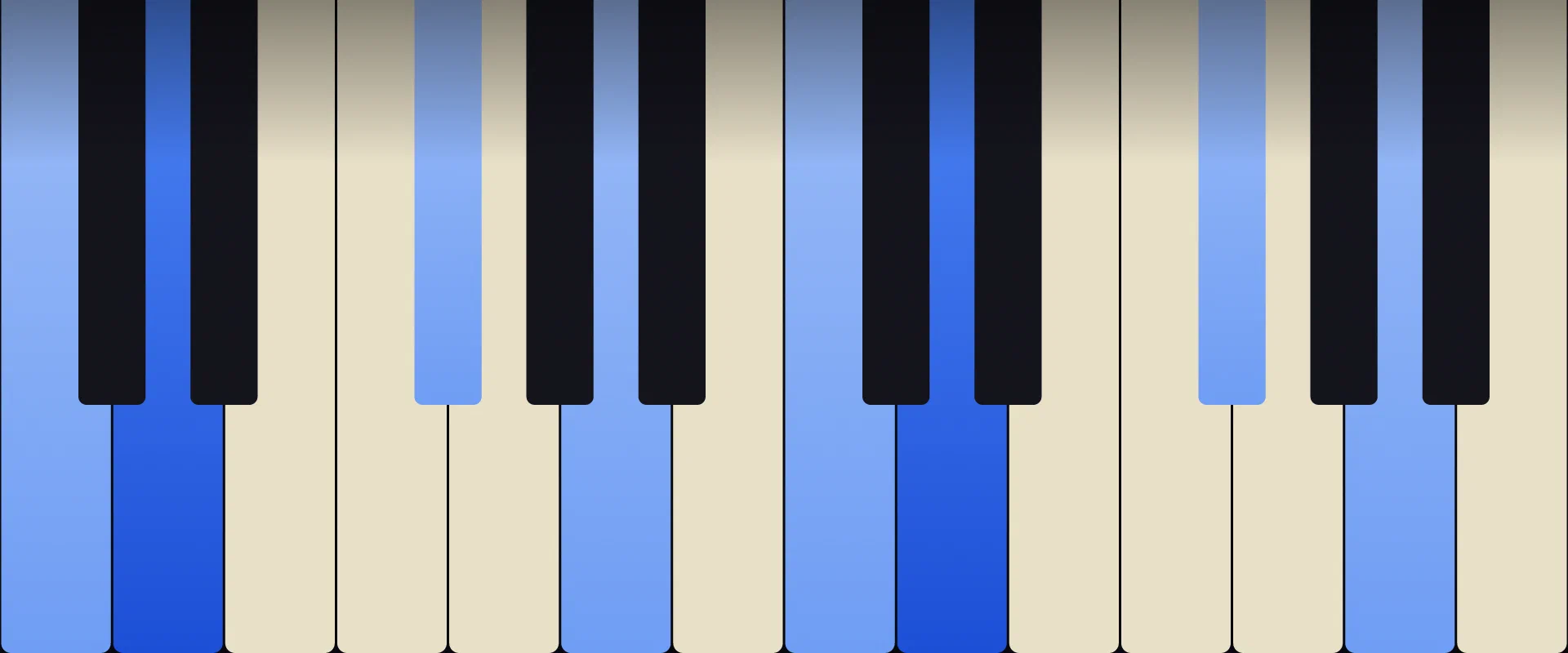
Three white keys and one black, and the black one gives no trouble. Right hand 1, 2, 3, 5 covers root position: thumb on D, index on F♯, middle on A, little finger on C. Ten semitones is a wide span for a small hand, and the note usually sacrificed is the A.
Drop the fifth and you have D, F♯ and C, which is all the chord needs. Root in the left hand, F♯ and C in the right, one black key and one white about a hand’s breadth apart. The fifth of a dominant seventh adds weight and nothing else, while the third and the seventh carry the whole argument.
That pair of keys leads a double life. Read the C as the lower note and the F♯ as G♭ above it and the same two fingers hold the third and seventh of A♭7, whose root sits a tritone from D. A jazz pianist can play A♭7 where D7 is written and still land on G, and only the bass note has to move.
Resolving is unusually clean under the hand. F♯ rises to G and C falls to B, so both moving fingers come forward onto white keys and the hand flattens as the chord arrives.
D7 on the Guitar
x x 0 2 1 2, low to high, is D, A, C, F♯. Open fourth string for the root, middle finger at the 2nd fret of the G string for A, index at the 1st fret of the B string for C, ring finger at the 2nd fret of the top string for F♯. Two strings sit out, as with every open D shape.
Notice where the tritone lands. C and F♯ sit on the second and first strings, one fret apart, at the thin bright end of the instrument. That is why an open D7 sounds edgy rather than fat, and cuts through a band without anyone playing harder.
Now play it into an open G, 3 2 0 0 0 3, and watch every voice at once. The second string is released to open: C falls a semitone to B. The first string moves up one fret: F♯ rises a semitone to G. The third string is released too, A dropping a whole tone to G. The open fourth string never moves. One finger lifts, one finger shifts a fret, and the two silent bass strings come in underneath, so the guitar gains an octave of bottom end at the moment the harmony settles.
This voicing puts the C below the F♯ rather than above it, so the tritone opens outwards into a sixth instead of closing inwards into a third. Same two semitone steps, opposite directions, identical result.
For a bass note, let the open fifth string ring, x 0 0 2 1 2, or hook the thumb over for F♯ at the 2nd fret of the sixth string, 2 x 0 2 1 2, which then walks down a semitone into the G. Up the neck the A7 shape barres at the 5th fret, x 5 7 5 7 5, where the frets are wide and the grip is easy. The E7 shape at the 10th fret, 10 12 10 11 10 10, is the only common form with a low D underneath, and the frets there are cramped.
Inversions
| Inversion | Bass Note | Notes | Symbol |
|---|---|---|---|
| Root position | D | D, F♯, A, C | D7 |
| 1st inversion | F♯ | F♯, A, C, D | D7/F♯ |
| 2nd inversion | A | A, C, D, F♯ | D7/A |
| 3rd inversion | C | C, D, F♯, A | D7/C |
The third inversion is the useful one. With C in the bass, the lowest voice is the note that has to fall, so D7/C resolves to G with B in the bass and the cadence arrives without the bass jumping a fourth. Figured bass calls it four two to six. Songwriters use it to keep a descending bass line moving.
Voicings
Guitar, open (x x 0 2 1 2). D, A, C, F♯. The tritone on the top two strings.
Guitar, thumbed bass (2 x 0 2 1 2). F♯ underneath for D7/F♯, a semitone from G.
Guitar, A7 shape at fret 5 (x 5 7 5 7 5). Five strings, movable, comfortable frets.
Piano, shell (left hand D, right hand F♯ and C). Root, third and seventh. Everything the chord needs.
Piano, spread (left hand D and A, right hand C and F♯). The tritone up top where it stays clear of the bass.
Which Keys Contain D7
Six keys where D7 arrives as a diatonic chord:
- V of G major
- V of G harmonic minor
- V of G melodic minor
- VII of E natural minor
- I of D mixolydian
- IV of A dorian
Three of those six are keys of G. The chord is the dominant of G major and of both G minors alike, and contains nothing that says which is coming. Hold a D7 and a listener cannot tell whether the resolution will be bright or dark until the G sounds.
Where D7 Shows Up
Second position harmonica. A blues harp played cross harp sounds a fifth above the key stamped on it, so a G harmonica plays in D. G and C are the two harps everybody owns, which makes D and G the keys blues harmonica players call by default, and the I chord of a shuffle in D is this one, held for four bars and never resolved.
VI7 in F: D7, G7, C7, F. Eight bars each, the whole first half of “Sweet Georgia Brown”. This chain of dominants running anticlockwise round the circle of fifths is the backbone of ragtime and trad jazz, and D7 is where it starts. Each chord is a dominant seventh resolving to another dominant seventh, so nothing lands until the F.
V7 of V in C major: C, D7, G7, C. In the piano’s home key this is the first chromatic chord most players meet, and it costs one accidental. D minor is what C major offers on that degree; sharpening its F turns a mild ii chord into something that shoves at G.
Sitting still in D mixolydian. Plenty of Irish and old-time tunes in D use C natural rather than C♯, and an accompanist holds this sonority for bars at a time with no intention of going anywhere. The shape invented to resolve gets used as a drone.
Between the guitarist’s key and the pianist’s, this chord is the hinge: dominant of G, and dominant of the dominant of C.
Related Chords
- D Major Chord, the triad this is built on.
- G Major Chord, where it wants to go.
- D Major 6th Chord, the same triad with B on top instead of C.
- The D Mixolydian Scale, where D7 is the tonic rather than the dominant.
- The G Major Scale, the key this chord belongs to.
Learn More
Practice Chords
Drill chord recognition with a metronome, MIDI support, and score tracking.
Start PracticingRelated Articles
A Dominant 7th Chord: Notes, Voicings, and How to Play It
Aug 28, 2026 · 8 min
A♭ Dominant 7th Chord: Notes, Voicings, and How to Play It
Aug 28, 2026 · 8 min
B Dominant 7th Chord: Notes, Voicings, and How to Play It
Aug 28, 2026 · 8 min