A major and E major both contain a diatonic seventh chord built on C♯, and in both keys it is C♯m7: C♯, E, G♯, B. Raise one note, E up to E♯, and it becomes C♯7. One accidental turns a mild inner chord into the strongest pull either key has. That is why a symbol this sharp keeps appearing in ordinary guitar music. C♯7 drags a progression back to F♯ minor, F♯ minor is the relative minor of A, and A is where a great deal of recorded guitar music lives.
Try It: C♯7 in the Chord Finder
The Notes of C♯7
| Degree | Note | Interval from root | Semitones |
|---|---|---|---|
| 1 | C♯ | Root | 0 |
| 3 | E♯ | Major 3rd | 4 |
| 5 | G♯ | Perfect 5th | 7 |
| ♭7 | B | Minor 7th | 10 |
Three sharps and one natural. B is the only note in the chord that needs no accidental at all, and it is the note doing all of the work.
How C♯7 Is Built
Take the C♯ major triad and add a minor seventh. Counting letters from C gives C, D, E, F, G, A, B, so the seventh of any chord rooted on some kind of C must be some kind of B, and ten semitones above C♯ is B natural. No accidental required, which is unusual on this root.
What the B creates is an interval, not just a colour. E♯ sits four semitones above the root and B sits ten, six apart: a tritone, written here as the diminished fifth E♯ to B. In sound they are F and B, the same pair of white keys that forms the tritone in the C major scale. Every dominant seventh is built round one of these. This one owns the most notorious example.
Rewriting the chord in flats, the usual escape route on this root, does not help. Spelled strictly, D♭7 is D♭, F, A♭, C♭, and C♭ is played on the white key B. Sharps put the awkward accidental on the third; flats move it to the seventh. Neither version escapes it.
C♯7 on the Piano
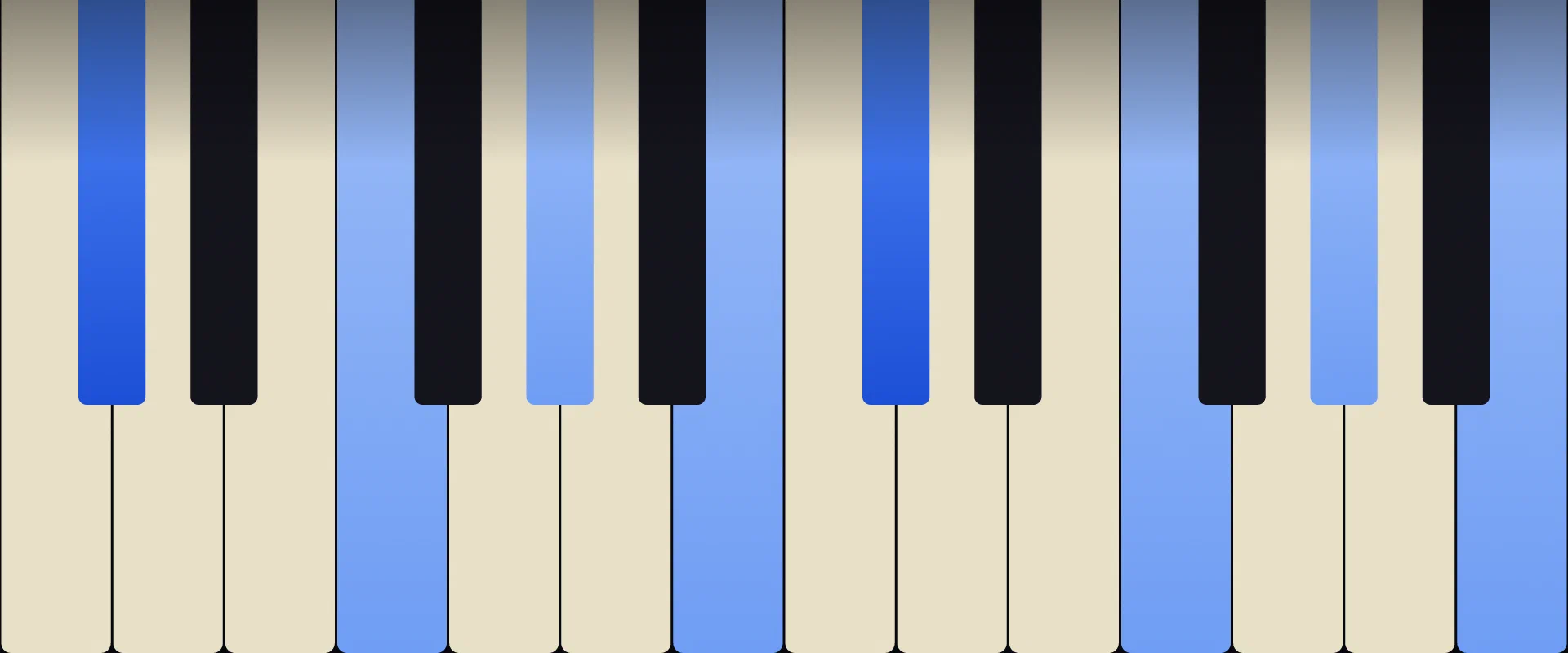
The four keys are C♯, F, G♯ and B, and the white ones are exactly the keyboard’s two seams. F has no black key on its left; B has none on its right. The chord takes one of each, and those two are the tritone.
Right hand, root position: 1 on C♯, 2 on F, 4 on G♯, 5 on B. Black, white, black, white, and yet the hand never rocks between two planes. Both white keys have a usable rear section beside a black one, F beside F♯ and B beside A♯, so all four fingers meet the keyboard at the same depth with the wrist level. C♯ up to B is ten semitones, comfortably inside an octave.
Isolate the three notes above the root. E♯, G♯ and B is a diminished triad, sounding F, A♭ and B, and it is the part that refuses to sit still. Hold C♯ in the left hand, play those three in the right, and you hear the instability without the root muddying it.
C♯7 on the Guitar
The seventh shapes are easier than the triad, not harder. The A7 form barred at the 4th fret is x 4 6 4 6 4, sounding C♯, G♯, B, E♯, G♯: index barre at the 4th, ring finger on the fourth string at the 6th, little finger on the second at the 6th, and a gap between them. The plain A shape at the same fret needs a second finger flattened across three strings, so adding a note here removes the hardest part of the grip.
Higher up, the E7 form at the 9th fret is 9, 11, 9, 10, 9, 9. Six strings sound, the low root sits on the sixth, and it wants three fingers: barre, ring on the fifth string at the 11th, middle on the third at the 10th. The full E major barre there needs a fourth finger too.
There is no open form, but the chord is not entirely deaf to open strings. One of its notes is available open: B, the seventh, on the second string. Nothing else matches E, A, D or G, and that single coincidence lets a partial voicing high on the neck leave the open B ringing underneath without clashing.
Inversions
| Inversion | Notes | Lowest note |
|---|---|---|
| Root position | C♯ E♯ G♯ B | C♯ |
| 1st inversion | E♯ G♯ B C♯ | E♯ |
| 2nd inversion | G♯ B C♯ E♯ | G♯ |
| 3rd inversion | B C♯ E♯ G♯ | B |
Third inversion is the one to remember. It puts the only natural at the bottom, and B falls to A on resolution, giving F♯m in first inversion: a light landing that keeps the bass moving by step instead of leaping a fourth. First inversion is the awkward one to notate, since a bass player reading E♯ plays F and a flat chart prints D♭7/F rather than argue about it.
Voicings
Drop the fifth. C♯, E♯ and B is the whole chord in three notes, and G♯ contributes nothing that the root has not already said. Pianists usually go further and split it: left hand on C♯, right hand on F and B alone. Two white keys and one black, and the chord is complete.
Stack a ninth on top for C♯9, adding D♯, or a thirteenth for C♯13, adding A♯. Flatten or sharpen that D♯ and you are in altered dominant territory, which suits this chord because its resolution target is minor.
Then there is the substitution. G7 is G, B, D, F, and its guide tones are B and F, the same two white keys as this chord’s B and E♯ with their roles swapped. So C♯7 can stand in for G7, and D♭7 falling a semitone to C is the textbook example of tritone substitution. The most basic cadence in Western music has this chord as its alternative.
Which Keys Contain C♯7
- V of F♯ major
- V of F♯ harmonic minor
- V of F♯ melodic minor
- I of C♯ mixolydian
- IV of G♯ melodic minor
- VII of E♭ natural minor
Look at what is missing. F♯ harmonic minor and F♯ melodic minor are both here; F♯ natural minor is not, because it keeps E natural as its seventh degree and yields C♯m7 instead. The raised seventh that defines harmonic minor is precisely this chord’s E♯. That is the historical reason harmonic minor exists: composers wanted a dominant with a leading note, and in F♯ minor the only way to get one is to write E♯.
The last entry uses other names for the same sounds, spelling the chord D♭, F, A♭, C♭, because a flat key has no business printing E♯. C♯ mixolydian differs in function rather than spelling: there the chord is the tonic and resolves nowhere, which is what a vamp is for.
Where C♯7 Shows Up
| Progression | Chords | Turns up in |
|---|---|---|
| V7 i in F♯ minor | C♯7, F♯m | Cadences in the key |
| V7/vi in A major | A, C♯7, F♯m, D | Pop, rock, singer-songwriter |
| V7/ii in E major | E, C♯7, F♯m, B7 | Blues-tinged rock |
| I7 IV7 V7 blues in C♯ | C♯7, F♯7, G♯7 | Twelve bar blues at pitch |
| ♭II7 as tritone sub | Dm7, D♭7, C | Jazz turnarounds |
Rows two and three explain the traffic. Neither A major nor E major carries E♯ in its key signature, so the chord always arrives with a printed accidental, and that accidental is the signal that something outside the key is coming. Both are guitar strongholds, F♯ minor sits in both, and the detour to F♯ minor is one of the commonest in popular music.
Watch the voices when it lands.
| Voice | In C♯7 | Moves to | Motion |
|---|---|---|---|
| 3rd | E♯ | F♯ | Up a semitone |
| ♭7 | B | A | Down a semitone |
| 5th | G♯ | A or F♯ | By step |
| Root | C♯ | C♯ | Held |
The tritone closes inward onto the third of F♯ minor, F♯ and A, and the root of the dominant does not have to move at all, because C♯ is already the fifth of the chord it is heading for. Two voices carry the whole cadence. Aim at F♯ major instead and only one note changes course: B falls to A♯ rather than A, and the tritone closes onto a major third.
The blues row is the one place this chord holds still. As a I7 it stops resolving and starts grooving, and guitarists reach it from the 4th fret barre rather than from a key signature. The last row is the reverse case, the chord landing where it has no diatonic business being, a semitone down onto C.
Related Chords
- C♯ Major Chord, the triad this chord sits on, and the page that works through the E♯ spelling in detail
- C♯ Major 6th Chord, the same triad carrying A♯ instead of B, which removes the tritone and with it the pull
- Seventh Chords: The Complete Guide for how a dominant seventh differs from the major seventh on this root, C♯maj7, which replaces B with B♯
- The ii, V, I Progression for tritone substitution worked through properly
- Guitar Chord Shapes: The CAGED System for moving the A7 and E7 forms to any fret
Learn More
- Diatonic Chords: A Beginner’s Guide
- Chord Inversions and Voice Leading
- Extended Chords and Jazz Harmony
- The Circle of Fifths Explained
- F♯ Harmonic Minor Scale, the scale this chord was effectively invented for
- C♯ Mixolydian Scale
Practice Chords
Drill chord recognition with a metronome, MIDI support, and score tracking.
Start PracticingRelated Articles
A Dominant 7th Chord: Notes, Voicings, and How to Play It
Aug 28, 2026 · 8 min
A♭ Dominant 7th Chord: Notes, Voicings, and How to Play It
Aug 28, 2026 · 8 min
B Dominant 7th Chord: Notes, Voicings, and How to Play It
Aug 28, 2026 · 8 min