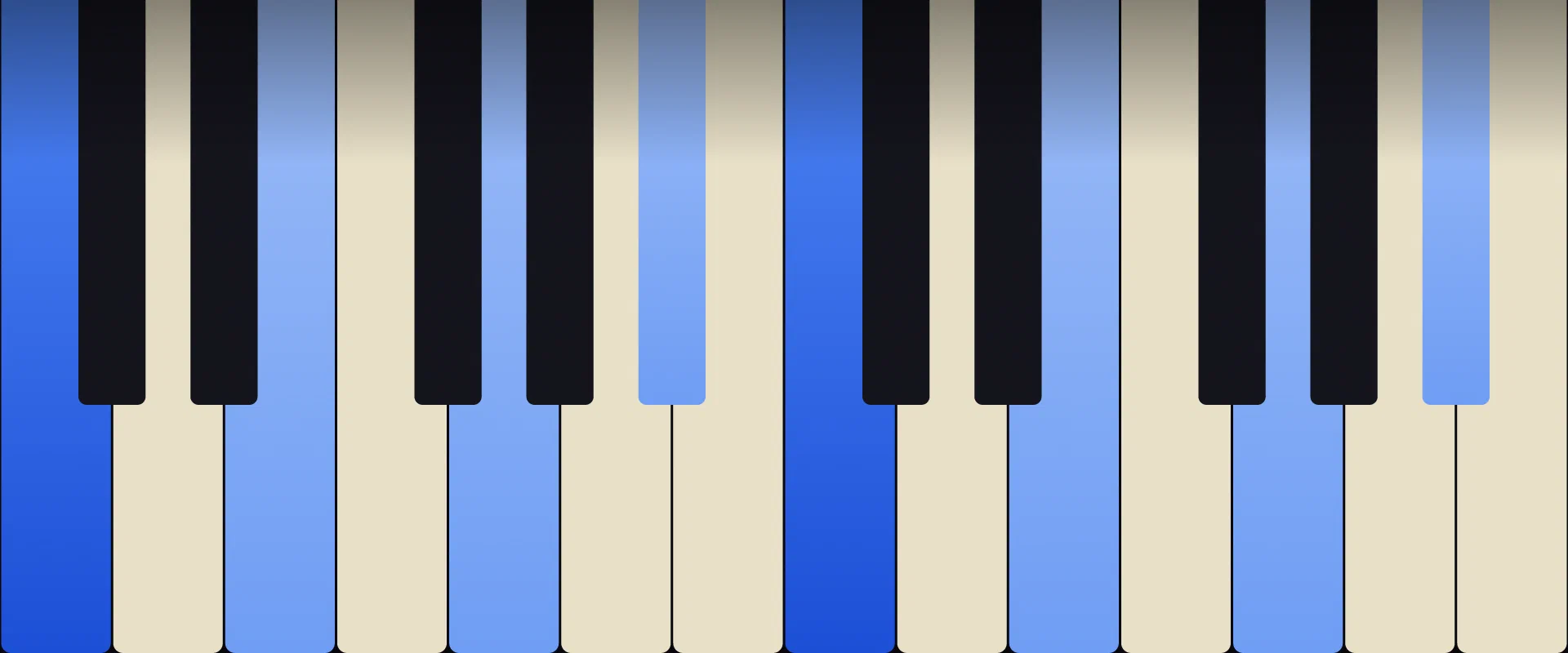
Two of these four notes do all the work. E and B♭ sit six semitones apart, the most restless interval in Western music. The E wants to rise a semitone to F, the B♭ wants to fall a semitone to A, and F and A are the root and third of F major. That pull is why C7 is the V of F, and it is the engine the whole tonal system runs on. Then the blues took the same four notes, planted them on the tonic and declined to resolve them, which is why a C7 can be the last chord of a tune as comfortably as the second to last. Both readings are correct, and a player has to know which room they are in.
Try It: C7 in the Chord Finder
Set the root to C and the scale to Mixolydian. C7 is the chord on the first degree.
The Notes of C7
| Degree | Note | Interval from root | Semitones |
|---|---|---|---|
| 1 (root) | C | Perfect unison | 0 |
| 3 | E | Major 3rd | 4 |
| 5 | G | Perfect 5th | 7 |
| ♭7 | B♭ | Minor 7th | 10 |
Written out: C, E, G, B♭. Three white keys and one black one. The seventh is B♭ and never A♯: a seventh chord uses every other letter, C then E then G then B, so the top note keeps the letter B and takes a flat with it.
How C7 Is Built
Take C major, C, E and G, and put B♭ on top. The triad underneath is untouched, so the chord still sounds firmly major, and the one addition costs it all its stability. From E up to B♭ is six semitones, written as a diminished 5th, and that interval belongs to no key on its own.
Raise the B♭ to B and you have Cmaj7; lower the E to E♭ and you have Cm7. The tritone vanishes in both, so of the seventh chords on this root the dominant is the only one carrying an obligation.
A shortcut hides in the top three notes: E, G and B♭ alone are an E diminished triad, so C7 is that unstable triad with a friendly root underneath.
C7 on the Piano
The B♭ is the topmost of the group of three black keys, wedged between A and B, and the only note in the chord that leaves the flat plane of the keyboard. Right hand: thumb on C, second finger on E, third on G, fifth on B♭. That puts the weakest finger on the raised key while the other three stay out on the wide white keys, so the hand tilts along its length. Keep the wrist level and let the little finger reach forward rather than dragging the arm after it.
Nobody stays there long, because the G is the least useful note in the chord. Drop it. Left hand takes C alone, right hand takes E and B♭, and the ear hears a complete C7. Add a D and an A on top and it becomes C13 without moving anything already down.
The best drill the chord offers is its own cadence. Hold C, E, G and B♭, keep the C still, push the E up to F and let the B♭ fall to A. Two fingers, one semitone each, travelling towards each other, and F major arrives.
C7 on the Guitar
The open form is x 3 2 3 1 0, and the interesting thing about it is what is missing. The notes ringing are C, E, B♭, C and E: no G anywhere in the chord. In the open C major shape the only G is the open 3rd string, and that is exactly the string the B♭ needs, at the 3rd fret. Adding the seventh costs the fifth, a trade the guitar makes happily since the fifth tells the ear nothing the root has not.
It is a four finger chord, unlike the triad it comes from: index at the 1st fret of the 2nd string, middle at the 2nd fret of the 4th, ring at the 3rd fret of the 5th, little finger at the 3rd fret of the 3rd. Leave the 6th string ringing and the low E turns the chord into first inversion, so damp it with the underside of the ring finger.
Two barres cover the rest of the neck. The A7 shape at the 3rd fret, x 3 5 3 5 3, is the comfortable one, an index barre clear of the stiff first fret with the ring and little fingers at the 5th. The E7 shape at the 8th fret, 8 10 8 9 8 8, puts C on the 6th string and sounds all six.
Neither is necessary for rhythm work. Play x 3 x 3 5 x: C on the 5th string, B♭ on the 3rd, E on the 2nd, nothing doubled, the shell a big band guitarist plays four to the bar.
Inversions
| Inversion | Notes | Bass | Symbol |
|---|---|---|---|
| Root position | C E G B♭ | C | C7 |
| 1st inversion | E G B♭ C | E | C7/E |
| 2nd inversion | G B♭ C E | G | C7/G |
| 3rd inversion | B♭ C E G | B♭ | C7/B♭ |
The third inversion is worth learning as a gesture rather than a label. With B♭ in the bass, the lowest note is the one obliged to fall, so C7/B♭ goes to F with A underneath it, and the harmony arrives already in first inversion and still moving.
Watch the tritone across the table. With E below B♭ the two squeeze inwards onto F and A; with B♭ below E they spread outwards and land on the same pair. The interval changes name depending which way up it sits, but the destination does not. For the voice leading behind this, see Chord Inversions and Voice Leading.
Voicings
Keep the E and the B♭ near middle C, where the ear hears them as an interval rather than as noise. Sunk into the bass register the chord loses its edge and turns grumbly.
On guitar the shapes below all sound as C7.
| Shape | Frets | Result |
|---|---|---|
| C7 | x 3 2 3 1 0 | Open, no 5th |
| C7 | x 3 5 3 5 3 | A shape at the 3rd fret |
| C7 | 8 10 8 9 8 8 | E shape at the 8th fret |
| C7 | x 3 x 3 5 x | Shell: root, 7th, 3rd |
| C9 | x 3 2 3 3 3 | Adds D, smoother and richer |
| C7♯9 | x 3 2 3 4 x | Adds D♯ against the E |
D♯ and E are adjacent keys, so the last row holds a major third and a sharpened ninth a semitone apart. It sounds wrong alone and perfect over a blues, which is a fair summary of the whole chord family.
Which Keys Contain C7
- I of C mixolydian
- V of F major
- V of F harmonic minor
- VII of D natural minor
- IV of G dorian
- III of A phrygian
The first three rows are the chord’s two lives. C Mixolydian is C7 stretched out into a scale, a home to sit on. F major and F harmonic minor both use it as the chord before the end, and they disagree only about where it lands, on F major or on F minor, which the C7 cannot tell you. The fourth row breaks the rule again: in D natural minor this chord sits on the seventh degree doing no dominant work at all, and tends to fall to F rather than push towards D.
Where C7 Shows Up
| Progression | Chords | Context |
|---|---|---|
| V7 I (F major) | C7, F | The cadence itself |
| ii V I (F major) | Gm7, C7, F | Jazz standards in F |
| I7 IV7 V7 (C blues) | C7, F7, G7 | Twelve bar blues in C |
| V7 of V (B♭ major) | C7, F7, B♭ | Ragtime chain of dominants |
The third row is where the classical account collapses. In a blues in C all three chords are dominant sevenths and only the G7 does dominant work. C7 is the tonic here, and its B♭ is not a leading note in disguise but the flattened seventh a singer bends towards. Nothing resolves and nothing needs to. See the C blues scale for where that B♭ comes from.
The fourth row shows the opposite habit. Ragtime strung dominants together in fifths so that every chord resolved onto another that also had to move: E7, A7, D7, G7, C7, F7, B♭, six tritones contracting in a row, a device covered further in Secondary Dominants and Borrowed Chords.
The tritone also permits a substitution. G♭7 is G♭, B♭, D♭ and F♭, and F♭ is the same key as E, so G♭7 and C7 share both of the notes that matter. Either can land on F, which is why swapping one for the other is the commonest reharmonisation in jazz. It works because the tritone is indifferent to the root holding it.
Keys settle along instrument lines. Blues with a horn section sits in C, F or B♭, the comfortable keys for trumpet, tenor and alto, which puts C7 at the centre of a great many jump blues and soul charts. Guitar bands drift to E and A, where the open strings ring, so a guitarist often meets C7 first as the IV chord of a blues in G.
Related Chords
- C Major Chord, the triad the B♭ is added to
- C Major 6th Chord, the same triad with A instead of B♭, and no tritone as a result
- C Sus4 Chord, the chord behind C7sus4, where F replaces the E and the tension goes on hold
- Seventh Chords: The Complete Guide for Cmaj7 and Cm7
- Extended Chords and Jazz Harmony for C9, C11 and C13
- Guitar Chord Shapes: The CAGED System for moving the barre shapes around
Learn More
Practice Chords
Drill chord recognition with a metronome, MIDI support, and score tracking.
Start PracticingRelated Articles
A Dominant 7th Chord: Notes, Voicings, and How to Play It
Aug 28, 2026 · 8 min
A♭ Dominant 7th Chord: Notes, Voicings, and How to Play It
Aug 28, 2026 · 8 min
B Dominant 7th Chord: Notes, Voicings, and How to Play It
Aug 28, 2026 · 8 min