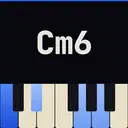
B minor is the chord that stalls beginners. It is the vi of D and the ii of A, the two keys a guitar hands out first, so it turns up months before the barre that plays it. The obvious guess about Bm6 is that a fourth note makes a hard chord harder. It does not. Bm6 is B, D, F♯ and G♯, and it has a first position grip, x20102, with two open strings, three fingers and no barre. The plain triad, one note simpler, has no standard open form at all.
The note doing the work is G♯. B natural minor contains G, so raising it puts the chord in B Dorian rather than the minor key it looks like it came from. That semitone is the whole colour of the chord, and it is why Bm6 has two other names.
Try It: Bm6 in the Chord Finder
The Notes of Bm6
| Degree | Note | Interval from Root | Semitones |
|---|---|---|---|
| 1 (Root) | B | Perfect unison | 0 |
| ♭3 | D | Minor third | 3 |
| 5 | F♯ | Perfect fifth | 7 |
| 6 | G♯ | Major sixth | 9 |
How Bm6 Is Built
Take the B minor triad, B D F♯, and add a major sixth above the root. Not a minor sixth: G♯, not G. The symbol says minor, the added interval is major, and that mismatch is the commonest misreading of the family. Its neighbours are a semitone away in each direction: B6 has D♯ where this has D, Bm7 has A where this has G♯.
The interval that decides how the chord behaves is not the obvious one. D up to G♯ is six semitones, a tritone, and it is the only tritone here. B6 has none at all, since D♯ up to G♯ is a comfortable fourth. That is why B6 sounds like an ending and Bm6 sounds like something about to happen.
That tritone also lives inside E7, where G♯ is the third and D the seventh. Put an E underneath and you have E, G♯, B, D, F♯, which is E9. Bm6 is a rootless E9, so a guitarist needing a ninth chord can play the minor 6 shape a fifth above the dominant root instead of learning a new one.
Bm6 on the Piano
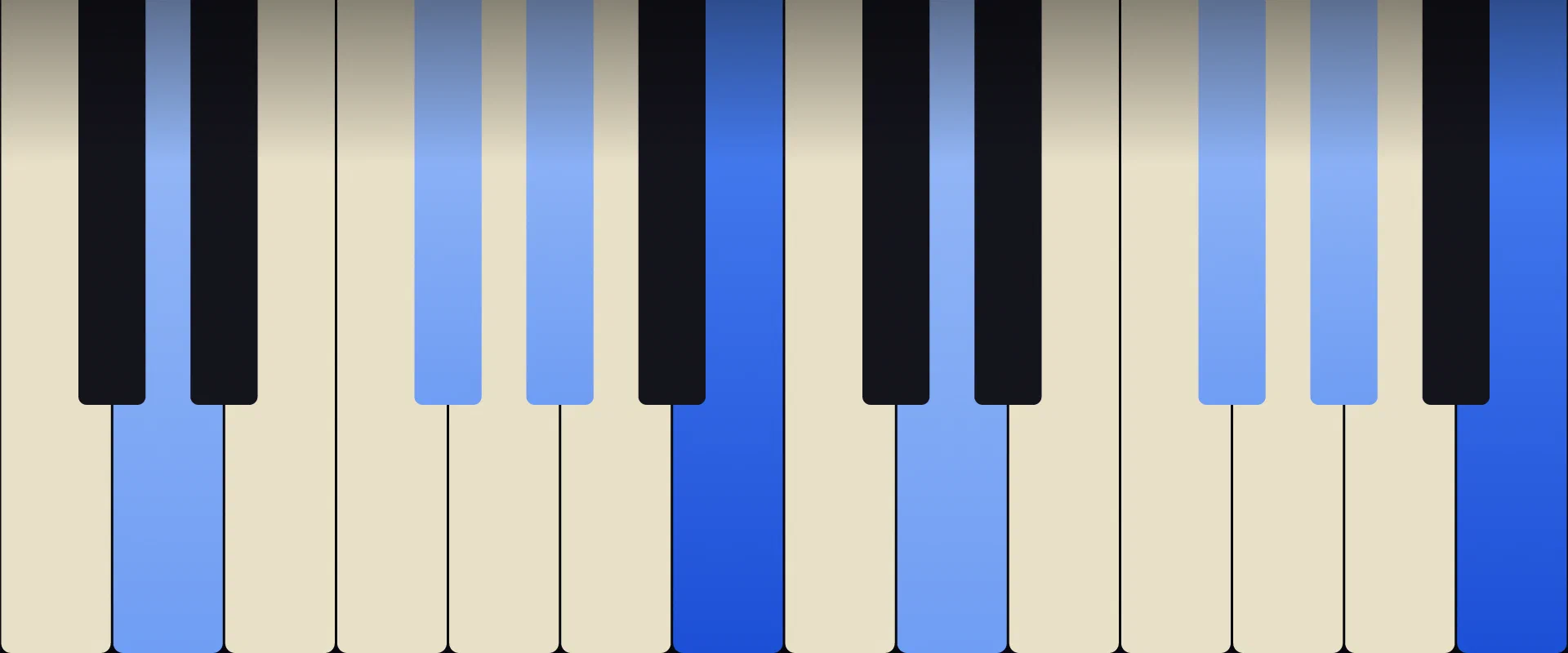
Two white keys and two black, which makes it the lighter of the two sixth chords on B, since B6 needs three black keys. B and D are out at the front, F♯ and G♯ are the first pair in the group of three.
Because those two are immediate neighbours, the right hand wants 1 on B, 2 on D, 3 on F♯ and 4 on G♯. Middle and ring land one black key apart, the gap they already sit at when the hand is relaxed, and the little finger stays free above. The left hand mirrors it: 5, 4, 2, 1, thumb on G♯.
Close root position buries the tritone: F♯ sits between D and G♯, in the middle of a stack of thirds. Low on the keyboard that turns to sludge. Above middle C it is why the chord sounds like it is leaning somewhere. Same fact, two outcomes.
Bm6 on the Guitar
Start from the shape most players already use to dodge the B minor barre. x20202 is a Bm7: root at fret 2 on the fifth string, fourth and second strings open, a finger at fret 2 on the third string for the A. Move that one finger back a single fret to x20102 and the A becomes G♯. The chord is now Bm6, still three fingers in first position, low E muted by the side of the middle.
Low to high it sounds B, D, G♯, B, F♯. The tritone sits at the bottom, between the open fourth string and the G♯ above it, so the grip is tenser than its fingering suggests. Good for a vamp, poor for an ending.
Both barre forms cost more than the plain triad does. The A shape at the second fret is x24434 against B minor’s x24432: the top string climbs from fret 2 to fret 4, which spares the index barre any work on the treble side but demands a fourth finger at fret 4, in the widest part of the neck. The E shape at the seventh fret, 799797, is worse. The second string goes to fret 9 while the third stays at fret 7 under the barre, so a finger must sit between two others across a skipped string. Ring flat over the fifth and fourth at fret 9, little finger on the second at fret 9, index barring underneath.
The useful compromise drops the root. xx4434 gives F♯, B, D and G♯ on four strings with no barre, in the register where a guitar comps without fighting a vocal.
Inversions
| Inversion | Notes | Bass Note |
|---|---|---|
| Root position | B D F♯ G♯ | B |
| 1st inversion | D F♯ G♯ B | D |
| 2nd inversion | F♯ G♯ B D | F♯ |
| 3rd inversion | G♯ B D F♯ | G♯ |
The third inversion is the important one. Read G♯, B, D, F♯ upwards and you have a minor third, a diminished fifth and a minor seventh above G♯, which is G♯m7♭5 in root position. Every minor 6 chord doubles as the half diminished chord a major sixth above it, and this pair is the clearest reason to learn one shape and get two.
Voicings
Split the tritone across the hands and the chord opens up: B and F♯ low in the left, D and G♯ in the right, an octave or more between the two notes that were rubbing.
Dropping a note changes the chord’s name. Lose the fifth and B, D, G♯ is a G♯ diminished triad, thin and pointed. Lose the root and F♯, B, D, G♯ is a G♯m7♭5, which is what xx4434 gives you. The bass decides which one is heard.
Which Keys Contain Bm6
- II of A major
- IV of F♯ natural minor
- IV of F♯ harmonic minor
- I of B melodic minor
- I of B dorian
- VI of D lydian
Exactly one major key holds all four notes, and it is A. Exactly one natural minor key does, and it is F♯ minor. Those are the same seven notes, so the chord belongs to a single key signature and the rest of the list is modes of it.
F♯ minor is where the double identity pays off in plain analysis. Bm6 is that key’s iv chord with its sixth added, and G♯m7♭5 is its iiø7. Subdominant and supertonic, textbook opposites, are one set of four notes.
The G♯ blues scale swallows the chord whole: G♯, B, C♯, D, D♯, F♯, with B on its second degree. Solo on it over Bm6 and every note is a chord tone or a blue note.
Where Bm6 Shows Up
| Progression | Numerals | Chords |
|---|---|---|
| Dorian vamp in B | i6, IV | Bm6, E |
| Minor cadence in B | iiø7, V7♭9, i6 | C♯m7♭5, F♯7♭9, Bm6 |
| Supertonic in A | ii6, V7, I | Bm6, E7, Amaj7 |
| Ninth by another name | V9, I in A | Bm6 over E, A |
The first row is the reason to own this chord. B Dorian’s fourth degree is E major rather than E minor, and the note responsible is G♯, the one this chord adds. Vamp Bm6 to E and both chords hold it, so the mode announces itself in two bars. Both are first position on a guitar, x20102 and an open E, so the vamp needs no barre at all. The same vamp on plain B minor does.
The second row is the standard minor cadence, and the identity repeats one step round: C♯m7♭5 is itself a minor 6 chord, the one built on E. The cadence is two minor 6 shapes with a dominant between them.
The third row hides the best fact. In A major, B is the supertonic and G♯ is the leading note, so Bm6 and G♯m7♭5, the ii and the viiø7, are one object. The key’s predominant chord and its leading note chord share all four notes, and only the bass underneath tells them apart.
D major, the other key everyone expects, does not contain this chord at all. Its vii is C♯ half diminished, which is C♯, E, G, B, and that is Em6 rather than this one. Bm6 needs G♯ where D major has G natural. Raise it and you have not found a second diatonic chord in D, you have changed the key: D, E, F♯, G♯, A, B, C♯ is D lydian, where Bm6 is the vi. Dmaj7 to Bm6 is a lift rather than a step, one note away from the folk key this chord is usually met in. Read the other way, G♯ leads to A and the chord is secondary dominant work dressed as a vi.
Related Chords
- B Minor Chord
- B Major 6th Chord
- B Diminished Chord
- B Dorian Scale
- B Melodic Minor Scale
- Guitar Chord Shapes and the CAGED System
Learn More
Practice Chords
Drill chord recognition with a metronome, MIDI support, and score tracking.
Start PracticingRelated Articles
A Minor 6th Chord: Notes, Voicings, and How to Play It
Aug 27, 2026 · 8 min
A♭ Minor 6th Chord: Notes, Voicings, and How to Play It
Aug 27, 2026 · 8 min
B♭ Minor 6th Chord: Notes, Voicings, and How to Play It
Aug 27, 2026 · 8 min