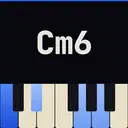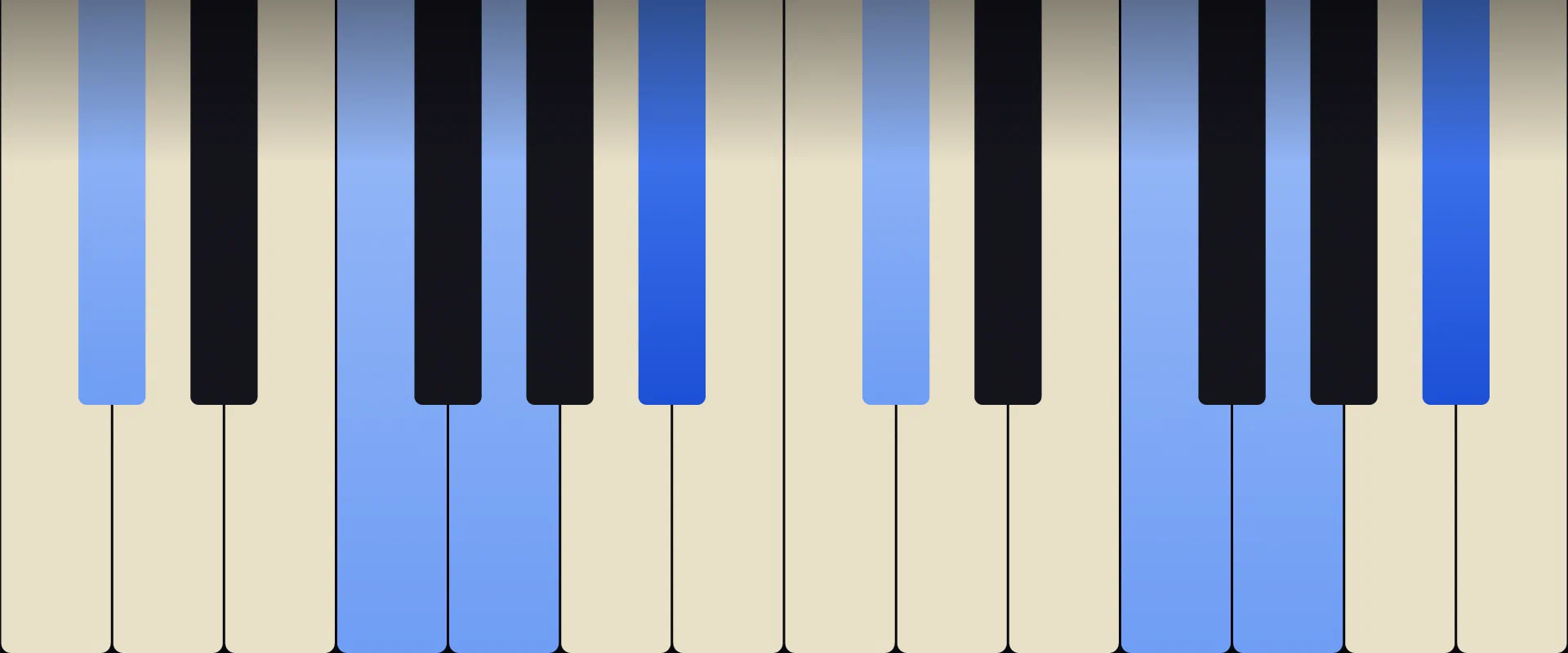
B♭ minor carries five flats and one of them is G♭. B♭m6 needs G natural. Write this chord into a piece in its own key and you write a natural sign in front of every G, because the 6th in a minor 6th chord is major and the signature has already flattened it. That cancelled flat is the whole chord. It lifts B♭ minor out of Aeolian and into Dorian, and it is the only thing separating this from the plain minor triad.
The notes are B♭, D♭, F and G. Shuffle them and they are also Gm7♭5, which is where most players first meet them without realising it.
Try It: B♭m6 in the Chord Finder
Play B♭, D♭, F and G, then play the same four notes starting from G and hear the chord change identity.
The Notes of B♭m6
B♭m6 has four notes: B♭, D♭, F and G.
| Degree | Note | Interval from B♭ | Semitones |
|---|---|---|---|
| 1 (root) | B♭ | Perfect unison | 0 |
| ♭3 | D♭ | Minor 3rd | 3 |
| 5 | F | Perfect 5th | 7 |
| 6 | G | Major 6th | 9 |
Two black keys, B♭ and D♭, then two white ones, F and G, with nothing spelled awkwardly.
How B♭m6 Is Built
Take the B♭ minor triad, B♭ D♭ F, and add G a major 6th above the root. Nothing is altered or removed, so the minor 3rd still carries the mood and the 5th still steadies the chord.
Compare it with the more familiar B♭m7, which adds A♭. A♭ is inside the key signature and sounds like the key agreeing with itself, while G is outside it and sharpens rather than deepens. B♭6 sits one note away in the other direction, D natural instead of D♭, since both chords take the same G.
Now count a major 6th up from B♭ and you land on G. Stack a half-diminished 7th there and you get G, B♭, D♭, F, written Gm7♭5. That is B♭m6 exactly, and the spelling needs no double flat, because G’s minor 3rd, diminished 5th and minor 7th are already the three notes above B♭. Every minor 6th chord has such a twin a major 6th above it. The tritone driving the pairing runs from D♭ up to G, buried in the middle when B♭ is in the bass and exposed when G is. See Seventh Chords: The Complete Guide for what half-diminished chords do next.
B♭m6 on the Piano
The hand travels from the back of the keyboard to the front in two neat pairs. B♭ and D♭ are consecutive black keys, the ones either side of the gap where B and C interrupt the pattern. F and G are consecutive white keys. The right hand therefore takes 1 and 2 on the raised pair and 4 and 5 on the plain pair, and the shape almost teaches itself: two black, skip, two white. Reverse it for the left hand.
The catch is at the top. F and G sit a whole step apart and in close position they become the two highest voices, which thickens badly below middle C. Do not fix that by dropping the 5th. F is what holds D♭ and G apart, and without it the tritone takes over and the chord turns into a rootless dominant. Split the pair across registers instead, B♭ and F in the left hand, D♭ and G in the right, and the whole step becomes a 9th.
B♭m6 on the Guitar
There is no open form, and unlike the plain triad, no honest barre either. The Am6 shape, x 0 2 2 1 2, already uses all four fingers, with the root on the open A string. Move it to fret 1 for B♭m6 and the index must barre to replace that open string, leaving three fingers for four stopped notes. The shape needs a fifth finger. Guitarists get round it by muting the third string and playing x 1 3 x 2 3, all four chord tones, one per string, at the stiffest and widest end of the neck.
Fret 6 is where the chord actually lives, and there the arithmetic turns generous. B♭m as the Em shape is 6 8 8 6 6 6, the second string sounding F under the barre. Lift that one string to fret 8 with the little finger and it becomes G: 6 8 8 6 8 6 is B♭m6. One extra finger on a barre you were holding anyway, and F is not lost, since it is still on the fifth string. For once the more complicated chord costs less effort than the simpler one.
A third route skips the barre. Play 3 x 3 3 2 x and you have G, F, B♭ and D♭: the standard Gm7♭5 grip at fret 3, and note for note B♭m6 with G in the bass. The CAGED system explains why the A shape runs out of fingers here and the E shape does not.
Inversions
| Inversion | Notes | Bass note | Symbol |
|---|---|---|---|
| Root position | B♭ D♭ F G | B♭ | B♭m6 |
| 1st inversion | D♭ F G B♭ | D♭ | B♭m6/D♭ |
| 2nd inversion | F G B♭ D♭ | F | B♭m6/F |
| 3rd inversion | G B♭ D♭ F | G | B♭m6/G, or Gm7♭5 |
The first two behave normally, though second inversion wants care: F and G land at the bottom with the whole step under everything else, on two adjacent white keys.
Third inversion is not really an inversion. Put G in the bass and nobody hears a rearranged B♭m6, they hear Gm7♭5 in root position, because the bass note now supports a proper stack of thirds. A walking figure that lands on G under a bar of B♭m6 has changed the harmony, not the voicing. Chord Inversions and Voice Leading covers the general case, but few chords swap names this cleanly.
Voicings
B♭ F D♭ G, spread across two hands, is the default: root and 5th below, colour notes above, the awkward whole step neutralised.
G D♭ F B♭ is the same chord read as a half-diminished shell, what a jazz pianist plays when the bass has G. One hand shape, two chords.
B♭ D♭ F G C adds the 9th for B♭m6/9. C is diatonic to B♭ Dorian, so nothing is borrowed and the chord widens without losing its centre.
Which Keys Contain B♭m6
- I of B♭ dorian
- I of B♭ melodic minor
- IV of F natural minor
- IV of F harmonic minor
- II of A♭ major
- entirely contained in G blues
Notice what is missing. B♭ natural minor and B♭ harmonic minor both flatten the 6th degree to G♭, so neither can produce this chord on its own tonic. Only Dorian and melodic minor raise that note.
One entry needs a warning. The chord also sits on degree 2 of G♯ melodic minor, where the sharp side spelling starts it on A♯ and puts a double sharp on the 6th. Identical sounds, and unrecognisable on the page.
Where B♭m6 Shows Up
F minor is the home key. B♭m6 is the iv chord with the 6th added, and because F natural minor contains G, nothing is borrowed:
Fm | B♭m6 | C7 | Fm
The same four notes reappear as the ii chord of the minor cadence in F, which is how the sound usually gets written:
Gm7♭5 | C7♭9 | Fm
A pianist handed that first bar very often voices it as B♭m6 over the bass player’s G, because the shape sits better under the hand. The minor ii-V-I runs on that substitution more than the symbols admit.
Guitarists arrive from another direction, meeting it as a borrowed iv in F major, a key they actually play in:
B♭ | B♭m6 | F
D♭ falls to C, G falls to F or rises to A, and the gesture takes two bars. It is the minor plagal cadence with a 6th stirred in, and ballads are full of it.
For modal use, loop B♭m6 | E♭9 and leave it running. That is the B♭ Dorian vamp, and the two chords share three notes including the G, which is why the loop sounds like one colour rather than two chords arguing.
Then there is the use nobody names. G blues, the scale, is G B♭ C D♭ D F, and B♭m6 lies entirely inside it. Its four notes are the root, ♭3, ♭5 and ♭7 of G, the blue notes of that key stacked into a chord. A guitarist who would never willingly play in B♭ minor plays this chord constantly in G, one bent note at a time, without ever writing the symbol down.
Related Chords
- B♭ Minor Chord, the triad underneath, and the source of the fret 1 problem.
- B♭ Major 6th Chord, the same G on top of a major 3rd.
- G Minor Chord, which becomes the half-diminished twin once its D is flattened and F is added.
- Extended Chords and Jazz Harmony, on why a 6th is a chord tone and a 13th is not.
Learn More
Practice Chords
Drill chord recognition with a metronome, MIDI support, and score tracking.
Start PracticingRelated Articles
A Minor 6th Chord: Notes, Voicings, and How to Play It
Aug 27, 2026 · 8 min
A♭ Minor 6th Chord: Notes, Voicings, and How to Play It
Aug 27, 2026 · 8 min
B Minor 6th Chord: Notes, Voicings, and How to Play It
Aug 27, 2026 · 8 min