Gypsy jazz has one tune everybody calls first, Minor Swing, and it sits in A minor. Look at the chart and the opening chord is usually printed Am6, not Am. Where other music writes a minor chord that style writes a minor sixth, and guitarists meet the chord here rather than anywhere else because in this key it costs one finger: take the open Am grip and drop the little finger onto the first string. The note it adds is F♯, which is worth a moment, because A minor is the key famous for having no sharps in it.
Try It: Am6 in the Chord Finder
Set the root to A, sound the minor triad, then add F♯ and hear it brighten without turning major.
The Notes of Am6
| Degree | Note | Interval from root | Semitones |
|---|---|---|---|
| 1 (root) | A | Perfect unison | 0 |
| ♭3 | C | Minor 3rd | 3 |
| 5 | E | Perfect 5th | 7 |
| 6 | F♯ | Major 6th | 9 |
Written out: A, C, E, F♯. Three white keys and one black, and that black key is the whole story.
If you have never played a minor sixth chord, the name misleads. The sixth in Am6 is a major sixth, nine semitones above the root; the word minor describes the third, C, and nothing else. A genuinely minor sixth above A would be F natural, which belongs to another chord.
How Am6 Is Built
Start from A minor, A, C and E, and add the note a major 6th above the root. Nothing is taken away, so the chord stays unambiguously minor and the F♯ sits on top rather than replacing anything.
That added note is why this key is the one to learn the chord in. A natural minor runs A, B, C, D, E, F, G, so its sixth degree is F natural and the chord named after the tonic of A minor is not available in A minor. Am6 needs A Dorian, which raises that F to F♯, or A melodic minor, which raises the seventh too. The symbol is an instruction to the soloist: stay out of Aeolian. Am7, by contrast, adds G, a whole tone higher and perfectly at home in A natural minor. One note apart, two different scales.
Am6 and F♯m7♭5 Are the Same Four Notes
Stack A, C, E and F♯ from the F♯ upward and they read F♯, A, C, E, which spells F♯m7♭5. That is the most useful fact about the minor sixth family: every m6 chord doubles as the half-diminished chord a major sixth above it, and only the bass decides which name is honest.
The demonstration takes two seconds. Play A, C, E, F♯ with A at the bottom and you hear a minor chord with a lift on top. Play F♯, A, C, E and the same four keys turn anxious. On the guitar the fretted core does not move at all: x 0 2 2 1 2 is Am6, and 2 x 2 2 1 x keeps the same three fingers while swapping the open A bass for F♯ on the sixth string. Put a D underneath the same notes and you get D9 with its root supplied by somebody else: three symbols, one handful of notes, and the bass deciding.
Am6 on the Piano
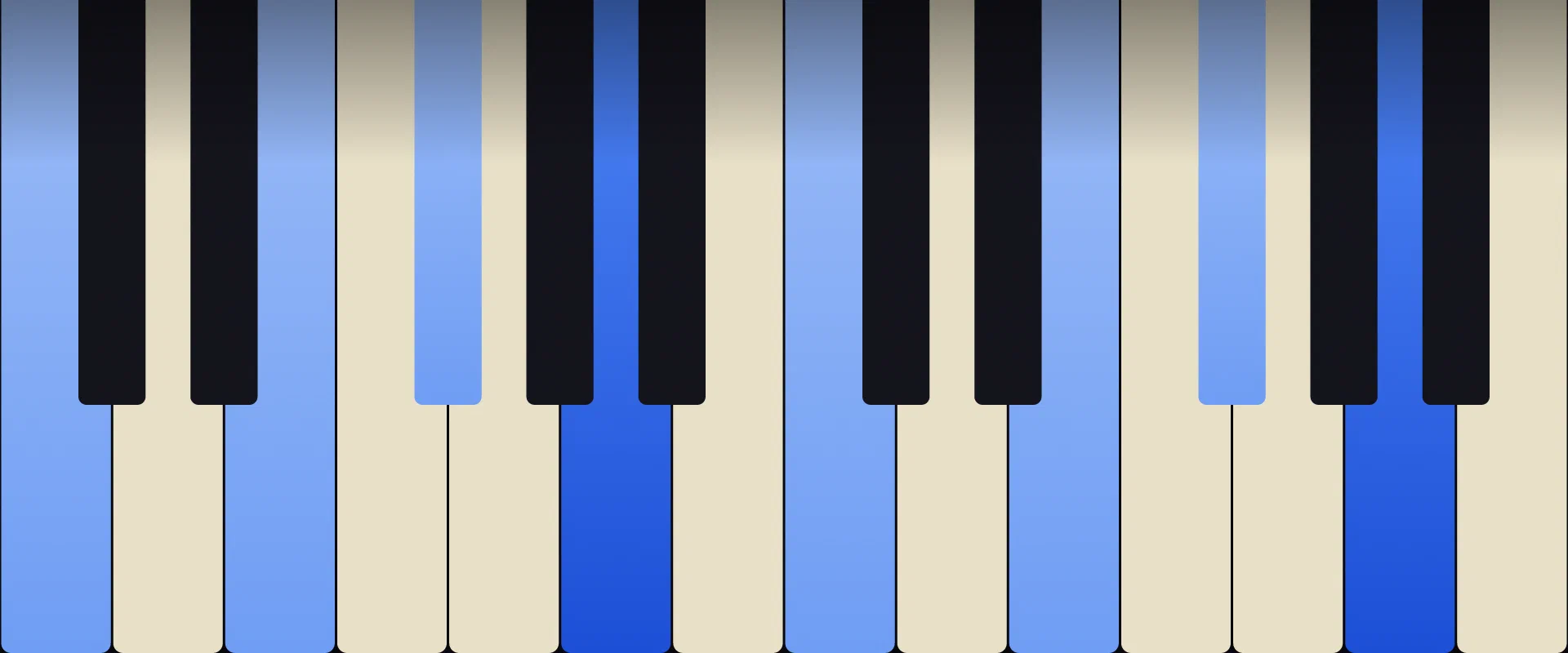
A, C and E are the shape every pianist owns before they own anything else, so the only new thing here is where the last finger goes. F♯ makes that easy: it is the first black key of the group of three, directly up and right of the E already under the hand.
Right hand 1, 2, 3, 5 works: thumb on A, index on C, middle on E, little finger reaching to F♯. Anyone whose little finger dislikes raised keys should use 1, 2, 4, 5, which puts the ring finger on E and shortens the reach at the top. The full span is a major 6th, so the chord stays inside a relaxed hand either way.
The sound lives at the top. E to F♯ is a whole tone, the closest interval in the voicing, and that is what makes a minor sixth tart rather than plush; in Am7 the gap is E to G, a comfortable minor 3rd. Pack all four notes together below middle C and that whole tone growls. Put A alone in the left hand, spread C, E and F♯ across the right, and it reads as colour instead. Roll the F♯ below the root instead and you have the half-diminished layout in a compact row.
Am6 on the Guitar
The open form is x 0 2 2 1 2, the Am fingering with one addition. Index on the first fret of the second string for C, middle on the fourth string at the second fret for E, ring on the third string at the second for A, little finger on the first string at the second for F♯. The fifth string rings open as the root and the sixth is damped with the thumb.
That gives A, E, A, C, F♯ from the bass up: the root doubled, one F♯, and it is on top where nothing covers it. The usual error is letting the first string ring open, which restores the E, removes the sixth and quietly turns the chord back into plain Am.
Two movable forms cover the rest of the neck. The Em6 shape barred at the fifth fret, 5 7 7 5 7 5, is the same voicing with the root on the sixth string, and it is a heavy grip. Far more practical is 5 x 4 5 5 x: root on the sixth string at the fifth fret, F♯ on the fourth string at the fourth, C on the third and E on the second. One of each note, and the skipped fifth string keeps it tidy. Swing and gypsy players use this one, struck rather than strummed and released early to keep the rhythm dry.
Inversions
| Inversion | Notes | Bass | Symbol |
|---|---|---|---|
| Root position | A C E F♯ | A | Am6 |
| 1st inversion | C E F♯ A | C | Am6/C |
| 2nd inversion | E F♯ A C | E | Am6/E |
| 3rd inversion | F♯ A C E | F♯ | F♯m7♭5 |
The last row is barely an inversion. With F♯ underneath, the ear hears a half-diminished chord in root position, so write F♯m7♭5 unless the harmony is genuinely still in A. Handle the second inversion with care instead: E and F♯ end up adjacent at the bottom, and lifting the F♯ an octave fixes it.
Voicings
| Voicing | How to play it |
|---|---|
| Open Am6 | x 0 2 2 1 2, the Am shape plus the little finger |
| Barre at the 5th fret | 5 7 7 5 7 5, the Em6 shape moved up |
| Compact grip | 5 x 4 5 5 x, one of each note, no doubling |
| F♯m7♭5 from the same core | 2 x 2 2 1 x, the bass moved to F♯ |
| Piano, spread | A2 in the left hand, C4, E4 and F♯4 in the right |
| Piano, half-diminished | F♯3, A3, C4 and E4 in a compact row |
Which Keys Contain Am6
- i of A dorian
- i of A melodic minor
- iv of E natural minor
- iv of E harmonic minor
- ii of G major
- v of D mixolydian
Three of those are the same seven notes. G major, A Dorian and D mixolydian all carry one sharp, and that sharp is F♯, so the note A minor cannot supply is native to the key signature next door. The E minor entries cover the rest of the chord’s working life: on the fourth degree it is a subdominant with a raised sixth.
Where Am6 Shows Up
| Progression | In this key | Chords |
|---|---|---|
| i6, iv6, V7 | A minor | Am6, Dm6, E7 |
| Minor ii, V, i | A minor | Bm7♭5, E7, Am6 |
| Read as F♯m7♭5 | E minor | Am6/F♯, B7, Em |
| Dorian vamp | A Dorian | Am6, D |
| Line cliché | A minor | Am, Am(maj7), Am7, Am6 |
The first two rows interlock. Bm7♭5 is the ii chord of A minor, and B, D, F, A rearranged is D, F, A, B, which is Dm6. The ii chord of this key and the sixth chord on its fourth degree are one object with two labels, which is why a gypsy jazz chart here can print Am6, Dm6 and E7 and still be a textbook minor cadence: the iv6 is doing the ii chord’s work.
Turn the chord over and it changes employer. As F♯m7♭5 it is the ii of E minor, so Am6 into B7 into Em is a minor ii, V, i whose first chord is spelled from the wrong root, and on the guitar only the bass string moves.
The Dorian vamp is the simplest use of all. Am6 to D and back, with F♯ in both chords, so the mode is settled before the second chord arrives.
Pop and film writing prefers the line cliché. Hold A minor and walk one voice down by semitones, A, G♯, G, F♯; each step names a chord and the last one is this one. Put that line in the bass and it ends on Am6 over F♯.
Ending a minor tune on Am7 can sound like stopping halfway, since a minor seventh chord is the standard ii and the ear expects it to move. Am6 carries no such job description, so swing and bebop endings in this key finish here.
Related Chords
- A Minor Chord the triad and the shape underneath this one
- A Major 6th Chord the same added note over a major third
- A Sus2 Chord a note replaced rather than added
- Seventh Chords: The Complete Guide
- Extended Chords and Jazz Harmony
Learn More
Practice Chords
Drill chord recognition with a metronome, MIDI support, and score tracking.
Start PracticingRelated Articles
A♭ Minor 6th Chord: Notes, Voicings, and How to Play It
Aug 27, 2026 · 8 min
B Minor 6th Chord: Notes, Voicings, and How to Play It
Aug 27, 2026 · 8 min
B♭ Minor 6th Chord: Notes, Voicings, and How to Play It
Aug 27, 2026 · 8 min