Six flats in the key signature and not one accidental in the bar. Write A♭m6 inside E♭ minor, whose signature already carries B♭, E♭, A♭, D♭, G♭ and C♭, and all four noteheads go down plain. Spell the same sounds the way they look on the keyboard, A♭ B E♭ F, and you must add a natural sign to cancel a flat the signature put there on purpose. The tidy version is the one costing ink.
A♭ is a singer’s key, so the chord turns up more than its spelling suggests: as the iv of E♭ minor, as a borrowed iv in E♭ major, and as the tonic of a vamp that never leaves A♭ Dorian.
Try It: A♭m6 in the Chord Finder
The Notes of A♭m6
| Degree | Note | Interval from root |
|---|---|---|
| 1 | A♭ | Perfect unison |
| ♭3 | C♭ | Minor 3rd, 3 semitones |
| 5 | E♭ | Perfect 5th, 7 semitones |
| 6 | F | Major 6th, 9 semitones |
Written low to high in root position: A♭ C♭ E♭ F.
C♭ is played on the white key B. Why a chord on A♭ must contain some kind of C is set out on the A♭ Minor Chord page. The 6th applies that rule to an interval rather than a note, which is where it bites.
Measure from the 3rd up to the 6th. C♭ to F spans four letters, C D E F, so it is a fourth, and six semitones, so it is an augmented 4th. Look at the keys instead and you see B up to F, which every player reads at sight as a diminished 5th. The two are not interchangeable: an augmented 4th widens, pushing its outer voices apart by step, while a diminished 5th narrows and draws them together. Spelling decides which way the tritone leans, and that is the seam along which this chord turns into another one.
How A♭m6 Is Built
Take A♭m, A♭ C♭ E♭, and put F a major 6th above the root. Which F matters. A♭ natural minor runs A♭ B♭ C♭ D♭ E♭ F♭ G♭, so its 6th degree is F♭: this chord adds the one note A♭’s own natural minor lacks. Raising F♭ to F is what makes A♭ Dorian, and why the chord never sounds like Aeolian gloom however long you hold it.
Now stand it on its head. From F upward: F to A♭ is a minor 3rd, F to C♭ is a diminished 5th (the augmented 4th again, measured the other way), F to E♭ is a minor 7th. That stack defines a half diminished chord, so these four notes are also Fm7♭5.
The root is not arbitrary. A minor 6th chord’s half diminished twin is built on its added 6th, and A♭ up a major 6th is F. The chord that needs a C♭ to spell its third is named, upside down, after the plainest letter available.
A♭m6 on the Piano
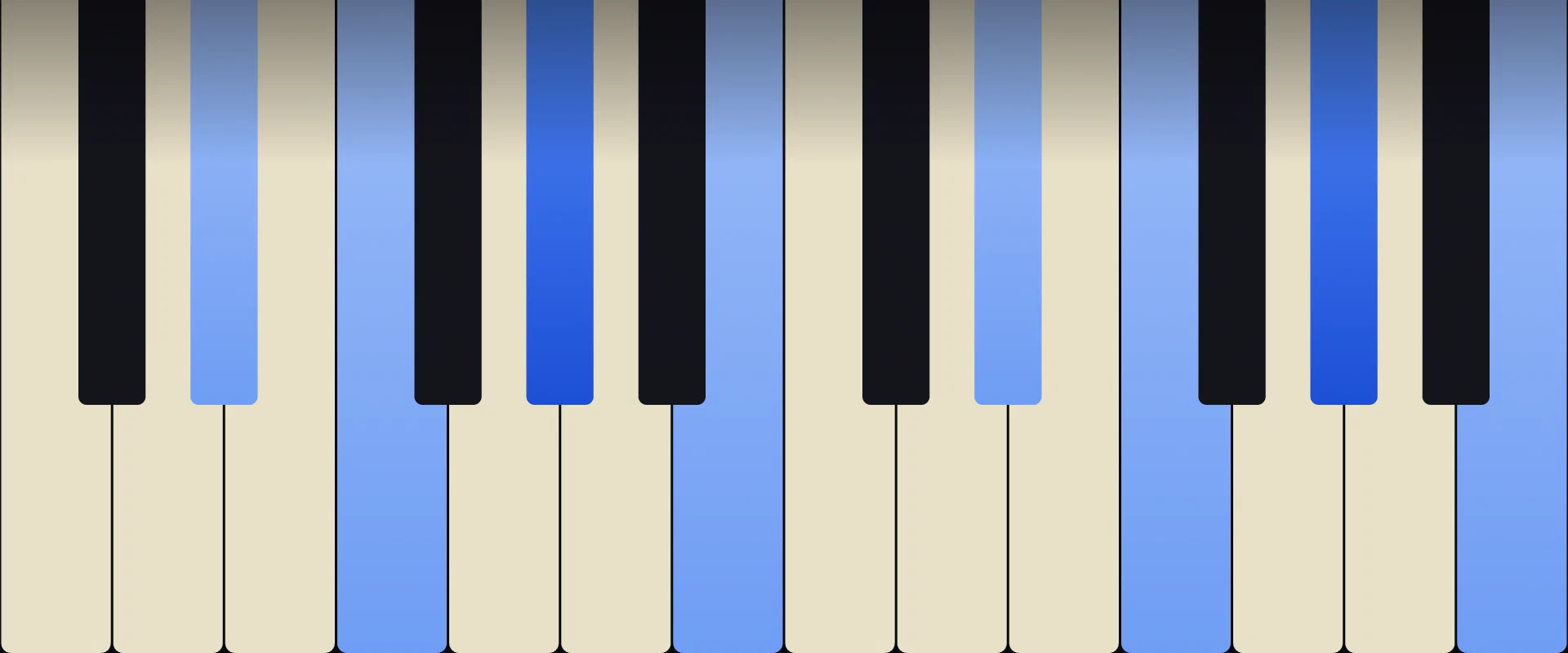
Two black keys and two white, but notice which whites. B and F are the only white keys with a white neighbour a semitone away (B to C, E to F), so they sit at the two seams in the black key pattern, and they are a tritone apart.
Right hand root position is 1 on A♭, 2 on C♭, 4 on E♭, 5 on F, and the awkwardness is at the top. The fourth finger sits back on a raised black key, then the little finger must come forward past E to reach F, so the hand changes depth at its weakest joint.
For comping, take A♭ in the left hand and play C♭ E♭ F with 1, 2 and 4, six semitones wide. Easiest of all is F in the bass: F and A♭ under the left hand is a plain minor 3rd, white key then black, no stretch anywhere, and what you hear is the Fm7♭5 reading. The other name is the more comfortable grip.
A♭m6 on the Guitar
No open form, and both barres are real work. The E shape sits at the 4th fret as 4 6 6 4 6 4: index across the 4th, then three fingers at the 6th on the A, D and B strings, skipping the G string. That gap is what makes it hard, and the A shape at the 11th, x 11 13 13 12 13, is worse and cramped. Prefer the four note reduction: x 6 6 4 6 x, no barre, sounding E♭ A♭ C♭ F.
Guitarists in A♭ capo rather than barre, though, and the two obvious positions are not close.
Capo 4 is free. A barre at the 4th fret and a capo at the 4th fret are the same object, so 4 6 6 4 6 4 becomes 0 2 2 0 2 0, the open Em6 grip: three fingers at one fret with three strings ringing behind them, and not one pitch changed. It also drops you into E Dorian, where the IV chord is an open A and the ♭VII an open D, so an eight bar A♭ Dorian vamp becomes three open chords.
Capo 1 buys you nothing here. Thinking in G, the same shape must be barred three frets above the capo, which is the 4th fret of the neck: the identical barre, now with a capo behind it. The escape is 3 x 0 3 3 0 counted from the capo, where two notes come off the capo so three fingers suffice. Workable rather than good.
Capo 4 costs tone, four frets of it, so a tune really in A♭ major, with this chord as one borrowed bar, is better off at capo 1.
Inversions
| Inversion | Notes low to high | Bass note |
|---|---|---|
| Root position | A♭ C♭ E♭ F | A♭ |
| 1st inversion | C♭ E♭ F A♭ | C♭ |
| 2nd inversion | E♭ F A♭ C♭ | E♭ |
| 3rd inversion | F A♭ C♭ E♭ | F |
Third inversion goes wobbly, but not simply. F in the bass does not settle the chord as Fm7♭5, because a half diminished chord is unstable in itself and the ear waits to be told. The next bass note decides: B♭ and it was Fm7♭5, the ii of E♭ minor; back to A♭ and it was A♭m6 all along.
Voicings
Drop the 5th. A♭ C♭ F is the essential version, since losing C♭ takes the minor and losing F takes the 6th. Those three notes are an F diminished triad with A♭ underneath.
C♭ and F do the work. Over A♭ they are the ♭3 and the 6th; over F, the ♭3 and the ♭5; over D♭, the 3rd and the ♭7 of D♭7, which means the whole chord is a D♭9 with the root left out. One tritone, three functions, no fingers moved.
Which Keys Contain A♭m6
The F is the restriction, which is why A♭ natural minor is missing from this list.
- 1st degree of A♭ Dorian
- 4th degree of E♭ natural minor
- 4th degree of E♭ harmonic minor
- 1st degree of G♯ melodic minor
- 3rd degree of F Locrian
- 2nd degree of F Blues
The G♯ melodic minor page spells these sounds G♯ B D♯ E♯, the same keys from the sharp side. Melodic minor’s tonic chord is a minor 6th chord, so that scale is this chord’s home as much as A♭ Dorian is. F Locrian is the scale of the Fm7♭5 reading. And in F Blues the four notes are the root plus the ♭3, ♭5 and ♭7, so a soloist in F walks through this chord without naming it.
Where A♭m6 Shows Up
| Progression | In letters | Where it lives |
|---|---|---|
| iv6, i | A♭m6, E♭m | Gospel and soul cadences in E♭ minor |
| I, IV, iv6, I | E♭, A♭, A♭m6, E♭ | The minor plagal ending, borrowed into E♭ major |
| i6, IV9 | A♭m6, D♭9 | Eight bar A♭ Dorian grooves |
| ii7♭5, V7♭9, i | Fm7♭5, B♭7♭9, E♭m | Minor ii, V, i opening on this chord |
Rows one and two are one move, straight and then borrowed. Watch the voices going into E♭ major: A♭ falls a semitone to G, C♭ falls a semitone to B♭, F falls a whole tone to E♭, and E♭ never moves. Three voices step down and one holds, which is why the ending sounds settled with no dominant in sight. Reach it from a plain A♭ major and the C♭ arriving under the singer is the whole effect.
Row three explains a familiar frustration. A♭m6 is a rootless D♭9, so a vamp between the two changes almost nothing above the bass. The fix is register, not harmony: shift the right hand up an octave on the D♭ bar.
Row four repays the spelling work. It opens on the grip you already have, so a horn section in E♭ minor can hold four notes dead still while the bass drops from A♭ to F, turning a chord that had arrived into one that has to leave.
Related Chords
- A♭ Minor Chord the triad underneath, and the full case for C♭
- A♭ Major 6th Chord the same shape with C natural, settled where this one is restless
- F Diminished Chord the triad hiding in the top three notes
- A♭ Dorian Scale the mode this chord is the tonic of
- F Blues Scale the scale that holds all four notes
Learn More
Practice Chords
Drill chord recognition with a metronome, MIDI support, and score tracking.
Start PracticingRelated Articles
A Minor 6th Chord: Notes, Voicings, and How to Play It
Aug 27, 2026 · 8 min
B Minor 6th Chord: Notes, Voicings, and How to Play It
Aug 27, 2026 · 8 min
B♭ Minor 6th Chord: Notes, Voicings, and How to Play It
Aug 27, 2026 · 8 min