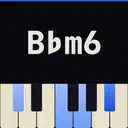
Write Gm6 into a piece in G minor and you have to argue with the key signature. Two flats, B♭ and E♭. The chord keeps the B♭, which is its third, and cancels the E♭, because its sixth is E natural. Every bar the chord appears in needs a natural sign, and that one accidental is the entire chord. Put the E♭ back and G, B♭, D, E♭ is not a minor 6th at all, it is E♭maj7 with G in the bass.
So this is not G minor with an ornament attached. It is a G minor chord that has quietly left G natural minor for G Dorian, which carries the B♭ but not the E♭. Read the same four notes from the bottom rather than from G and they spell E, G, B♭, D, which is Em7♭5. One chord, two names, and only what happens next decides which.
Try It: Gm6 in the Chord Finder
The Notes of Gm6
| Degree | Note | Interval from Root | Semitones |
|---|---|---|---|
| 1 (Root) | G | Perfect unison | 0 |
| ♭3 | B♭ | Minor 3rd | 3 |
| 5 | D | Perfect 5th | 7 |
| 6 | E | Major 6th | 9 |
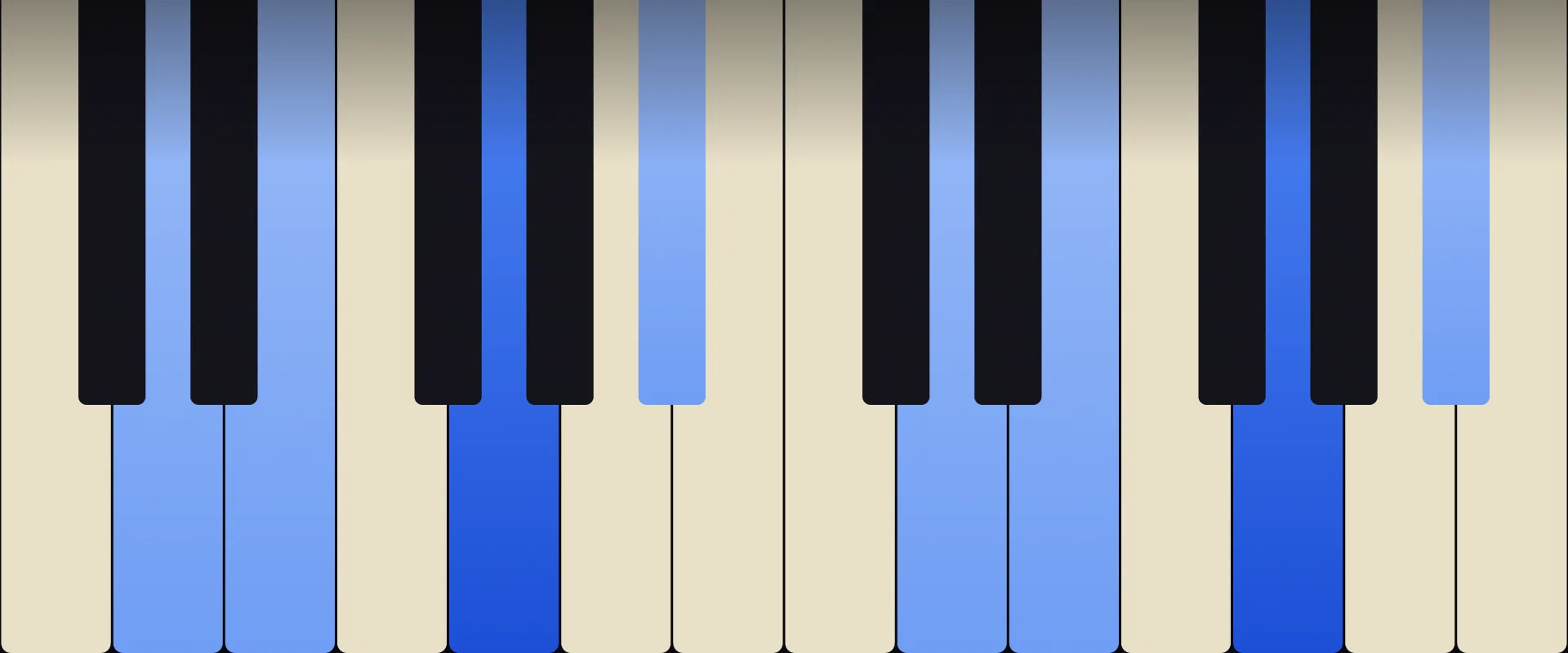
Three white keys and one black. Note that the sixth is major even though the third is minor: nothing about a minor chord obliges the note above the fifth to be flattened as well.
How Gm6 Is Built
Take Gm, the G, B♭ and D every chart in F major and B♭ major asks for, and put E on top. That one note sits a semitone away from a far more common chord in each direction. Lower it to E♭ and you have the relative major seventh in disguise. Raise it to F and you have Gm7, the workhorse ii chord of every standard in F. Gm6 is the narrow strip of ground between them.
Its edge comes not from the sixth against the root, which is consonant, but from the B♭ against the E. Those two are a tritone apart. A minor triad has no tension in it anywhere; add the major sixth and a tritone has been smuggled into a chord that still works as a resting place. That is why Gm6 can serve as a tonic and as a dominant substitute in the same tune.
Gm6 on the Piano
The hand is shaped by the top two notes here, not by the black key. D and E are neighbouring white keys, a whole step apart, so the fourth and fifth fingers land side by side at the top. Right hand 1, 2, 4, 5 from G upwards, left hand 5, 4, 2, 1, and the span from G to E is a major 6th, comfortable for almost any hand.
That crowded top is worth listening to before you decide where to put the chord. Two adjacent white keys in the highest voices thicken the sound, and below middle C the B♭ and E tritone under them turns the whole thing to mud. Keep the root low and alone, put G and D in the left hand, and voice B♭, E and G in the right, so the sixth sits inside the chord as colour instead of jutting out of the top.
Only one arrangement of these four notes has no second in it anywhere: E, G, B♭, D, three minor thirds in a row. That is the third inversion, and it is why the half diminished name exists. A minor 6th is the one common four note chord whose tidy stack of thirds is not its root position, which is why Gm6 looks lopsided on paper and Em7♭5 does not.
Gm6 on the Guitar
Plain Gm is where a guitarist runs out of open strings: the six of them supply G, B and D and no B♭ anywhere. Adding the sixth does not fix that. What it fixes is the top string.
The lowest B♭ on the instrument is the 1st fret of the 5th string, easy ground. Fret it, add the 3rd fret of the 6th string for the root, and the open D and G strings are already chord tones. Only the 2nd string is a problem, since open B is the major third, so put it at the 3rd fret for a D. That leaves the top string, and here is the payoff: open high E is the sixth. Plain Gm has to mute it. Gm6 lets it ring.
| Form | Frets | Notes sounded |
|---|---|---|
| Open position | 3 1 0 0 3 0 | G B♭ D G D E |
| Em6 shape, barred at 3 | 3 5 5 3 5 3 | G D G B♭ E G |
| Compact grip | 3 x 2 3 3 x | G E B♭ D |
| Am6 shape, barred at 10 | x 10 12 12 11 12 | G D G B♭ E |
| Over an E bass | 0 1 0 0 3 0 | E B♭ D G D E |
The barred form deserves a warning. Gm at the 3rd fret is an index barre plus two fingers on one fret. Gm6 in the same position needs three fingers at the 5th fret on strings 5, 4 and 2, skipping the 3rd string in the middle, while the index still holds all six. Up there the sixth costs you a finger. Down in open position it gives you one back.
Most players who meet this chord in a jazz context never barre it at all. The compact grip, 3 x 2 3 3 x, has all four notes, no doublings, and moves to any root. Try the last row too: two fingers, four open strings, and because the bottom note is E it sounds like Em7♭5 rather than Gm6.
Inversions
| Inversion | Notes | Bass | Symbol |
|---|---|---|---|
| Root position | G B♭ D E | G | Gm6 |
| 1st inversion | B♭ D E G | B♭ | Gm6/B♭ |
| 2nd inversion | D E G B♭ | D | Gm6/D |
| 3rd inversion | E G B♭ D | E | Gm6/E, or Em7♭5 |
Nobody writes Gm6/E. The third inversion is called Em7♭5, and that is by far the most common way these four notes appear in print, because a half diminished chord has a job to do: it is the ii of D minor, and it leads to A7.
Second inversion is the awkward one: D and E end up adjacent at the bottom, and a whole step down there is muddy at any pitch.
Voicings
Where the E goes decides what the chord is for. High on top it is bright and slightly bluesy, the sound of a western swing band. Buried between B♭ and G it turns plush, which is what a big band arranger means when the score says Gm6.
Drop the fifth if you need room: G, B♭ and E still name the chord, since B♭ gives the quality and E rules out Gm7. Drop the root instead and B♭, D and E is what a pianist plays over a bass player’s G.
The most useful thing to know is what happens when the bass moves. Hold G, B♭, D and E and let the bass fall from G to C: the five notes now sounding are C, E, G, B♭ and D, a complete C9 with nothing doubled. In F major that makes Gm6 and C9 one handful of notes, so a ii to V asks nothing of your right hand.
Which Keys Contain Gm6
- I of G dorian
- I of G melodic minor
- II of F major
- IV of D harmonic minor
- V of C mixolydian
- III of E locrian
The scale you would expect at the top of that list is missing. G natural minor does not contain the chord, because its sixth degree is E♭. That absence is the whole point, and the reason a minor 6th pulls its key towards Dorian.
All four notes also sit inside the E blues scale, where G is the second degree, so a blues lick in E runs over Gm6 with no wrong note available.
Where Gm6 Shows Up
| Progression | Chords | Typical use |
|---|---|---|
| iiø7, V7, i in D minor | Em7♭5, A7, Dm | Minor ii V i, the chord’s day job |
| iv6, V7, i in D minor | Gm6, A7, Dm | The same notes, root in the bass |
| i6, iv7, V7, i6 in G minor | Gm6, Cm7, D7, Gm6 | Swing and gypsy jazz tonic |
| ii, V, I in F | Gm6, C9, F | Bass moves, hand does not |
| i, IV vamp in G Dorian | Gm6, C7 | Modal jazz, soul, film cues |
The first two rows are one progression written twice. Whether the arranger calls it Em7♭5 or Gm6 comes down to the note the bass player is given, and the two genuinely differ: the half diminished version leans hard on A7, while the Gm6 version is a plagal chord sliding into the dominant.
The third row is why the chord exists in swing. Before bebop, a minor key tune ending on Gm7 sounded unfinished, because the F on top is a seventh and sevenths move. A minor 6th has no seventh in it, so it stops. That is the same instinct that ended major key arrangements on 6th chords rather than major 7ths, applied to the minor. Autumn Leaves, whose standard fake book key is G minor, usually lands here rather than on a plain Gm.
The last row belongs to the mode. Vamp Gm6 against C7 and the E natural is shared by both chords, so the harmony barely moves while the bass does all the work. That is G Dorian stated in two chords, and it is the sound of a great many soul and film cues that never name a mode anywhere on the page.
Related Chords
- G Minor Chord, the triad this one is built on
- G Major 6th Chord, the same added E over a major third
- G Diminished Chord, which flattens the fifth instead of adding a sixth
- Em7♭5, these four notes read from the bottom up, and the reason the chord is on so many charts
- Seventh Chords: The Complete Guide for Gm7 and GmMaj7
- Extended Chords and Jazz Harmony for Gm6/9 and Gm11
- The G Dorian Scale, the mode this chord announces
- The G Melodic Minor Scale, the other scale it is the tonic of
- Guitar Chord Shapes: The CAGED System
Learn More
Practice Chords
Drill chord recognition with a metronome, MIDI support, and score tracking.
Start PracticingRelated Articles
A Minor 6th Chord: Notes, Voicings, and How to Play It
Aug 27, 2026 · 8 min
A♭ Minor 6th Chord: Notes, Voicings, and How to Play It
Aug 27, 2026 · 8 min
B Minor 6th Chord: Notes, Voicings, and How to Play It
Aug 27, 2026 · 8 min