F♯ minor is the minor chord guitarists actually own, because it is the vi of A major and A major is where a great deal of guitar music lives. F♯m6 is not welcome there. The note that makes it is D♯, A major has a D natural, and the one addition that turns the triad into this chord is also the one that walks it out of the key that made the triad popular.
What it buys is a mode. D♯ is the sixth degree of F♯ Dorian and of F♯ melodic minor, and both claim this chord as their tonic. F♯m leaves the question open; F♯m6 has answered it before a melody has played a note.
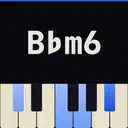
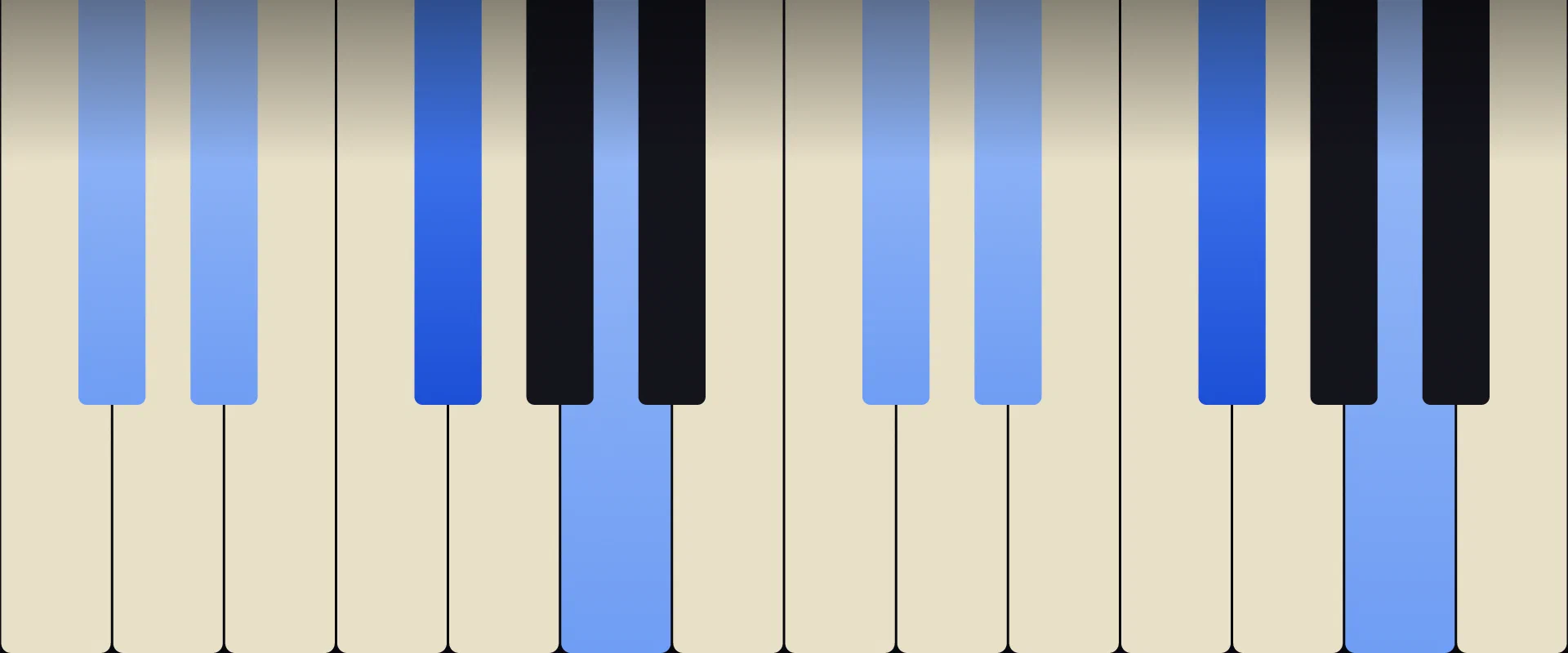
Try It: F♯m6 in the Chord Finder
The Notes of F♯m6
F♯m6 contains four notes.
F♯, A, C♯, D♯
| Degree | Note | Interval from root | Semitones |
|---|---|---|---|
| 1 | F♯ | Root | 0 |
| ♭3 | A | Minor 3rd | 3 |
| 5 | C♯ | Perfect 5th | 7 |
| 6 | D♯ | Major 6th | 9 |
The third is flattened and the sixth is not, which looks like a contradiction and is the point: a minor sixth above F♯ would be D natural, and F♯, A, C♯ and D is a far darker chord. Notice too which note is plain. F♯, C♯ and D♯ all carry an accidental, and A is the only natural here, as it is in the F♯ minor triad.
How F♯m6 Is Built
Take F♯, A and C♯ and add D♯ on top. No seventh sits underneath, so all four are chord tones rather than extensions, and any of them can take the bass or the melody.
F♯m7 adds E instead, one semitone away and nothing alike in use. E leans downward and makes the chord a ii waiting for a B; D♯ leans nowhere and lets F♯ sound like home, which is why jazz players end a minor tune on F♯m6.
Buried inside is a tritone, A up to D♯. F♯6 holds no such interval, and it is why this chord can pull as well as rest. Rotate the notes so D♯ is lowest and they spell D♯, F♯, A, C♯, which is D♯m7♭5. A minor 6th chord and the half diminished chord a major sixth above its root are one set of notes in two orders, and the bass decides the name.
F♯m6 on the Piano
Look at the black key groups. C♯ and D♯ are the complete pair, F♯ is the first key of the group of three, and A is a white key buried inside that group between G♯ and A♯. The one lowered note sits in the middle of the hand, not at either end.
Finger it 1, 2, 3, 5 in the right hand. The obvious 1, 2, 4, 5 is a trap: C♯ and D♯ are neighbouring black keys with only D between them, and fingers 4 and 5 are the pair least able to separate, so they arrive as a clump and one note is late. Skipping the fourth opens a gap across the narrowest part of the shape. The left hand mirrors it, 5, 4, 2, 1.
The A wants care. In the plain triad it can be taken on its rear strip, level with the black keys either side. Here the stretch to D♯ drags the second finger onto the wide front of the key, the wrist tilts, and the little finger loses the top of D♯. Set A back first, then place the outer fingers. Keep those three in the right hand, put D♯ alone in the left, and you are playing D♯m7♭5.
F♯m6 on the Guitar
There is no open form, and the movable shape that works is the one a player already owns. The F♯ minor barre at the 2nd fret, 2 4 4 2 2 2, becomes F♯m6 when the second string alone moves up two frets: 2 4 4 2 4 2.
The cost is precisely the little finger. F♯m there barres with the index, uses two fingers behind it and leaves the fourth idle. F♯m6 puts it on the second string at the 4th fret, in line with the two already down. Nothing stretches, but the weakest finger now holds the note the chord is named for, at the 2nd fret where the barre is already fighting the stiffest part of the string. Let it go soft and the D♯ buzzes or dies, and a dead D♯ is F♯ minor again.
Higher up, the A minor shape at the 9th fret, x 9 11 11 10 9, needs only the first string raised: x 9 11 11 10 11. Narrow frets and lower action make that one nearly free, and dropping the third string, x 9 11 x 10 11, costs only a doubled F♯. Add the sixth string at the 11th fret, D♯, and the grip is D♯m7♭5.
Inversions
| Inversion | Notes | Bass note |
|---|---|---|
| Root position | F♯ A C♯ D♯ | F♯ |
| 1st inversion | A C♯ D♯ F♯ | A |
| 2nd inversion | C♯ D♯ F♯ A | C♯ |
| 3rd inversion | D♯ F♯ A C♯ | D♯ |
The third inversion is barely an inversion at all: it is D♯m7♭5 in root position, and an arranger writing D♯ underneath means that chord. First inversion hides another surprise. A, C♯, D♯ and F♯ over an A bass reads as A major with a raised fourth and no fifth, the A Lydian colour rather than anything minor. Three chords, one set of notes. Chord Inversions and Voice Leading explains why the lowest note decides.
Voicings
Drop the fifth. F♯, A and D♯ wastes nothing: root, minor third, major sixth, the tritone and its anchor. C♯ adds body but no information. On guitar that is x x 4 2 4 2 across the top four strings. On piano, hold F♯ and C♯ low as a bare fifth and keep A and D♯ together above, since it is the distance between those two that people recognise.
Which Keys Contain F♯m6
| Degree | Key |
|---|---|
| i | F♯ dorian |
| i | F♯ melodic minor |
| ii | E major |
| iv | C♯ natural minor |
| iv | C♯ harmonic minor |
| vi | A lydian |
The first two rows are the chord naming its own mode, and it cannot tell them apart: F♯ Dorian and F♯ melodic minor differ only at the seventh, E against E♯, and this chord has none.
As the ii of E major it carries D♯, that key’s leading note, so a subdominant is doing a dominant’s pulling, where F♯m7 in the same slot carries E and pulls nowhere. The last row is the warning: A lydian, not A major. The parent key of the F♯ minor triad has D natural in it, so F♯m6 is not available there, and using it anyway raises the fourth degree of the key.
Where F♯m6 Shows Up
F♯m6 and B, repeated. The i and IV of F♯ Dorian. B major is B, D♯ and F♯, so both chords carry the D♯ and neither offers a D natural, which is the whole modal argument in two bars. On guitar the hand never travels: B is x 2 4 4 4 2, the A shape at the same 2nd fret the F♯m6 grip occupies.
F♯m, F♯m(maj7), F♯m7, F♯m6. The descending line cliché, and this chord is where it lands. An inner voice walks F♯, E♯, E, D♯ while everything around it holds still, a semitone a bar, which is the standard way of making a static minor chord feel as though it moves.
D♯m7♭5, G♯7, C♯m. The minor ii, V, i in C♯ minor, where the first chord is this one with D♯ in the bass. C♯ minor is the relative minor of E major, so the cadence sits in guitar territory: the ii is the fret 2 grip and both G♯7 and C♯m are barres at the 4th fret. The G♯7 takes its B♯ from C♯ harmonic minor.
One short move nobody teaches: F♯m6 straight to E major, with no dominant between them. The leading note is already inside the chord, so the resolution is prepared without a B7 being played.
Related Chords
- F♯ Minor Chord, the triad underneath the added sixth
- F♯ Major 6th Chord, the same operation on a major triad, with A♯ in place of A
- F♯ Sus2 Chord, the third removed rather than a sixth added
- Guitar Chord Shapes: The CAGED System, for the other positions that produce it
Learn More
- Seventh Chords: The Complete Guide, including D♯m7♭5, which shares all four notes
- Extended Chords and Jazz Harmony, for why a 6th is not a 13th
- Minor Scales: Natural, Harmonic and Melodic, and where the D♯ comes from
- The F♯ Dorian Scale, the mode this chord announces
Practice Chords
Drill chord recognition with a metronome, MIDI support, and score tracking.
Start PracticingRelated Articles
A Minor 6th Chord: Notes, Voicings, and How to Play It
Aug 27, 2026 · 8 min
A♭ Minor 6th Chord: Notes, Voicings, and How to Play It
Aug 27, 2026 · 8 min
B Minor 6th Chord: Notes, Voicings, and How to Play It
Aug 27, 2026 · 8 min