The sixth degree of F natural minor is D♭. Fm6 refuses it and takes D natural instead, and that one white key is the entire chord. Raising the 6th of a natural minor scale is what produces Dorian, so this is less a minor chord with a note bolted on than a Dorian chord compressed into four notes.
The refusal has consequences. F minor is the vi of A♭ major, but A♭ major owns D♭, so the moment the 6th arrives the chord walks out of that key. It stays put in C minor, where D is diatonic and F minor is the iv, and in E♭ major as the ii chord.
Try It: Fm6 in the Chord Finder
Set F as the root, then play the same four notes with D at the bottom and hear the label change.
The Notes of Fm6
| Degree | Note | Interval from Root | Semitones |
|---|---|---|---|
| 1 (Root) | F | Perfect unison | 0 |
| ♭3 | A♭ | Minor 3rd | 3 |
| 5 | C | Perfect 5th | 7 |
| 6 | D | Major 6th | 9 |
Look at A♭ and D together: six semitones apart, a tritone, inside a chord containing no 7th at all. That interval is the reason Fm6 has an edge Fm does not.
How Fm6 Is Built
Take the F minor triad and add D a whole tone above the 5th. Nothing is displaced, which separates this from a suspension, and no 7th appears, which separates it from Fm13.
Now restack the same pitches from D upwards: D, F, A♭, C. Those are thirds, and they spell Dm7♭5. A minor 6th chord and the half diminished chord a major 6th above it are one collection of notes with two possible bass notes. Put F underneath and the ear hears a coloured minor chord. Put D underneath and it hears a chord that wants to resolve, because the tritone now runs from root to 5th instead of sitting buried in the middle.
Fm6 on the Piano
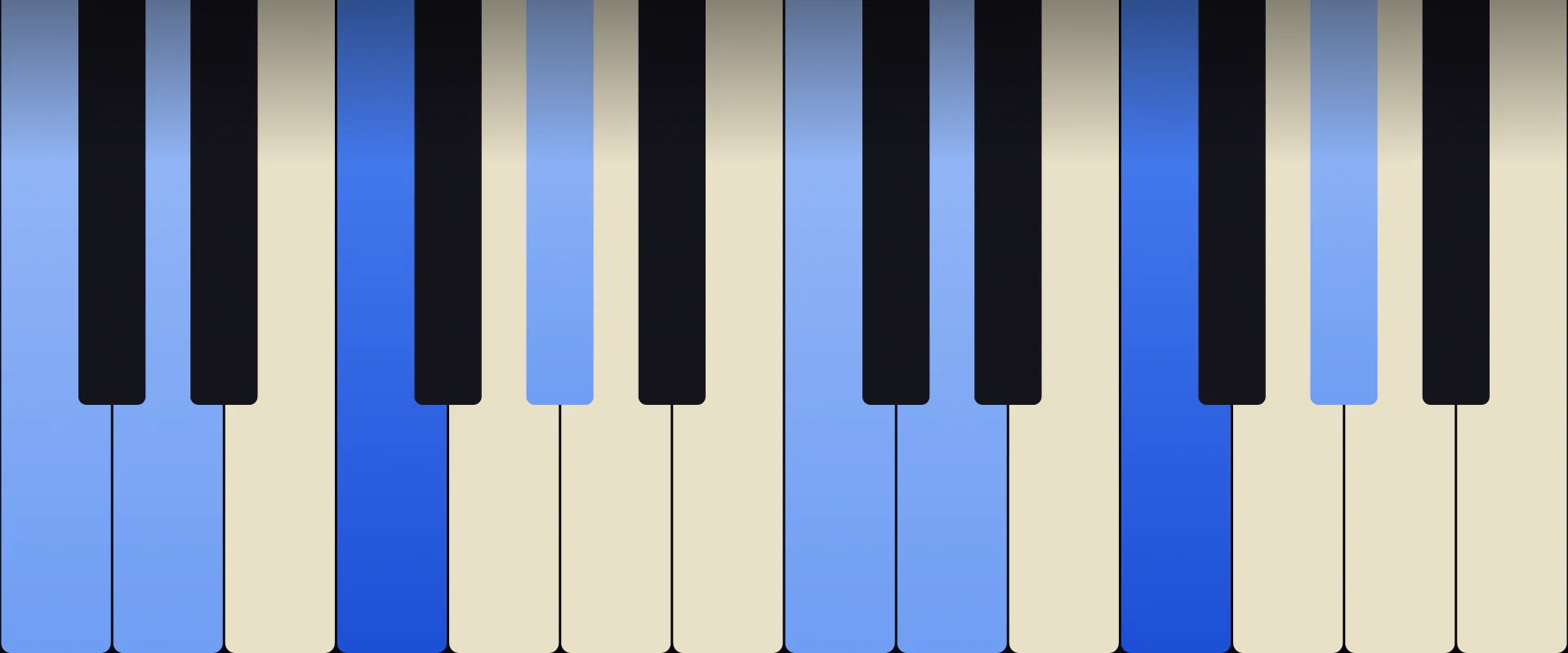
One black key out of four, and it is the middle of the group of three. Thumb on F, the white key immediately left of that group. Index on the black key at its centre. Ring finger on C, little finger on D, the white key between the two blacks. Right hand 1, 2, 4, 5. Left hand 5, 4, 2, 1. The stretch is a 6th, so nothing strains.
Set that beside Fm7, which is F, A♭, C and E♭. The seventh chord puts a second black key under the little finger and pushes the top of the hand deeper into the keyboard. Fm6 keeps both outer fingers on white keys, so the hand lies flatter here than on any other four note chord in F minor.
The chord also earns a drill. Hold A♭ and C with F below them and walk a single finger down from F to E to E♭ to D. The harmony reads Fm, Fm(maj7), Fm7, Fm6, and this chord is where the descent lands. For arranging, drop the 5th: F, A♭ and D is a minor 3rd under a tritone, lean enough to stay legible low on the keyboard. Add G for Fm6/9.
Fm6 on the Guitar
F minor is famously kinder to the left hand than F major, because the Em shape barred at the 1st fret, 1 3 3 1 1 1, needs only two fingers above the barre where F major needs three. That advantage does not survive the 6th. The Em6 shape at the same fret is 1 3 3 1 3 1, sounding F, C, F, A♭, D, F, and it puts three fingers back above the barre: middle on the 5th string at fret 3, ring on the 4th at fret 3, little finger reaching across to the 2nd string at fret 3.
It is arguably worse than F major, not merely equal. The fingers sit in two separate clusters with the 3rd string running under the gap, and that 3rd string, fretted at the 1st fret by the barre alone, is where A♭ comes from. Let the barre buzz there, as it does at the nut end where string tension is highest, and the chord loses the note that makes it minor.
Most players avoid the full shape. Drop the 5th and the top four strings give x x 3 1 3 1, which is F, A♭, D, F: ring finger on the 4th string, little finger on the 2nd, index across the 3rd and 1st at fret 1. Further up, the Am6 shape barred at fret 8 gives x 8 10 10 9 10, with the ring finger flat across the 4th and 3rd strings, where slacker strings make the grip work.
The easiest route is a cheat. Play x x 0 1 1 1: open D string, index barred across the top three at fret 1, one finger for four notes. That is D, A♭, C and F, every note of this chord with D in the bass, and no chart will call it Fm6. It is written Dm7♭5. A capo at fret 1 solves the problem from the other side, since the open Em6 shape, 0 2 2 0 2 0, becomes Fm6 with three ordinary fingers.
Inversions
| Inversion | Notes | Bass Note | Symbol |
|---|---|---|---|
| Root position | F, A♭, C, D | F | Fm6 |
| 1st inversion | A♭, C, D, F | A♭ | Fm6/A♭ |
| 2nd inversion | C, D, F, A♭ | C | Fm6/C |
| 3rd inversion | D, F, A♭, C | D | Fm6/D |
The bottom row is not an inversion in practice. Nobody writes Fm6/D, because a stack of thirds from D sounds rooted on D. The 2nd inversion is the awkward one: C and D adjacent at the bottom thicken into mud below middle C, so send the D up an octave. First inversion is better than it looks, since A♭ in the bass steps down to G under the G7 that so often follows.
Voicings
Keep the 6th above the ♭3. D over A♭ opens the tritone outward and reads as colour. D squeezed below A♭ closes it inward and starts to sound like an inverted diminished chord looking for somewhere to go.
| Shape | Frets, low to high | Sounding notes |
|---|---|---|
| Em6 shape, barred at fret 1 | 1 3 3 1 3 1 | F, C, F, A♭, D, F |
| Am6 shape, barred at fret 8 | x 8 10 10 9 10 | F, C, F, A♭, D |
| Four strings, no 5th | x x 3 1 3 1 | F, A♭, D, F |
| Open, 6th in the bass | x x 0 1 1 1 | D, A♭, C, F |
Which Keys Contain Fm6
- I of F dorian
- I of F melodic minor
- IV of C natural minor
- II of E♭ major
- V of B♭ mixolydian
- III of D locrian
The first line is the home address. The second adds a raised 7th, E natural, which is why improvisers reach for F melodic minor when Fm6 is a tonic rather than a passing colour.
The B♭ mixolydian entry looks odd until you count notes. B♭9 is B♭, D, F, A♭ and C; take the root away and D, F, A♭, C remains. Fm6 is a rootless B♭9, which is why it drops onto a B♭7 bar with no preparation. C harmonic minor holds it too, which is where its partnership with G7 begins, and the whole chord fits inside the D blues scale.
Where Fm6 Shows Up
| Progression | Chords | Where it lives |
|---|---|---|
| i, iv6, V7, i | Cm, Fm6, G7, Cm | Minor cadence in C |
| iiø7, V7, i | Dm7♭5, G7, Cm | Jazz standards in C minor |
| I, iv6, I | C, Fm6, C | Borrowed subdominant in C major |
| i, IV7 | Fm6, B♭7 | Dorian vamp in F |
The first two lines are one chord doing one job with two bass notes. Fm6 and G7 share D and F, so the move to the dominant costs two semitones: A♭ falls to G, C falls to B. Put D underneath instead and you have the minor ii V of a hundred standards, Blue Bossa and Softly, as in a Morning Sunrise among them. Pianists voice that Dm7♭5 as Fm6 in the right hand over a single D in the left, which is why the shape is worth owning under both names.
The third line is where guitarists actually meet this chord. In C major, C to Fm6 and back is the borrowed minor subdominant, and only A♭ is foreign to the key, where Fm7 would import E♭ as well. That one chromatic note is why the minor iv with a 6th ends so many songs in C that never go near F minor: it darkens the plagal cadence without leaving the key.
Horn players see this chord more often than guitarists do. Concert F minor is four flats, which reads as G minor for a B♭ trumpet and D minor for an E♭ alto, both easy keys, while the same music is a 1st fret barre on a guitar. Big band charts sit here happily, and rhythm guitarists reach for a capo.
Related Chords
- F Minor Chord is the triad underneath, before the 6th arrives.
- F Major 6th Chord is the same construction over a major 3rd, and it behaves very differently.
- D Diminished Chord is D, F and A♭, the triad hiding inside this one and the source of the tritone.
- Seventh Chords: The Complete Guide covers half diminished chords in full.
- Chord Inversions and Voice Leading explains why the bass note decides the name.
Learn More
For the raised 6th that defines this sound, see F Dorian. For 6th chords against 13th chords, see Extended Chords and Jazz Harmony. For the iv chord in a minor key, see Diatonic Chords: A Beginner’s Guide, and for why F minor sits where it does among the flat keys, see the circle of fifths. For every scale containing this chord, see Scales for Piano and Guitar: The Complete Reference Guide.
Practice Chords
Drill chord recognition with a metronome, MIDI support, and score tracking.
Start PracticingRelated Articles
A Minor 6th Chord: Notes, Voicings, and How to Play It
Aug 27, 2026 · 8 min
A♭ Minor 6th Chord: Notes, Voicings, and How to Play It
Aug 27, 2026 · 8 min
B Minor 6th Chord: Notes, Voicings, and How to Play It
Aug 27, 2026 · 8 min