Hold an open E minor, drop the little finger on the second string at the 2nd fret, and you have one of only three minor sixth chords the guitar offers in open position. The other two sit on A and D and both need strings muted. This one, 0 2 2 0 2 0, keeps all six ringing. Em6 is E, G, B and C♯, and that fourth note is doing more than adding colour: it is a major sixth sitting over a minor triad, which is a contradiction in natural minor terms, and it forms a tritone with the G underneath it.
Try It: Em6 in the Chord Finder
Set the root to E and pick Dorian, then compare the same chord under E melodic minor and under C♯ Locrian.
The Notes of Em6
Em6 is the minor triad with a major 6th added:
E, G, B and C♯
| Degree | Note | Interval from Root |
|---|---|---|
| 1 (Root) | E | Perfect unison |
| ♭3 | G | Minor 3rd |
| 5 | B | Perfect 5th |
| 6 | C♯ | Major 6th |
Three white keys and one black one, with no spelling trap anywhere: C♯ is where a beginner would look for it, on the lower key of a group of two.
How Em6 Is Built
E minor stays intact and C♯ arrives nine semitones above the root. The sixth has to be major: lower it to C and the four notes read E, G, B, C, which is Cmaj7 with E in the bass.
Two things follow from that C♯. The first is modal. E natural minor has a C, so Em6 is not available in it at all, while the raised sixth is the note that makes E Dorian Dorian. A single Em6 states the mode without help from a melody. The second is the interval between G and C♯: six semitones, a tritone, which no minor seventh contains. Em7 is E, G, B and D and it drifts. Em6 has an edge.
That tritone is the chord’s second identity. Read the notes from C♯ and you get C♯, E, G, B: a minor 3rd, a diminished 5th and a minor 7th above C♯, which is C♯m7♭5. Every minor sixth is the half diminished chord a major sixth above it under another name, and here that is C♯.
Em6 on the Piano
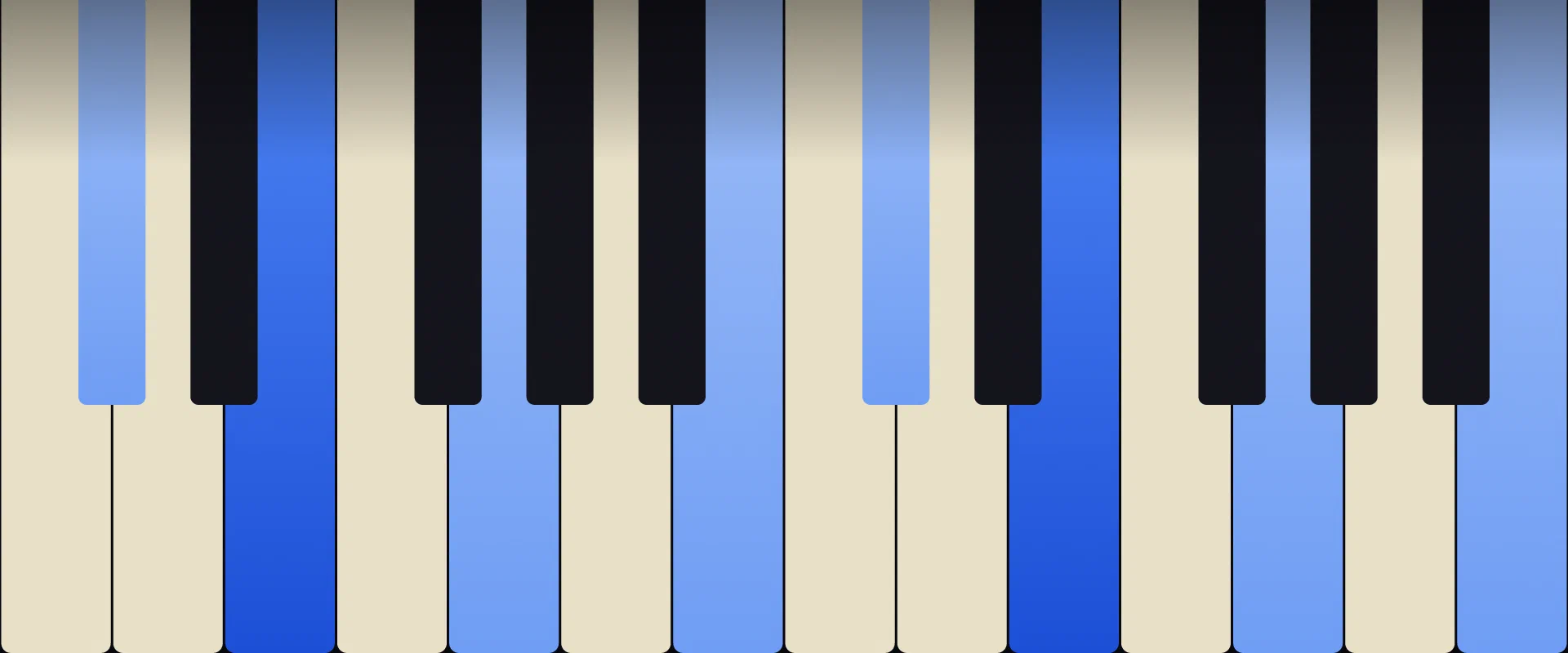
The three white notes are the plain E minor triad, so the hand already knows most of this shape and the sixth disturbs none of it.
Right hand: thumb on E, second finger on G, third finger on B, fifth finger on C♯.
Left hand: fifth finger on E, fourth finger on G, second finger on B, thumb on C♯.
Both landmarks are the same pair of black keys an octave apart. The thumb sits on the white key immediately right of a group of two, and the fifth finger lands on the left key of the next group of two. Nothing needs counting once you see it that way.
Voicing decides which of the two chords you hear. Stack G and C♯ close together in the middle of the keyboard and the tritone dominates, so the ear reports a half diminished chord even with E in the bass. Separate them, E and B low with G and C♯ above middle C, and the same notes settle into a minor chord with a lift in it.
Em6 on the Guitar
The open form sounds E, B, E, G, C♯, E from the bottom up. Keep the standard E minor grip on the middle and ring fingers and use the little finger for the C♯: the index stays free and no open string is given up. E major 6th needs that index as well, on the third string, so the minor version is a finger cheaper and the two differ by a single fret.
Where the C♯ lands gives the shape its character. The top three strings sound G, C♯ and E, so the tritone sits at the very top of the voicing, adjacent and exposed. Strum it hard and it sounds tart. Fingerpick the bottom four and it sounds like an ordinary E minor, because the C♯ is the first thing you drop.
Barre the same fret pattern and it produces every minor sixth with the root on the sixth string: Gm6 at the 3rd fret, Am6 at the 5th, Bm6 at the 7th. That costs the open strings, which is most of the reason to be here at all.
For a lighter voice without the three low E’s, take the A minor sixth shape up to the 7th fret, x 7 9 9 8 9. Quieter still, x x 2 0 2 0 gives E, G, C♯ and E with no fifth at all. For the half diminished reading you need a different bass: x 4 5 4 5 x sounds C♯, G, B and E, the standard grip for that chord in a minor turnaround.
Inversions
| Voicing | Notes | Bass note |
|---|---|---|
| Root position | E G B C♯ | E |
| 1st inversion | G B C♯ E | G |
| 2nd inversion | B C♯ E G | B |
| 3rd inversion | C♯ E G B | C♯ |
Third inversion changes the chord’s name rather than its shape: C♯ in the bass and the ear files it as C♯m7♭5 in root position. Second inversion puts B and C♯ side by side at the bottom, which muddies below middle C. First inversion is the useful one, G under a line falling from E, and on guitar it is nearly free, since 3 2 2 0 2 0 puts a G on the sixth string.
Voicings
- Open form, 0 2 2 0 2 0, six strings, the sixth exposed at the top.
- Fifth omitted, x x 2 0 2 0, light and unobtrusive.
- A minor sixth shape at the 7th fret, x 7 9 9 8 9, no open strings, easy to stop.
- Half diminished bass, x 4 5 4 5 x, the same notes as C♯m7♭5.
- Piano, split, E and B low with G and C♯ above middle C, keeping the tritone open.
Which Keys Contain Em6
Four notes, one sharp, a short list:
- degree 2 (II) of D major
- degree 4 (IV) of B natural minor
- degree 4 (IV) of B harmonic minor
- degree 1 (I) of E melodic minor
- degree 1 (I) of E dorian
- rooted on degree 2 of, and entirely contained in, C♯ blues
E Dorian and E melodic minor both treat this as home and differ only in their seventh. B minor is worth reading twice: the chord is diatonic to the natural and the harmonic form alike, which explains the two jobs it does below. The C♯ blues entry is the improviser’s shortcut, a scale holding all four chord tones.
Where Em6 Shows Up
As the ii of a minor ii V i. C♯m7♭5, F♯7, Bm is the standard approach to a minor tonic, and the first of those three chords is Em6 by another name. That is the practical use of the half diminished identity: a guitarist comps the open shape, the bass plays C♯, and the progression is intact. In B minor the chord is also the iv with its sixth raised, so it approaches F♯7 from two directions at once.
As a Dorian tonic that never resolves. Em6 to A and back is the i to IV vamp of E Dorian, and the C♯ that turns Em into Em6 is the same note that makes the A chord major. Gypsy jazz and bossa nova park on a minor sixth rather than a minor seventh for this reason: m7 sounds like a chord on its way somewhere, m6 sounds like an address.
As two chords at once in D major. Em6 is the ii there, its sixth supplied by the key’s leading tone, and the identical four notes are the viiø7 of D. Play Em6, A7, D and the first chord is predominant and leading tone chord together, which is why it pulls harder than a plain Em in that slot. D, A7 and the open Em6 all sit inside the first three frets, so this is the friendliest home the chord has.
The sixth here is louder than the sixth in a major chord, being a tritone from the third rather than a comfortable fourth. Put Em6 where the harmony should lean, plain E minor where it should rest.
Related Chords
- E Minor Chord: Notes, Voicings, and How to Play It is the triad underneath, one finger cheaper.
- E Major 6th Chord: Notes, Voicings, and How to Play It adds the same C♯ to a major triad and sits one fret away on the third string.
- C♯ Diminished Chord: Notes, Voicings, and How to Play It is C♯, E and G, this chord without its root and the half diminished reading without its seventh.
- Seventh Chords: A Complete Guide to maj7, min7, dom7, and More covers Em7 and C♯m7♭5, the chord’s neighbour and its alter ego.
Learn More
- Extended Chords: Which Tensions Work, and How to Voice Them on why this is a sixth and not a thirteenth.
- The ii V I Progression: Jazz Theory in Practice on the minor cadence this chord opens.
- Chord Inversions and Voice Leading on the bass note that decides between Em6 and C♯m7♭5.
- E Dorian Scale: Notes, Chords, and How to Play It is the mode this chord belongs to, C♯ and all.
Practice Chords
Drill chord recognition with a metronome, MIDI support, and score tracking.
Start PracticingRelated Articles
A Minor 6th Chord: Notes, Voicings, and How to Play It
Aug 27, 2026 · 8 min
A♭ Minor 6th Chord: Notes, Voicings, and How to Play It
Aug 27, 2026 · 8 min
B Minor 6th Chord: Notes, Voicings, and How to Play It
Aug 27, 2026 · 8 min