In the key signature of E♭ minor the sixth degree is written C♭. E♭m6 refuses it and takes C natural, so the chord needs a natural sign inside a key already carrying six flats. That cancellation is the whole story: E♭, G♭, B♭ and C, a minor triad with its sixth borrowed from Dorian. Stack the same four notes with C at the bottom and you are fingering Cm7♭5, which is how most jazz musicians meet this sound long before they write E♭m6 on a chart.
Try It: E♭m6 in the Chord Finder
The Notes of E♭m6
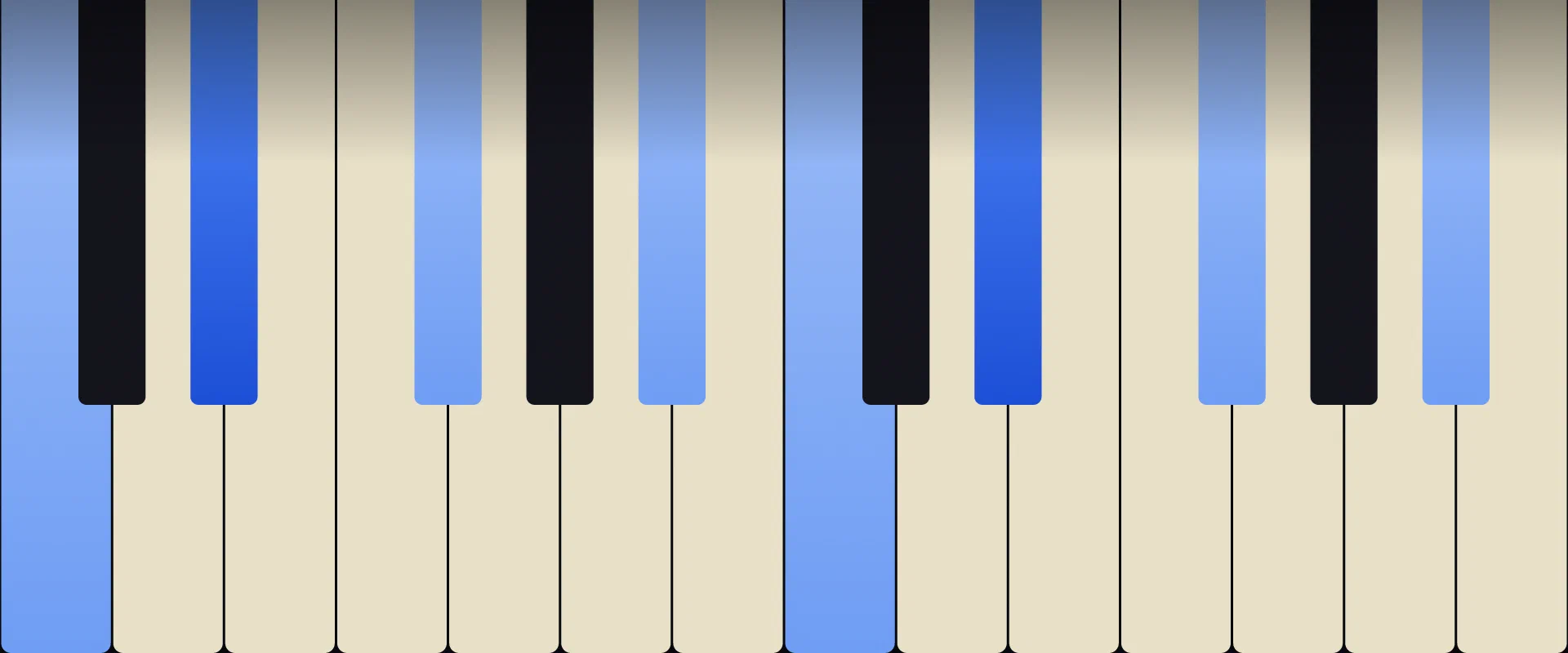
The chord contains four notes: E♭, G♭, B♭ and C.
| Degree | Note | Interval from root | Semitones |
|---|---|---|---|
| 1 | E♭ | Root | 0 |
| ♭3 | G♭ | Minor 3rd | 3 |
| 5 | B♭ | Perfect 5th | 7 |
| 6 | C | Major 6th | 9 |
The symbol is E♭m6, sometimes E♭min6 or, in jazz lead sheets, E♭-6.
How E♭m6 Is Built
Take E♭ minor, E♭ G♭ B♭, and add a major sixth above the root. Nothing is displaced, so the third stays and the chord is unambiguously minor.
The choice of sixth is where the interest sits. E♭ natural minor offers C♭, and E♭ G♭ B♭ C♭ is no minor sixth chord at all: rearranged as C♭ E♭ G♭ B♭ it is C♭maj7. Raising that C♭ a semitone changes the identity outright, which is why this chord belongs to E♭ Dorian and E♭ melodic minor rather than to the six flat key signature it appears to live in.
The engine of the sound is G♭ against C. Six semitones apart, they form a tritone, and that tritone inside an otherwise calm minor triad is what lets these four notes do three different jobs depending on the bass note.
E♭m6 against E♭m7
E♭m7 is E♭ G♭ B♭ D♭. One semitone separates D♭ from C and nothing else differs, but the function does. E♭m7 leans forwards, the ii chord of D♭ major heading for A♭7. E♭m6 leans nowhere: it is what E♭ Dorian and E♭ melodic minor build on their first degree, and a piece can end on it. Move the top voice from C to D♭ and one finger takes away the repose.
E♭m6 on the Piano
Three black keys and one white one, and the white one is the whole problem. E♭, G♭ and B♭ sit deep in the keyboard among the raised keys, while C is out past B at the front edge.
The right hand therefore plays it at an angle. Fingering 1 on E♭, 2 on G♭, 3 on B♭ and 5 on C works, but it asks the shortest finger to stay forward while the other three are pushed back. The instinct is to pull the whole hand out of the black keys, and then E♭ and G♭ slide off their narrow edges. Keep the arm back and let the fifth finger extend alone.
The left hand has the easier job. Fingering 5 on E♭, 3 on G♭, 2 on B♭ and 1 on C puts the thumb on the only white note, which is where a thumb wants to be anyway.
Better still, move the C down an octave and play C E♭ G♭ B♭. The thumb starts on white and the fingers above it climb onto black keys in order, one of the most comfortable four note shapes on the instrument. Same chord, and the reason pianists so often voice this harmony with C in the bass without deciding to.
E♭m6 on the Guitar
No open form exists for this root, and every practical shape lives between the 5th and 8th frets. The one to learn is the drop 2 voicing x 6 8 5 7 x: E♭ on the 5th string, B♭ on the 4th, C on the 3rd, G♭ on the 2nd, both outer strings muted. One finger per fret, index through little finger, no barre, all four notes present and none doubled. This is what a jazz guitarist means by E♭m6.
For strumming, the Am6 shape barred at the 6th fret is fuller, though the complete five string form needs more fingers than a hand has. The workable reduction is x 6 x 8 7 8, dropping the fifth and doubling the root. The fifth is the least missed note here, since losing it leaves the tritone intact.
A low root costs more. The Em6 shape barred at the 11th fret, 11 13 13 11 13 11, puts E♭ on the 6th string but wants a full barre plus three fingers two frets above it, where the spacing has closed to two thirds of what it was at the 6th. Worth it for a held final chord, not for comping.
The half-diminished grip is nowhere near any of these. x 3 4 3 4 x gives C, G♭, B♭, E♭ across the 3rd and 4th frets, which is E♭m6 with C in the bass. A guitarist reading Cm7♭5 plays it without thinking about E♭ at all.
Inversions
| Inversion | Notes | Lowest note |
|---|---|---|
| Root position | E♭ G♭ B♭ C | E♭ |
| 1st inversion | G♭ B♭ C E♭ | G♭ |
| 2nd inversion | B♭ C E♭ G♭ | B♭ |
| 3rd inversion | C E♭ G♭ B♭ | C |
The third inversion is barely heard as an inversion. C E♭ G♭ B♭ is Cm7♭5 in root position, note for note, and once a bass player commits to C the ear stops looking for E♭. The relationship is fixed: a minor sixth chord and the half-diminished chord a major sixth above its root are the same four pitches, so E♭m6 is C half-diminished and nothing in the notes decides which.
Second inversion has one specific use: B♭ is the dominant of E♭ minor, so holding it underneath lets the harmony change above a bass note that never budges.
Voicings
Strip the chord to E♭, G♭ and C. Root, third and sixth, no fifth, and the tritone that defines the sound left exposed. Arrangers write this when the harmony has to be unmistakable in a thin texture, and on guitar it is x 6 x 5 7 x, the drop 2 grip with the 4th string left out.
Where the C sits changes everything. On top of a close voicing the chord reads bright and modal, a Dorian tonic. In the bass the same notes read as a half-diminished chord awaiting a dominant. Buried in the middle it does neither, which is the one placement to avoid.
Add F above and you have E♭m6/9, with F drawn from E♭ Dorian and E♭ melodic minor alike, so nothing foreign has entered. Low E♭ alone in the left hand and G♭ C F in the right makes a good final chord.
Which Keys Contain E♭m6
- I of E♭ Dorian
- I of E♭ melodic minor
- iv of B♭ natural minor
- ii of D♭ major
- II of C♯ melodic minor
- Contained in C blues
The C♯ melodic minor page spells this chord D♯ F♯ A♯ B♯, since a sharp key has no business printing flats. Same sounds, and B♯ is the note you play as C.
The last entry is for improvisers. All four notes fit inside the C blues scale, rooted on its second degree, so a blues line in C cannot collide with this harmony. That is the half-diminished identity seen from the soloist’s side.
Where E♭m6 Shows Up
iiø7, V7, i: Cm7♭5, F7, B♭m. The minor ii V i, whose first chord is E♭m6 with C underneath. C and E♭ hold into the F7, G♭ falls to F, B♭ falls to A. This is where the four notes appear most often in written music, and why players learn them under the Cm7♭5 name.
i6, IV7: E♭m6, A♭7. The Dorian vamp, and barely a chord change. A♭7 is A♭ C E♭ G♭, so three of the four notes are already sounding: only B♭ leaves and A♭ arrives.
E♭m6 over A♭, resolving to D♭maj7. A♭9 is A♭ C E♭ G♭ B♭, so E♭m6 supplies everything but the root. The same four notes sit on the second degree of D♭ major and, over that one bass note, become its dominant.
Two keys generate most real appearances of this chord, B♭ minor and D♭ major, both on the flat side where pianists and horn players are at home and guitarists are not. E♭ Dorian accounts for the rest, in modal jazz and in film cues wanting a minor tonic with colour but no leading note. Which name the score prints, E♭m6 or Cm7♭5, says nothing about the sound and everything about the key the writer had in mind.
Related Chords
- E♭ Minor Chord
- E♭ Major 6th Chord
- C Diminished Chord
- The ii V I Progression in Jazz
- Guitar Chord Shapes: The CAGED System
Learn More
Practice Chords
Drill chord recognition with a metronome, MIDI support, and score tracking.
Start PracticingRelated Articles
A Minor 6th Chord: Notes, Voicings, and How to Play It
Aug 27, 2026 · 8 min
A♭ Minor 6th Chord: Notes, Voicings, and How to Play It
Aug 27, 2026 · 8 min
B Minor 6th Chord: Notes, Voicings, and How to Play It
Aug 27, 2026 · 8 min