Dm6 is D, F, A and B, and every one of those is a white key. Among the twelve minor 6th chords it is the only one that can say so, and the guitar is just as generous. Open Dm is x x 0 2 3 1; lift the ring finger off the second string and you are playing Dm6. No barre, no new grip, one finger removed.
The minor 6th is otherwise a chord players meet late, so reaching it this cheaply changes the question. It stops being how to hold the thing and becomes what it is for: tonic of D Dorian, destination of the descending minor line, three quarters of a G7 and, read from the other end, a half diminished seventh under a different name.
Try It: Dm6 in the Chord Finder
The Notes of Dm6
Dm6 is four notes: D, F, A and B.
| Degree | Note | Interval from Root | Semitones |
|---|---|---|---|
| 1 (Root) | D | Perfect unison | 0 |
| ♭3 | F | Minor 3rd | 3 |
| 5 | A | Perfect 5th | 7 |
| 6 | B | Major 6th | 9 |
How Dm6 Is Built
Take D minor, D F A, and add the sixth degree above D. That sixth is B natural, and emphatically not B♭. D natural minor contains B♭, so the B has come from elsewhere: from D Dorian or from D melodic minor, the two scales that raise the sixth degree. Dm6 is a minor chord announcing which kind of minor it stands in. Between its F and B sits a tritone, the only genuinely sharp interval here, and the reason it does not sound like a sad chord with decoration added.
Against Dm7 the difference is one semitone: C becomes B. That is a change of employment, not of colour. The C in Dm7 makes it the ii chord of C major, waiting on G7. The B is already inside G7, whose third, fifth and seventh are B, D and F, so Dm6 holds three quarters of the dominant instead of queueing in front of it.
Stack the same pitches from B and you get B, D, F, A: root, minor third, diminished fifth, minor seventh, which is Bm7♭5. B is a major sixth above D, so a minor 6th chord’s half diminished twin always sits on its own sixth degree. One set of four pitches, two jobs, and the bass decides.
Dm6 on the Piano
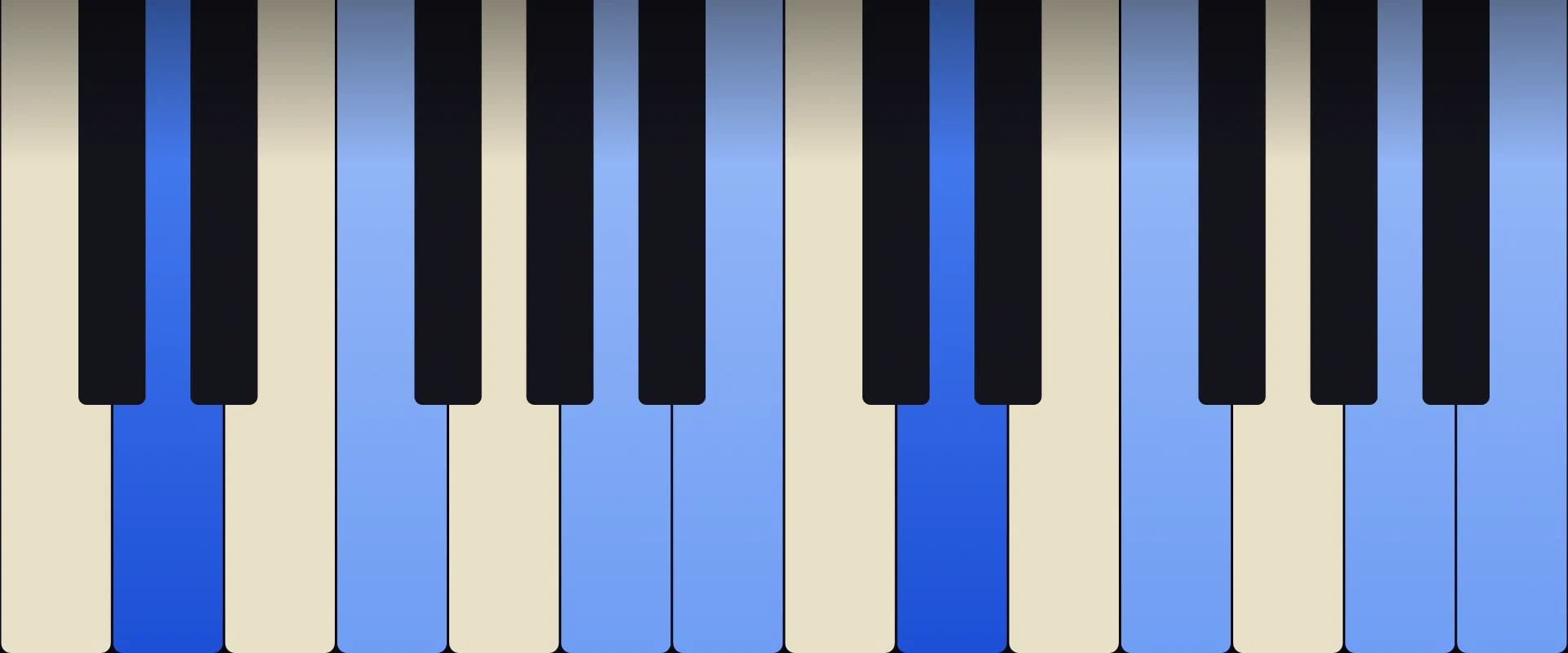
Four white keys and no black ones. Nothing to reach over, nothing to slide back between, and the fingers can lie flat. No other minor 6th chord allows that, which is why this one gets taught first.
Find it by shape rather than by counting. D sits in the notch of the group of two. The other three bracket the group of three: F just before it, A tucked between its second and third keys, B just after. Read it that way and the hand goes there without looking.
Right hand 1, 2, 3, 5 fits exactly, thumb on D and little finger on B, and since the chord spans a major sixth nothing stretches. The little finger is the part worth practising. Hold D, F and A with 1, 2 and 3 and the fifth has two adjacent white keys to choose between: B gives Dm6, C gives Dm7.
Watch the tritone rather than the whole step. F and B a tenth apart read as colour; jammed together in the middle they read as a dominant that never resolves. Put D alone low in the left hand, take F, A and B in the right, then hold the right hand still and move the left down to B. The chord is now Bm7♭5.
Dm6 on the Guitar
x x 0 2 0 1, low to high, is D, A, B, F. Index at the 1st fret of the top string for F, middle at the 2nd fret of the G string for A, open 4th and 2nd strings underneath. Two fingers, four ringing strings.
The top two voices are the tritone, both wide open at the bright end of the instrument: the second string ringing on B, the first stopped a fret above it on F. That is why the open shape sounds so much more pointed than open Dm.
The second string tells the whole story. Hold the 4th string open, the G string at the 2nd fret and the top string at the 1st, then move only the second:
| 2nd string | Note | Chord |
|---|---|---|
| 3rd fret | D | Dm |
| 2nd fret | C♯ | DmMaj7 |
| 1st fret | C | Dm7 |
| open | B | Dm6 |
Played downwards that is the minor line cliché, the device behind the James Bond theme and a long list of minor key ballads, and in D it walks chromatically onto an open string with Dm6 waiting at the bottom.
Higher up, the Am6 shape barred at the 5th fret gives x 5 7 7 6 7, five strings with the sixth on top, and the Em6 shape barred at the 10th fret gives 10 12 12 10 12 10, the only common grip with a low D underneath, at the price of cramped frets and a thin barre. For root position without a barre, x 5 3 2 0 x spells D, F, A, B in order.
One trick belongs to the open shape alone. Mute the 5th string and add the 3rd fret of the 6th: 3 x 0 2 0 1 is G, D, A, B, F, a complete G9.
Inversions
| Inversion | Bass Note | Notes | Symbol |
|---|---|---|---|
| Root position | D | D, F, A, B | Dm6 |
| 1st inversion | F | F, A, B, D | Dm6/F |
| 2nd inversion | A | A, B, D, F | Dm6/A |
| 3rd inversion | B | B, D, F, A | Dm6/B |
The third inversion is the one to know, because Dm6/B and Bm7♭5 are played identically. Resting on D, it is Dm6 with the sixth in the bass. Heading for E7 and then A minor, it is Bm7♭5.
Voicings
Guitar, open (x x 0 2 0 1). Two fingers.
Guitar, root position (x 5 3 2 0 x). No barre.
Guitar, Am6 shape at fret 5 (x 5 7 7 6 7). Movable.
Guitar, Em6 shape at fret 10 (10 12 12 10 12 10). The only grip with a low D.
Piano, spread (D low, F A B above). Tritone opened out.
Piano, as Bm7♭5 (B low, D F A above). Same right hand.
Which Keys Contain Dm6
Six scales on this site that hold all four notes without borrowing an accidental:
- i of D dorian
- i of D melodic minor
- ii of C major
- iv of A natural minor
- iv of A harmonic minor
- ii of C melodic minor
Those six cover four different collections, and one chord fits them all because of what it leaves out. D Dorian and D melodic minor differ only at C against C♯. A natural minor and A harmonic minor differ only at G against G♯. C major and C melodic minor differ only at E against E♭. Dm6 contains no C, no G and no E, so it omits precisely the degree each pair argues about.
Where Dm6 Shows Up
The tonic of D Dorian. Sixteen bars of “So What” sit on D Dorian before the tune lifts to E♭ Dorian, and D Dorian is the mode this chord comes out of. The written symbol there is Dm7, and Bill Evans voices it in fourths, E A D G B, with no F in it at all, but the B survives every version of that sound. Vamp i6 to IV, Dm6 to G, and the B holds through both chords.
The minor ii to V, from either side. In A minor the progression iv6, V7, i is Dm6, E7, Am, and the voice leading barely moves: F falls to E, A rises to G♯, B and D are held. Put B in the bass and the same four notes become iiø7, V7, i, or Bm7♭5, E7, Am, which is how a jazz player writes it.
Standing in for the dominant. Since B, D and F are the working parts of G7, a G underneath turns I, V9, I in C major into C, Dm6/G, C, a full dominant ninth with the left hand free.
Ending a minor tune. Swing bands and gypsy jazz players habitually finish on a minor 6th rather than a minor 7th, and in D minor the reason is audible. Dm7 ends a piece with a C in it, and a C over a D root sounds like the ii chord of C major looking for somewhere to go. Dm6 has no such note. Run i, i(maj7), i7, i6 as Dm, DmMaj7, Dm7, Dm6 and the chord you stop on sounds finished.
Related Chords
- D Minor Chord, the triad under the added sixth.
- D Major 6th Chord, the same construction on a major triad.
- The D Dorian Scale, where this chord is the tonic.
- The D Melodic Minor Scale, the other scale that claims it as home.
- Seventh Chords: The Complete Guide for Dm7 and the half diminished Bm7♭5.
Learn More
Practice Chords
Drill chord recognition with a metronome, MIDI support, and score tracking.
Start PracticingRelated Articles
A Minor 6th Chord: Notes, Voicings, and How to Play It
Aug 27, 2026 · 8 min
A♭ Minor 6th Chord: Notes, Voicings, and How to Play It
Aug 27, 2026 · 8 min
B Minor 6th Chord: Notes, Voicings, and How to Play It
Aug 27, 2026 · 8 min