Flatten the third of C♯6 and the chord stops arguing with you. C♯6 carries an E♯ that has to be played on the white key F, which is why most music at that pitch is printed as D♭6 instead. C♯m6 has no such problem: C♯, E, G♯, A♯, with the only natural written as the plain letter E. Here the flat reading is the awkward one, since D♭m6 spells out as D♭, F♭, A♭, B♭ and drops F♭ onto the white key E. The sharp spelling is also the tidy one, which is convenient, because C♯ minor is a key guitarists genuinely live in rather than a theoretical address like C♯ major.
Try It: C♯m6 in the Chord Finder
The Notes of C♯m6
| Degree | Note | Interval from root | Semitones |
|---|---|---|---|
| 1 | C♯ | Root | 0 |
| ♭3 | E | Minor 3rd | 3 |
| 5 | G♯ | Perfect 5th | 7 |
| 6 | A♯ | Major 6th | 9 |
Three semitones, then four, then two. The interval that decides the character is not between neighbours: E up to A♯ is six semitones, a tritone inside a chord that otherwise looks stable, which is why a minor sixth never quite settles.
How C♯m6 Is Built
Take the C♯ minor triad, C♯, E and G♯, and add A♯. Nothing is removed and the fifth stays perfect, so the chord is still unambiguously minor. The added note decides which minor you are in: C♯ natural minor has A natural as its sixth degree, and raising it to A♯ puts you in C♯ Dorian or C♯ melodic minor.
Now the identity that makes this chord worth learning. A♯ stands a major sixth above C♯: nine semitones, and C to A is six letter names. Take that A♯ as the bass and reread the same four pitches from the bottom. A♯ to C♯ is a minor third. A♯ to E is six semitones across five letter names, which makes it a diminished fifth rather than an augmented fourth. A♯ to G♯ is a minor seventh. Minor third, diminished fifth, minor seventh is the definition of a half-diminished seventh, so A♯m7♭5 and C♯m6 are not relatives. They are one set of notes with two bass notes and two names, and the tritone noticed a moment ago is that chord’s flattened fifth read upside down.
C♯m6 on the Piano
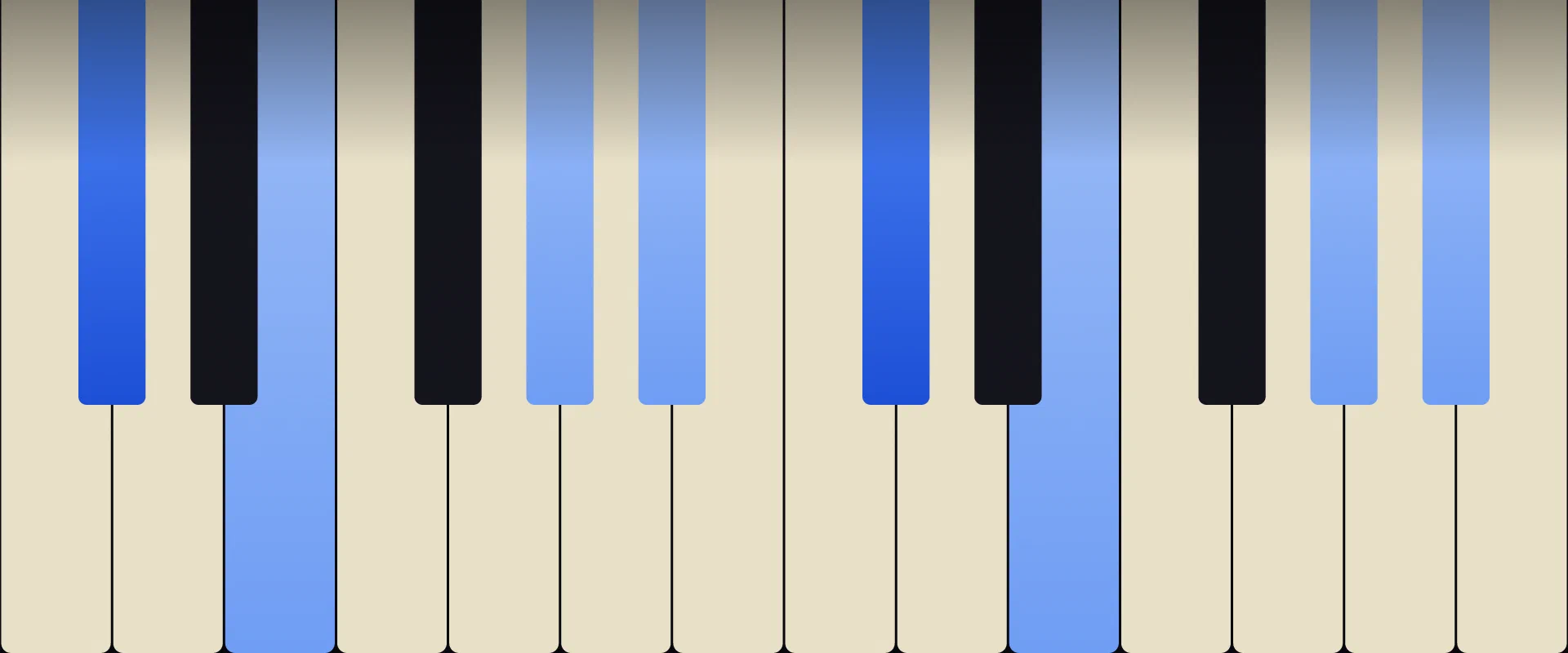
Each note has a distinct address, so the shape is easy to memorise. C♯ is the lower key of the group of two. E is the white key immediately left of the group of three. G♯ and A♯ are the middle and top keys of that group. The hand starts on the pair, drops into the notch before the triplet, then finishes on two raised keys with one white key skipped between them.
Right hand, root position: 1 on C♯, 2 on E, 4 on G♯, 5 on A♯. The thumb sits on a narrow black key, which beginners resist, and the two weakest fingers hold the two most characterful notes. Keep the wrist level: rolling the hand outward to reach A♯ is what slides the little finger off the edge. Left hand, mirrored: 5 on C♯, 4 on E, 2 on G♯, 1 on A♯.
Against the plain C♯ minor triad, where black, white, black lets the hand lie flat, this chord adds a second black key at the top, so three fingers sit back on the raised row and only the second is forward. Two dodges follow. Give C♯ to the left hand and take E, G♯, A♯ alone in the right. Or start from A♯, C♯, E, G♯, the half-diminished shape, which lies evenly under the fingers.
C♯m6 on the Guitar
Only one of these four notes is available on an open string, and it is E, the third. A third alone defines nothing, so there is no open form and no half-open cheat either.
The A minor sixth shape barred at the 4th fret is the usable low voicing: x 4 6 6 5 6, sounding C♯, G♯, C♯, E, A♯. The difficulty is specific. With the index committed to the barre, the ring finger has to cover the fourth and third strings together at the 6th fret while the middle tucks in behind it on the second string at the 5th and the little finger takes the first at the 6th. Down that low the strings are stiff and that double stop needs real force.
Higher up, the E minor sixth shape barred at the 9th fret gives the same voicing with a low root underneath and a C♯ on top: 9, 11, 11, 9, 11, 9. The ring finger doubles on the fifth and fourth strings while the little finger reaches the second. Narrow frets there help the stretch and thin the tone.
On this instrument the half-diminished identity is an escape route rather than a curiosity. The movable m7♭5 grip with its root on the fifth string puts A♯ at the 1st fret: x 1 2 1 2 x, sounding A♯, E, G♯, C♯, index across two strings, middle on the fourth, ring on the second. Notes that demand a four finger barre as C♯m6 fall out of the hand at the nut as A♯m7♭5. Same sound, different bass note, different name.
Inversions
| Inversion | Notes | Lowest note |
|---|---|---|
| Root position | C♯ E G♯ A♯ | C♯ |
| 1st inversion | E G♯ A♯ C♯ | E |
| 2nd inversion | G♯ A♯ C♯ E | G♯ |
| 3rd inversion | A♯ C♯ E G♯ | A♯ |
Handle second inversion carefully: it stacks G♯ and A♯ next to each other at the bottom, and a whole step low in the texture goes cloudy fast. Third inversion is barely an inversion, because once A♯ is underneath the ear reports A♯m7♭5 in root position.
Voicings
Drop G♯ first if you need three notes. C♯, E and A♯ keeps the minor third and the tritone, which is everything the chord is for.
Spread the four notes across two hands, C♯ and G♯ below, E and A♯ above. Keeping E and A♯ out of the bass register stops the tritone turning to mud.
Add D♯ for C♯m6/9, fuller and still without a seventh. And try the chord over F♯: those four notes above an F♯ spell F♯, A♯, C♯, E, G♯, which is F♯9, so the grip doubles as a rootless dominant a fifth below.
Which Keys Contain C♯m6
- I of C♯ dorian
- I of C♯ melodic minor
- IV of G♯ natural minor
- IV of G♯ harmonic minor
- II of B major
- III of A♯ locrian
The first entry is definitional, since Dorian is minor with exactly the raised sixth this chord is built from. The G♯ minor pair is the practical one: C♯m6 is the iv chord there with its sixth added, and that sixth, A♯, is the second degree of G♯ minor, so nothing has to be borrowed. In B major, C♯ is the second degree and A♯ the leading note, so the supertonic chord can carry the pull towards the tonic. A♯ locrian is the identity above seen from the other end: read that scale from its own root and its tonic seventh chord is A♯, C♯, E, G♯.
Where C♯m6 Shows Up
| Progression | Chords | Turns up in |
|---|---|---|
| iiø7, V7, i in G♯ minor | A♯m7♭5, D♯7, G♯m | Minor jazz standards |
| iim6, V7, I in B major | C♯m6, F♯7, B | Songwriting, guitar keys |
| im6 vamp in C♯ Dorian | C♯m6, F♯7, C♯m6 | Modal rock and funk |
| i, ivm6, i in G♯ minor | G♯m, C♯m6, G♯m | Plagal endings |
Row one is why anyone learns this chord. The minor two five one runs through a half-diminished supertonic, and in G♯ minor that chord is A♯m7♭5, which you now know by its other name. Watch what sits next to it: the dominant there is D♯7, whose third is F double sharp, a note that sounds as plain G, which is why the progression looks worse on paper than it plays.
Rows two and three use the same two chords for opposite ends. In B major, C♯m6 pushes on, since three of its notes are already inside F♯7 and A♯ is the leading note, so the phrase lands on B almost by gravity. In C♯ Dorian nothing lands: the pair rocks back and forth, and the raised sixth keeps the minor chord bright enough to hold a groove.
That second use is where guitarists meet the chord. C♯ minor is home territory for rock and metal, whether reached by a barre at the 4th fret, by tuning down a semitone, or by dropping the sixth string to C♯. What C♯m6 offers a band already parked there is one note of change: move the sixth degree from A natural up to A♯ and natural minor opens into Dorian, the difference between a riff that broods and one that swings. Play the chord to state that shift rather than imply it with a solo.
Related Chords
- C♯ Minor Chord, the triad underneath this one, and the page that covers barre positions for this root
- C♯ Major 6th Chord, the same added sixth over a major third, with the E♯ spelling problem this chord avoids
- The ii, V, I Progression for the minor version and where the half-diminished chord fits in it
- Seventh Chords: The Complete Guide for the A♯m7♭5 reading of these four notes
- Extended Chords and Jazz Harmony for 6/9 voicings and why a sixth is not a thirteenth
Learn More
Practice Chords
Drill chord recognition with a metronome, MIDI support, and score tracking.
Start PracticingRelated Articles
A Minor 6th Chord: Notes, Voicings, and How to Play It
Aug 27, 2026 · 8 min
A♭ Minor 6th Chord: Notes, Voicings, and How to Play It
Aug 27, 2026 · 8 min
B Minor 6th Chord: Notes, Voicings, and How to Play It
Aug 27, 2026 · 8 min