The A in Cm6 is not in C minor. That scale runs C, D, E♭, F, G, A♭ and B♭, so a chord named after it ends up holding a note the scale refuses. Nothing has gone wrong: the 6th in a minor 6th chord is a major 6th, always, and lifting A♭ to A is exactly what carries the chord out of C natural minor and into C Dorian. That semitone is the whole subject of this page, and it is why Cm6 is the chord funk and jazz players reach for when they want C to sound minor without sounding sorry for itself.
Try It: Cm6 in the Chord Finder
Set the root to C and the scale to Dorian, then do the same in natural minor. One key changes colour, and it is the one this chord is named after.
The Notes of Cm6
| Degree | Note | Interval from root | Semitones |
|---|---|---|---|
| 1 (root) | C | Perfect unison | 0 |
| ♭3 | E♭ | Minor 3rd | 3 |
| 5 | G | Perfect 5th | 7 |
| 6 | A | Major 6th | 9 |
Written out: C, E♭, G, A. One black key, three white, and no enharmonic argument anywhere.
The interval that gives the chord its character is not measured from the root. E♭ up to A is an augmented 4th, six semitones, a tritone sitting inside a chord most people would call mild. C6 has nothing of the kind, because there E up to A is an ordinary perfect 4th.
How Cm6 Is Built
Take C minor, C, E♭ and G, and add A a major 6th above the root. Use A♭ instead, the 6th degree the C minor scale actually offers, and you do not get a darker version of this chord: A♭, C, E♭ and G is A♭maj7 with C in the bass.
Cm6 and Cm7 differ by one semitone at the top, A against B♭, and behave nothing alike. Cm7 is the restless ii chord pointing at F7. Cm6 is a tonic, which is why jazz musicians end a piece in C minor on Cm6 or Cm(maj7) and almost never on Cm7, where a minor 7th makes the tonic sound borrowed. See Seventh Chords: The Complete Guide for the family Cm7 belongs to.
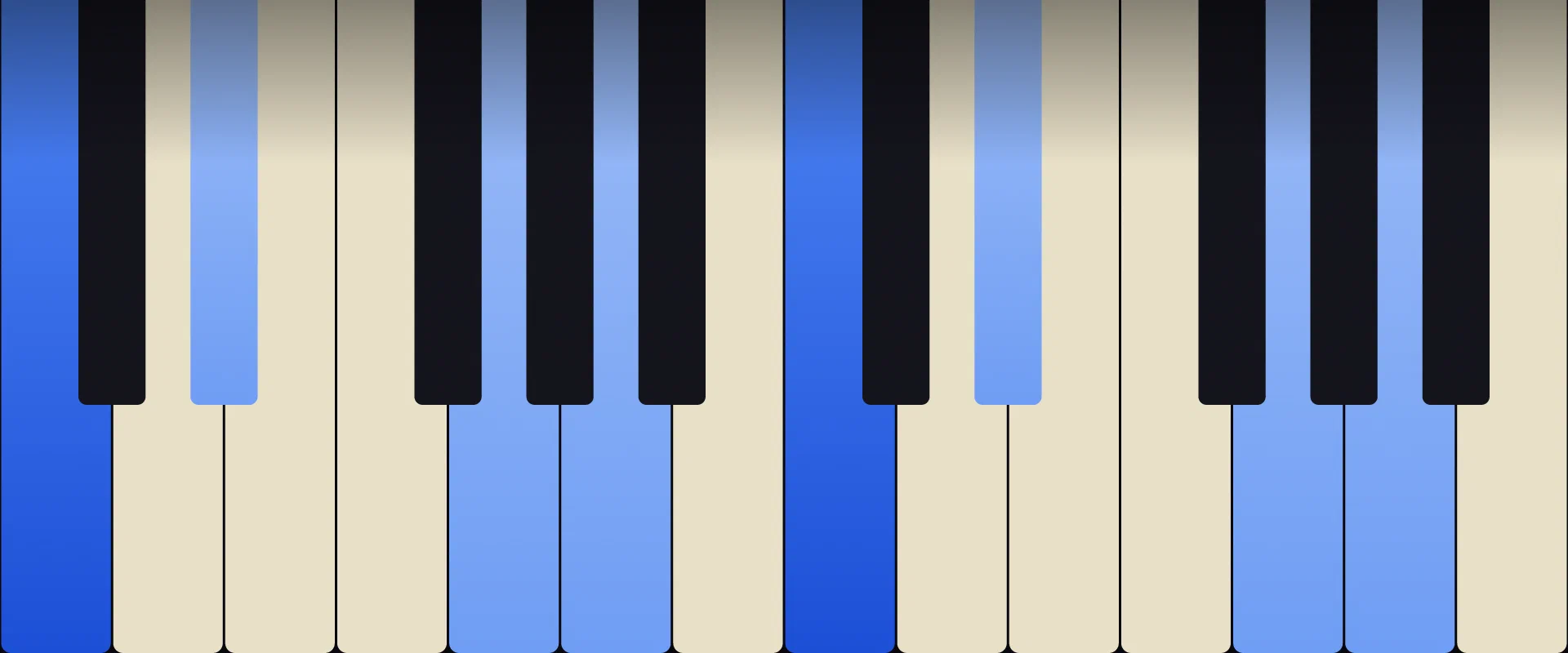
Cm6 on the Piano
E♭ is the right hand key of the two black key group, immediately above C, so the bottom half of the chord is located by feel. Right hand 1, 2, 4, 5: thumb on C, index on E♭, ring finger on G, little finger on A. Skipping the third finger points the index straight into the black key while the outer fingers stay on the wide front of the white keys. Left hand, upwards, is 5, 4, 2, 1.
Second inversion, G, A, C, E♭, is the most compact of the four positions, only a minor 6th from bottom to top, and it fits a small hand without stretching. It also puts G and A side by side as a whole step, the crunch that tells your ear this is no longer a plain minor triad.
The voicing worth learning first splits the chord: low C alone in the left hand, A, C and E♭ in the right. That right hand is an A diminished triad, and hearing it as one while the whole thing still functions as C minor is the shortest route into what this chord is.
Cm6 on the Guitar
Two open strings belong to this chord, the 5th string A and the 3rd string G, one more than plain C minor manages. It does not help. The string you gain is the 6th of the chord, and a 6th in the bass turns Cm6 into Am7♭5, so the near miss is instructive rather than useful.
The shape most players use is small and has no barre: x 3 1 2 1 x, giving C, E♭, A and C. The 5th is missing, which costs nothing here. Index across the 4th and 2nd strings at the 1st fret, middle finger on the 3rd string at the 2nd, ring finger on the bass C, and damp both outer strings.
For the full chord, the A shape barred at the 3rd fret gives x 3 5 5 4 5: barre at the 3rd, ring finger flattened over the 4th and 3rd strings at the 5th, middle on the 2nd string at the 4th, little finger out on the 1st at the 5th. The top string carries the A alone, so muting it by accident leaves an ordinary C minor. Dropping the 3rd string instead, x 3 5 x 4 5, keeps all four chord tones and frees a finger.
The E shape at the 8th fret, 8 10 10 8 10 8, buys a low C but wants three separate fingers at the 10th fret on strings that are not neighbours. The top four strings of the same region, x x 10 8 10 8, hold the chord in a flat two fret grip and comp far better.
Inversions
| Inversion | Notes | Bass | Symbol |
|---|---|---|---|
| Root position | C E♭ G A | C | Cm6 |
| 1st inversion | E♭ G A C | E♭ | Cm6/E♭ |
| 2nd inversion | G A C E♭ | G | Cm6/G |
| 3rd inversion | A C E♭ G | A | Cm6/A |
The bottom row is not an obscure position. A, C, E♭ and G is Am7♭5 in root position, the half diminished chord built a major 6th above C, and every minor 6th chord has a twin like it. Which name a chart prints depends on the bass note and on what comes next. For the mechanics, see Chord Inversions and Voice Leading.
Voicings
Bass notes rewrite this chord more thoroughly than most. Put an F under C, E♭, G and A and the result is a complete F9, every note present and none spare, which is why the vamp between Cm6 and F7 sounds less like two chords than like one chord with a moving floor. An A underneath gives Am7♭5.
| Shape | Frets | Result |
|---|---|---|
| Cm6 | x 3 1 2 1 x | Compact, no 5th, no barre |
| Cm6 | x 3 5 5 4 5 | A shape at the 3rd fret |
| Cm6 | x 3 5 x 4 5 | The same, 3rd string dropped |
| Cm6 | x x 10 8 10 8 | Top four strings, easy comp |
| Cm6/9 | x 3 1 2 3 x | Adds D, softer and wider |
| Am7♭5 | x 0 1 0 1 x | The same notes, A in the bass |
At the keyboard, keep A above E♭ rather than below it. Inverted, with A low and E♭ near the top, the tritone points downwards and the ear takes the half diminished reading first.
Which Keys Contain Cm6
- degree 2 (II) of B♭ major
- degree 4 (IV) of G natural minor
- degree 4 (IV) of G harmonic minor
- degree 1 (I) of C melodic minor
- degree 1 (I) of C dorian
- rooted on degree 2 of, and entirely contained in, A blues
C Dorian and C melodic minor both take Cm6 as their tonic chord and disagree only about the 7th degree, B♭ against B, which the chord does not contain, so a soloist can pick between them bar by bar. The last entry is the odd one: A blues, A, C, D, E♭, E and G, holds all four notes of Cm6 inside six, so a guitarist improvising there is already standing on this chord.
Where Cm6 Shows Up
| Progression | Chords | Context |
|---|---|---|
| i6, IV7 (C Dorian) | Cm6, F7 | Funk and modal jazz vamp |
| iiø7, V7, i (G minor) | Cm6/A, D7, Gm | Minor ii V i |
| iv6, I (G major) | Cm6, G | Minor plagal cadence |
| i, i(maj7), i7, i6 (C minor) | Cm, Cm(maj7), Cm7, Cm6 | Descending line |
The last row is where most listeners have met the chord without knowing it. Hold a C minor triad and walk one voice down from C to B to B♭ to A, and the four chords name themselves. “My Funny Valentine”, usually played in C minor, opens on that descent and lands on Cm6 in its fourth bar. The line works because the note it arrives at belongs to a real chord rather than a passing dissonance.
Row three explains why Cm6 turns up in songs that are not in a minor key at all. It is the minor subdominant of G major, and the return to G is unusually smooth: E♭ falls a semitone to D, C falls a semitone to B, A steps down to G, and the G never moves. Songwriters borrow it for the bar before a final chorus, and it is a gentler borrowing than plain Cm because A already belongs to G major.
The vamp is the funk use. Staying on Cm6 rather than Cm7 keeps A in the texture as a chord tone instead of a passing note, which is the sound of a rhythm section declining to resolve. Since Cm6 and F9 differ only in the bass, a bassist alternating C and F under one sustained keyboard voicing plays the whole progression alone.
Read from the other end, in G minor, these four notes are the iiø7 chord, and a pianist voicing Am7♭5 as a C minor triad with an A underneath is playing Cm6 and letting the bass decide.
Related Chords
- C Minor Chord, the triad underneath, three notes of the four
- C Major 6th Chord, the same addition over a major triad, and no tritone anywhere in it
- A Diminished Chord, the triad hiding in the top three notes
- Seventh Chords: The Complete Guide for Cm7 and the half diminished family
- Guitar Chord Shapes: The CAGED System for moving these shapes up the neck
Learn More
Practice Chords
Drill chord recognition with a metronome, MIDI support, and score tracking.
Start PracticingRelated Articles
A Minor 6th Chord: Notes, Voicings, and How to Play It
Aug 27, 2026 · 8 min
A♭ Minor 6th Chord: Notes, Voicings, and How to Play It
Aug 27, 2026 · 8 min
B Minor 6th Chord: Notes, Voicings, and How to Play It
Aug 27, 2026 · 8 min