After the blues, the most played chord progression in jazz is rhythm changes, and it is almost always played in B♭. Bar one gives two beats of B♭6 and two beats of Gm7, which means the first chord change in the most familiar tune in the repertoire is not really a chord change. B♭, D, F and G are the notes of both. The bass drops a minor 3rd and everyone above it can sit perfectly still.
That tells you most of what is odd about this chord. B♭6 spends much of its life being another chord’s inversion, and which name gets printed is a decision about where the music is going rather than about what the notes are.
Try It: B♭6 in the Chord Finder
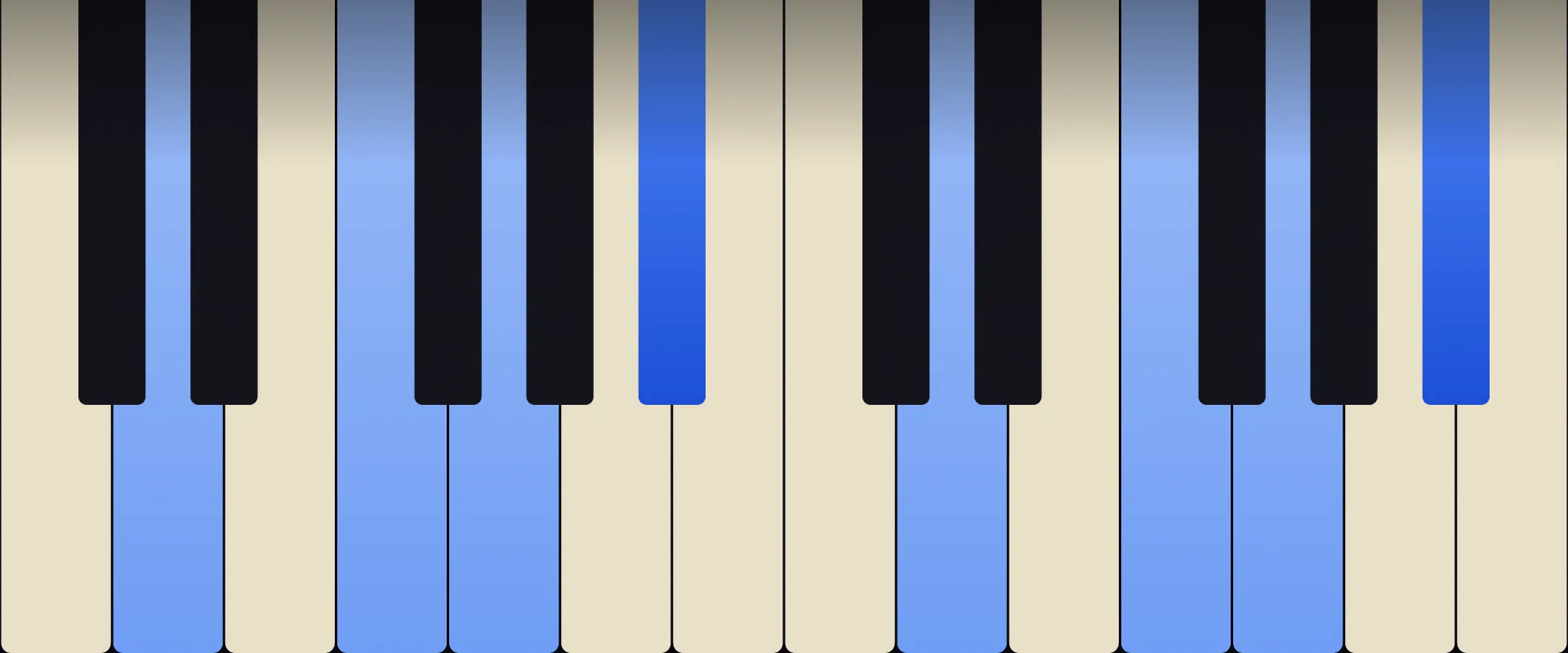
Set the root to B♭ and play the four notes, then play G, B♭, D and F and listen for the difference.
The Notes of B♭6
B♭6 has four notes: B♭, D, F and G.
| Degree | Note | Interval from B♭ | Semitones |
|---|---|---|---|
| 1 (root) | B♭ | Perfect unison | 0 |
| 3 | D | Major 3rd | 4 |
| 5 | F | Perfect 5th | 7 |
| 6 | G | Major 6th | 9 |
One black key and three white ones, all four notes inside the key signature of B♭ major.
How B♭6 Is Built
Start with the B♭ major triad, B♭ D F, and add G a major 6th above the root. Nothing is altered and nothing is removed, so the chord keeps the triad’s brightness and gains a note that softens the landing.
The question worth settling early is why this is not B♭13. A 13th chord is built on a 7th: B♭13 needs A♭ in it, and once that A♭ is there the G above becomes an extension stacked on a complete four note chord. Take the A♭ away and G stops being an extension. It is a chord tone, no more exotic than the 5th, which is why it is written as 6 and voiced in the middle of the chord rather than saved for the top. See Extended Chords and Jazz Harmony for the full stack.
The other identity is the one from bar one. G, B♭, D and F is Gm7, and B♭, D, F and G is B♭6. Same four pitches, two names, and the deciding vote belongs to the bass and to the function of the bar. If the harmony has arrived it is B♭6. If it is passing through on the way to a ii chord it is Gm7.
B♭6 on the Piano
B♭ is the only black key here and it takes the thumb, with D, F and G under 2, 3 and 5 on white. That is the B♭ major triad’s hand position with one finger added, so a pianist who plays B♭ major has nothing new to learn about where the hand goes.
What is new is the whole step at the top. F and G sit two semitones apart, and low in the register, with a root doubled underneath, that interval thickens badly. The traditional fix is blunt: leave out the 5th. B♭, D and G gives root, 3rd and 6th, three notes with no muddy pair, and almost every left hand shell voicing of this chord is that shape.
Try one experiment before moving on. Hold the four notes, then move the top one up a whole step from G to A, and you have B♭maj7. That white key to white key movement is the whole distance between a swing band’s tonic chord and a bebop one.
B♭6 on the Guitar
This is one of the few chords in B♭ a guitarist gets cheaply, and the reason is arithmetic: the four notes lie across the top strings at fret 3 in a straight line. Barre strings four to one there, x x 3 3 3 3, and you have F, B♭, D and G. One finger, all four notes, no stretch.
The full A shape adds the root below: x 1 3 3 3 3. Lay the ring finger flat across the top four strings at fret 3 and the index only has to stop the fifth string at fret 1. B♭ major in the same position, x 1 3 3 3 1, asks the index to barre right across the neck because the top string also needs fret 1. The 6 chord takes less work than the plain major chord inside it, which is rare in this key.
Higher up, the E shape at fret 6 is 6 8 8 7 8 6, a barre with four fingers on top of it, which nobody plays. Drop the outer strings: x 8 8 7 8 x gives the same four notes on the middle strings, and that clipped, rootless shape is the one big band rhythm guitarists strike on every beat. See Guitar Chord Shapes and the CAGED System for how the shapes relate.
Inversions
| Inversion | Notes | Bass note | Symbol |
|---|---|---|---|
| Root position | B♭ D F G | B♭ | B♭6 |
| 1st inversion | D F G B♭ | D | B♭6/D |
| 2nd inversion | F G B♭ D | F | B♭6/F |
| 3rd inversion | G B♭ D F | G | B♭6/G, or Gm7 |
Three of these behave the way inversions normally do, shifting the weight of the chord without changing what it is. The last does something else: putting G in the bass does not give an inverted B♭6, it gives Gm7 in root position, and nobody will read it any other way. Worth remembering when you write a bass line, because a walking line that lands on G under a bar of B♭6 has quietly rewritten the harmony. The principle is covered in Chord Inversions and Voice Leading.
Second inversion is the one to handle with care, since F and G end up at the bottom where a whole step sounds worst.
Voicings
B♭ D G, dropping the 5th, is the everyday shell: three notes, unambiguous, and it leaves room for a soloist.
B♭ D G C, adding the 9th, is B♭6/9, the sound of a final chord in a big band chart. The stack is a major 3rd then two perfect 4ths, which sits under one hand and rings evenly rather than clumping.
F B♭ D G is the guitar voicing above, and it works on piano when a bass player supplies the root. With F underneath, the chord loses its heaviness and does not tire the ear.
Which Keys Contain B♭6
- I of B♭ major
- IV of F major
- V of E♭ major
- III of G natural minor
- contained in B♭ major pentatonic
- contained in G minor pentatonic
The first two cover nearly all of its real use, as a tonic and as a IV chord. The E♭ major entry is true but rare in practice, because a dominant wants a 7th and B♭7 will be written there instead.
Read the last three together and the Gm7 question returns in another form. B♭6 is degree III of G natural minor, but a chord holding all four notes of the tonic minor 7th is not doing III chord work. For improvisers the useful consequence is that B♭ major pentatonic and G minor pentatonic are the same five notes and both fit this chord exactly, so a soloist can think in either.
Where B♭6 Shows Up
Rhythm changes first, since that is where most players meet it. The opening four bars of the A section run:
| Bar | Chords | Numerals in B♭ |
|---|---|---|
| 1 | B♭6, Gm7 | I6, vi7 |
| 2 | Cm7, F7 | ii7, V7 |
| 3 | Dm7, G7 | iii7, VI7 |
| 4 | Cm7, F7 | ii7, V7 |
Bar one is the still bar. Nothing above the bass has to move, and at speed a pianist holds one voicing across both chords. Many musicians make the second chord G7 rather than Gm7, and that version does move: G7 brings in a B natural, the one note in the passage foreign to B♭ major, pushing into the Cm7 that follows.
The second place to look is the last bar of almost any swing era arrangement in this key:
Cm7, F7 | B♭6
Ending on the 6th rather than the major 7th was not a flourish before bebop, it was what a tonic chord was. The reason is practical as well as fashionable. B♭maj7 puts A against the B♭ that the bass and half the horn section are playing, and in a loud ensemble that semitone rubs. The 6th adds warmth with no clash to tune.
Steel guitar players arrive from another direction. The standard C6 tuning makes a major 6th chord the instrument’s resting state, and a straight bar across the tenth fret sounds B♭6. Western swing bands carried horns, horns pushed the band into B♭ and E♭, and the steel player spent the evening parked at fret 10.
Related Chords
- B♭ Major Chord, the triad underneath, before G is added.
- G Minor Chord, whose 7th chord is these four notes rearranged.
- B♭ Sus4 Chord, the same root with the 3rd replaced instead of a 6th added.
- Seventh Chords: The Complete Guide, on why B♭6 and Gm7 sound alike and function differently.
Learn More
Practice Chords
Drill chord recognition with a metronome, MIDI support, and score tracking.
Start PracticingRelated Articles
A Major 6th Chord: Notes, Voicings, and How to Play It
Aug 26, 2026 · 8 min
A♭ Major 6th Chord: Notes, Voicings, and How to Play It
Aug 26, 2026 · 8 min
B Major 6th Chord: Notes, Voicings, and How to Play It
Aug 26, 2026 · 8 min