A guitarist who finds A major awkward has an odd consolation waiting: adding a fourth note makes it easier. Open A crams three fingertips into one fret between two open strings. x 0 2 2 2 2 puts the first string in the 2nd fret as well, and once all four fretted notes share a fret, one finger laid flat covers the lot. A6 is a one-finger barre over an open bass string, and that price is most of the reason it saturated Hawaiian steel music, western swing and the last chord of a thousand 1950s records.
Try It: A6 in the Chord Finder
Select A as the root, sound the major triad, then add the F♯ on top and hear the chord relax rather than tighten.
The Notes of A6
| Degree | Note | Interval from root | Semitones |
|---|---|---|---|
| 1 (root) | A | Perfect unison | 0 |
| 3 | C♯ | Major 3rd | 4 |
| 5 | E | Perfect 5th | 7 |
| 6 | F♯ | Major 6th | 9 |
Written out: A, C♯, E, F♯. Both accidentals are sharps and both land on black keys, so nothing about the spelling is going to surprise anyone at a keyboard.
A major pentatonic is these four notes plus B, and nothing else. A soloist working that box over this chord is playing chord tones almost every time, which is why the pairing sounds so settled and why steel players can slide around inside it without landing wrong.
How A6 Is Built
Take A major and add the note a major 6th above the root. Nothing is removed, so unlike a suspension the chord keeps its third and stays firmly major; the F♯ simply sits on top and softens it.
The label needs one caution. A6 is not A13. A thirteenth needs a seventh underneath it, and there is no G here. A6 is a place to stop. A7, one semitone away, is a chord that has to move, and on a guitar you hear the difference by changing a single finger: x 0 2 2 2 2 is A6, x 0 2 2 2 3 is A7. Take the same string to the 4th fret, x 0 2 2 2 4, and you have Amaj7. The whole difference between resting, leaning and floating lives on the first string.
A6 and F♯m7 Are the Same Four Notes
A, C♯, E and F♯ rearranged from the F♯ upward read F♯, A, C♯, E, which spells F♯m7. Two names, one collection, and only the bass note decides which is which. This is not a curiosity on the guitar, it is one finger: add the 2nd fret of the sixth string to the A6 barre, giving 2 0 2 2 2 2, and the same grip is now F♯m7.
Context settles the reading. If the chord is functioning as home in A, write A6. If it is a ii chord heading for B7, write F♯m7. If the bass insists on F♯ while the harmony is really A, A6/F♯ is the honest notation.
A6 on the Piano
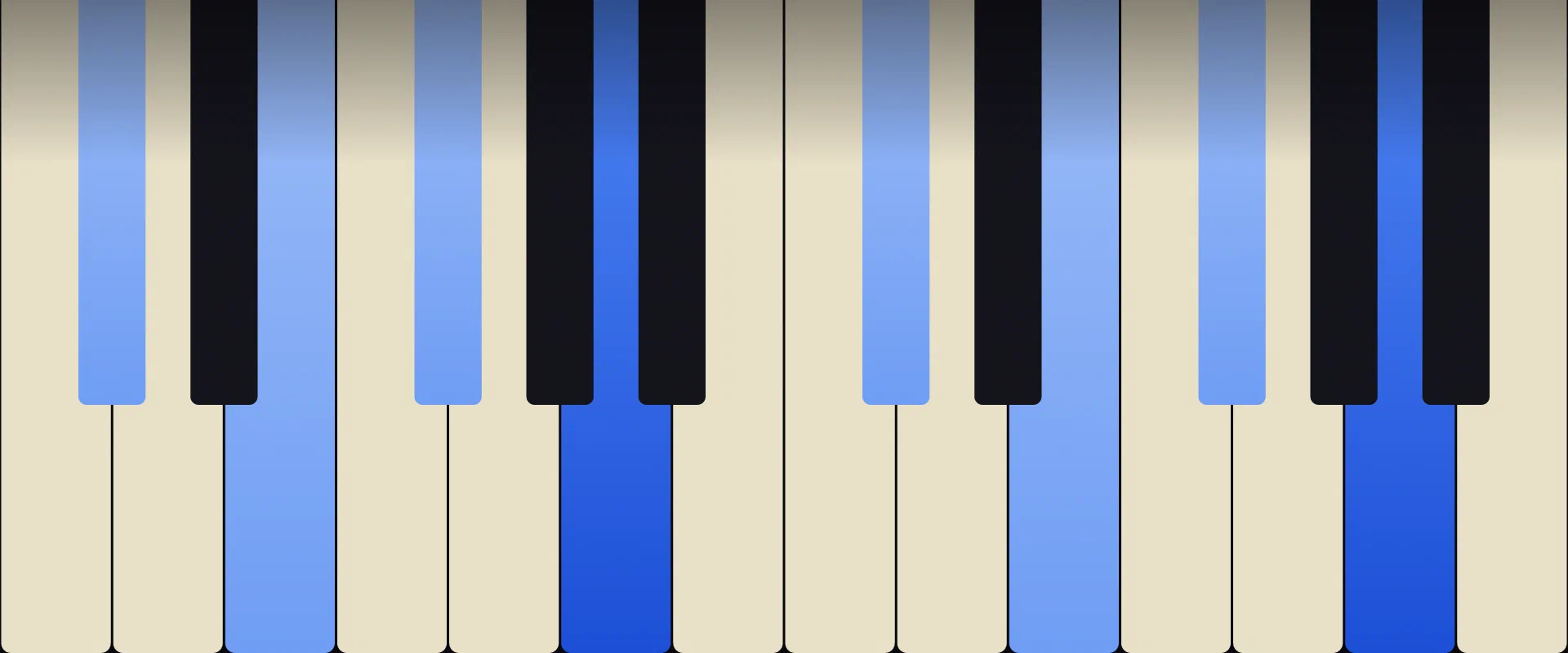
The hand alternates. A is white, C♯ is black, E is white, F♯ is black, so the fingers step in and out of the keyboard in a regular rhythm instead of clustering. Both black notes are the leftmost of their group, C♯ at the start of the pair and F♯ at the start of the three, which makes them easy to find without looking.
Right hand 1, 2, 3 and 5 fits: thumb on A, index back on C♯, middle out on E, little finger reaching in for F♯. The little finger on a raised key is the only real demand, and it is the reason many pianists prefer 1, 2, 4, 5, which puts the ring finger on E and shortens the reach at the top.
The span from A to F♯ is a major 6th, so this voicing stays inside the hand. Roll the F♯ down an octave instead, below the root, and the same four notes lie flatter and read as F♯m7 in root position: F♯, A, C♯, E, four keys in a compact row. Comping pianists move between the two layouts constantly without thinking of them as different chords.
Register does the rest of the work. All four notes packed together below middle C turn thick, since the chord already carries a whole tone between two of its members. Put the root alone in the left hand and stack C♯, E and F♯ in the right, and the sixth reads as sweetness rather than mud.
A6 on the Guitar
The open shape may be the easiest four-note chord in standard tuning. Lay the index flat across the fourth, third, second and first strings at the 2nd fret, let the fifth ring open for the root, mute the sixth with the thumb, and it is done. Beginners stumble onto it when a lazy barre across A major catches the first string. The sound they get is not a mistake.
The accident is worth understanding. In open A the first string sounds an open E, doubling the fifth. Fretting it at the 2nd fret trades that duplicate for the only F♯ in the voicing, so the chord gains a colour and loses nothing.
For a tighter swing texture, leave the bass to somebody else and take the top four strings: x x 7 6 7 5 drops the fifth entirely, which is standard for a comping guitarist in a band with a bass player. Rooted on the sixth string, 5 x 4 6 5 x spreads all four notes across the neck. The full barred version is the E6 shape at the 5th fret, 5 7 7 6 7 5, a stretch that buys the root in the bass.
The chord’s real home is the lap steel. A6 is one of the standard steel tunings alongside C6 and E7, and the point of a sixth tuning is that every open string is a chord tone: a straight bar across any fret gives a usable chord, and the slides between them never pass through a wrong note. The Hawaiian steel records of the 1920s and the western swing bands that took the instrument up in Texas are built on that.
Inversions
| Inversion | Notes | Bass | Symbol |
|---|---|---|---|
| Root position | A C♯ E F♯ | A | A6 |
| 1st inversion | C♯ E F♯ A | C♯ | A6/C♯ |
| 2nd inversion | E F♯ A C♯ | E | A6/E |
| 3rd inversion | F♯ A C♯ E | F♯ | F♯m7 |
The third inversion has a second name, and it is worth writing the one that matches what the ear does: with F♯ underneath, this is F♯m7 in root position, not an inverted A6.
The second inversion is the awkward one. E and F♯ end up adjacent at the bottom, a whole tone low in the register, and it muddles unless the F♯ is moved up an octave.
Voicings
| Voicing | How to play it |
|---|---|
| Open A6 | x 0 2 2 2 2, one finger barred at the 2nd fret |
| Barre at the 5th fret | 5 7 7 6 7 5, the E6 shape moved up |
| Swing grip | x x 7 6 7 5, top strings only, no fifth |
| Sixth string root | 5 x 4 6 5 x, spread across the neck |
| F♯m7 from the same grip | 2 0 2 2 2 2, the sixth string added |
| Piano, spread | A2 in the left hand, C♯4, E4 and F♯4 in the right |
Which Keys Contain A6
- I of A major
- V of D major
- IV of E major
- III of F♯ natural minor
- VII of B natural minor
- I of A mixolydian
The last of these is the useful surprise. A mixolydian has a G natural rather than a G♯, which rules out Amaj7 but leaves this chord untouched, since the sixth sits nowhere near the seventh degree. A blues or rock vamp on a dominant sounding A can therefore take a sixth on the tonic chord with no clash at all.
Where A6 Shows Up
| Progression | In this key | Chords |
|---|---|---|
| I, vi, IV, V (doo-wop) | A major | A6, F♯m7, D, E |
| V with a 6th, I | D major | A6, D |
| I, ♭VII, IV | A mixolydian | A6, G, D |
| Final cadence | A major | E7, A6 |
The first row hides a joke: in a doo-wop loop in this key, the first two chords are the same four notes. A6 to F♯m7 changes nothing but the bass, which is exactly how guitarists play it. Strum the barre, drop a finger onto the sixth string, and let the bass do the harmony.
The D major row explains the chord’s other main job. As the dominant of D, an A chord normally pushes hard; adding F♯ drops the tonic triad’s own third into the dominant, so the two chords share a note in advance and the arrival is gentler. Country and swing arrangers reach for it whenever a plain dominant would be too blunt.
The final cadence is a period marker. Ending on a bare triad sounded abrupt to arrangers between roughly 1935 and 1960, and a sixth on the last chord became the default finish for dance bands and early rock and roll. In this key the finish is free: one flat finger at the 2nd fret.
Related Chords
- A Major Chord the triad this is built on, and the harder shape of the two
- A Minor Chord the same root with the third lowered
- A Sus4 Chord the third replaced instead of a note added
- Seventh Chords: The Complete Guide
- Extended Chords and Jazz Harmony
Learn More
Practice Chords
Drill chord recognition with a metronome, MIDI support, and score tracking.
Start PracticingRelated Articles
A♭ Major 6th Chord: Notes, Voicings, and How to Play It
Aug 26, 2026 · 8 min
B Major 6th Chord: Notes, Voicings, and How to Play It
Aug 26, 2026 · 8 min
B♭ Major 6th Chord: Notes, Voicings, and How to Play It
Aug 26, 2026 · 8 min