Write A♭6 on a chart and the bass player takes A♭. Write Fm7 and the bass player takes F. The four notes above the stave are identical either way, A♭ C E♭ F, and that one instruction is the whole difference between a chord that has landed and a chord that is still travelling. Arrangers in soul, gospel and big band music make that choice constantly in this key, because A♭6 is how those styles end a piece, settled and warm, without the glassy edge a major 7th leaves hanging.
Try It: A♭6 in the Chord Finder
The Notes of A♭6
| Degree | Note | Interval from root |
|---|---|---|
| 1 | A♭ | Perfect unison |
| 3 | C | Major 3rd, 4 semitones |
| 5 | E♭ | Perfect 5th, 7 semitones |
| 6 | F | Major 6th, 9 semitones |
Written low to high in root position: A♭ C E♭ F.
How A♭6 Is Built
A♭ major is A♭ C E♭. Add F on top and the triad keeps everything it had, which is what separates a 6th from a suspension: nothing has been displaced, so the chord is still unambiguously major.
It is not a 13th chord, whatever the interval arithmetic suggests. A 13th needs a 7th underneath it, so A♭13 would be A♭ C E♭ G♭ B♭ F, a six note dominant. Without the G♭, F stops being an extension and becomes a chord tone.
Compare it with A♭maj7, A♭ C E♭ G. On a keyboard you can see why the two feel so different: that G is the white key immediately below the A♭, a semitone of rub sitting right under the root. The 6th puts F there instead, clear of everything, and the tension disappears. That is why arrangers write 6 rather than maj7 in the last bar of a ballad, and why a singer holding the tonic over it is never fighting the piano.
A♭6 on the Piano
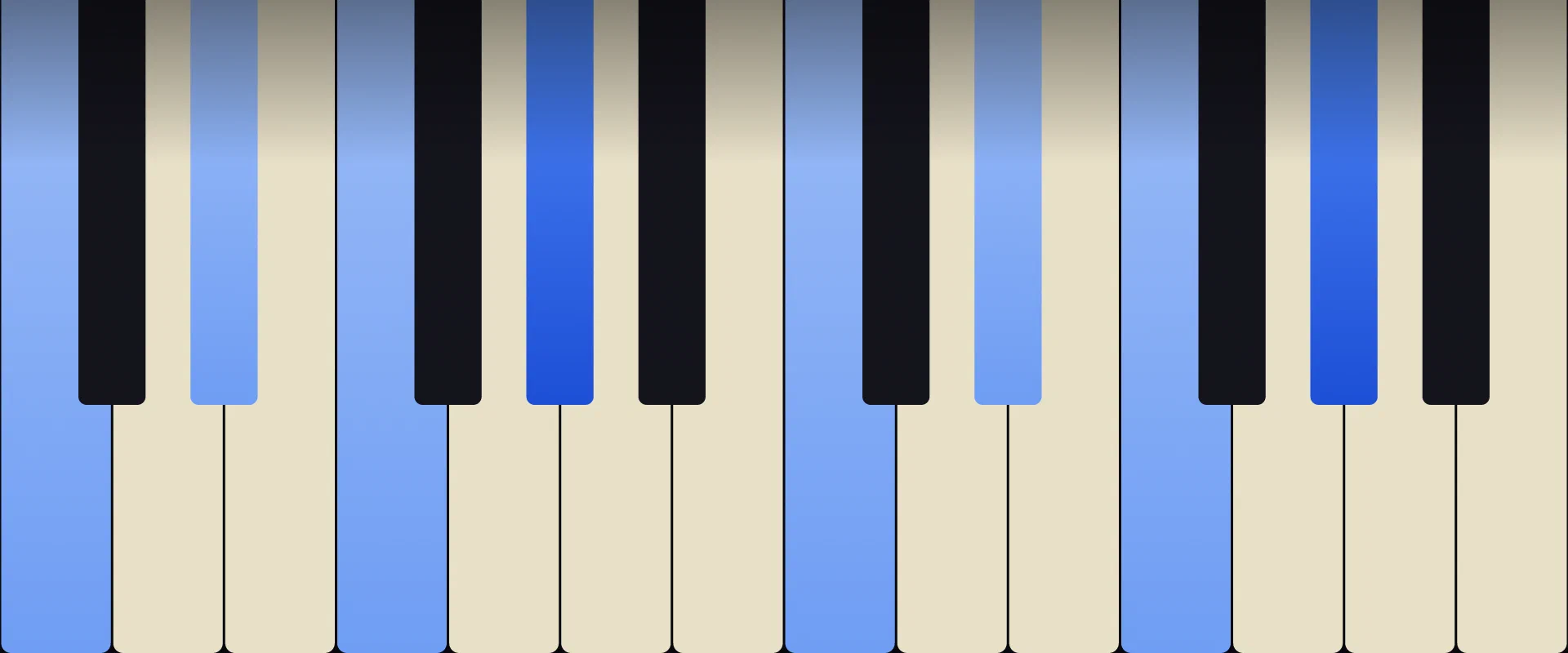
The keys alternate colour all the way up: A♭ black, C white, E♭ black, F white, so the hand rocks forward and back instead of sitting at one depth. Root position under the right hand takes 1 on A♭, 2 on C, 4 on E♭ and 5 on F, an easy span of a major 6th with no crossing and no stretch.
Better, split it. Left hand takes A♭ alone, or A♭ and E♭ as a shell, and the right hand plays C E♭ F, wide enough to leave room for a voice and narrow enough to comp all night. The E♭ and F a whole tone apart at the top give the chord its slight blur, and it is a friendly one.
Add B♭ and something neat happens. A♭ B♭ C E♭ F is A♭6/9, which is every note of the A♭ major pentatonic sounded at once. Hold it in the left hand, improvise on the keys you are already holding, and nothing you play can be wrong.
Keep the F above middle C, though. Voiced low, the whole tone between E♭ and F turns to mud.
A♭6 on the Guitar
This is the rare chord that is easier than its own major triad. A♭ major has no open form and demands a full barre. A♭6 has a barre that needs two fingers and a capo shape that needs two.
The A shape at the 11th fret is the double barre: index across the 11th, ring finger flat across the 13th, giving 11 13 13 13 13 on the top five strings, which sounds A♭ E♭ A♭ C F. No stretch, no individual fingers to place, and up there the frets are close enough that the second barre is comfortable rather than cramped.
The E shape at the 4th fret, 4 6 6 5 6 4, needs five fingers, since the barre cannot cover the B string at the 6th fret. Play the four note reduction instead: 4 on the low E, 3 on the D, 5 on the G, 4 on the B, the other two muted. That gives A♭ F C E♭, the compact rhythm voicing behind most western swing and Freddie Green comping.
There is also a grip you already know. Fm7 barred at the 1st fret is 1 3 1 1 1 1. Mute the low F, play x 3 1 1 1 1, and what is left is C E♭ A♭ C F, which is A♭6 in first inversion. Same fingers, and only the missing bass note changed the name.
With a capo it becomes trivial. Capo 1 and the G6 shape, 3 2 0 0 0 0, sounds A♭6 on two fingers with four open strings behind it, which is less work than A♭ major at the same capo, where the little finger goes back on the top string. Capo 4 and the E6 shape, 0 2 2 1 2 0, gives the same chord more body. Either way it rings, which a barred A♭ never does.
Inversions
| Inversion | Notes low to high | Bass note |
|---|---|---|
| Root position | A♭ C E♭ F | A♭ |
| 1st inversion | C E♭ F A♭ | C |
| 2nd inversion | E♭ F A♭ C | E♭ |
| 3rd inversion | F A♭ C E♭ | F |
Third inversion is not really an inversion. Once F is the lowest note the ear takes it as the root and hears Fm7, not A♭6 with a note out of place. A chord that changes name when you turn it over is unusual, and it is worth knowing which side of the line you are on before writing a bass part.
First inversion, C in the bass, is the useful one. It keeps the chord recognisably A♭ while putting the third underneath, which is how you slide into D♭ next: C rises a semitone and the other three voices barely move.
Voicings
Drop the fifth. A♭ C F is the essential version, root, third and sixth, leaving E♭ to the bass player or to nobody, and pianists comp it in the right hand all evening because it says everything the full chord says at a third of the weight. On guitar the same two notes, C and F, sit on the D and G strings at the 10th fret.
For a fuller sound, A♭6/9 (A♭ B♭ C E♭ F) is the standard final chord of an arrangement in this key, and A♭m6 (A♭ C♭ E♭ F) is the same shape with the third lowered, a much darker chord that turns up when the piece ends in the minor.
Which Keys Contain A♭6
Adding the F costs nothing in terms of key membership. Every key that holds the A♭ triad also holds an F, so the 6th chord travels to exactly the same six places the plain triad does:
- I of A♭ major
- IV of E♭ major
- V of D♭ major
- III of F natural minor
- VI of C natural minor
- VII of B♭ natural minor
It fills A♭ major pentatonic apart from the B♭, and it sits whole inside F minor pentatonic, so a blues soloist in F is playing these four notes whether or not anybody named them.
Where A♭6 Shows Up
| Progression | In letters | Where it lives |
|---|---|---|
| ii7, V7, I6 | B♭m7, E♭7, A♭6 | The last bar of a ballad or a big band chart |
| I6, vi7, ii7, V7 | A♭6, Fm7, B♭m7, E♭7 | Turnaround where the first move is bass only |
| I, IV6, I | E♭, A♭6, E♭ | Western swing and rockabilly in E♭ |
The first row is where the chord earns its living. A♭ is a horn section key, since concert A♭ reaches a tenor saxophone as B♭ major and an alto as F major, and a section holding a long final chord wants a 6th rather than a 7th on top: four players sustaining a semitone rub expose every fault in the tuning. The 6th sits still, and it lets the chord be an ending instead of a question.
The second row is the arranging point made audible. Since A♭6 and Fm7 hold identical notes, the pianist can keep both hands still while the bass walks from A♭ down to F, and the harmony changes anyway. It works as a pivot for the same reason: A♭6 is the tonic of A♭ major, Fm7 the tonic seventh of F minor, so a piece can cross between the relative keys without moving a finger.
The third row belongs to guitar players. As the IV chord of E♭ this turns up all over western swing, rockabilly and jump blues, styles where a 6th replaces the plain major almost everywhere and where flat keys arrive with the horn player. The 11th fret double barre is the shape those records are made of.
Related Chords
- A♭ Major Chord the triad this chord adds one note to
- F Minor Chord the root of the chord with the same four notes
- A♭ Sus4 Chord the other common way to leave the tonic open
- A♭ Major Pentatonic the scale that fits this chord exactly
- A♭ Major Scale the key it sits at the centre of
Learn More
Practice Chords
Drill chord recognition with a metronome, MIDI support, and score tracking.
Start PracticingRelated Articles
A Major 6th Chord: Notes, Voicings, and How to Play It
Aug 26, 2026 · 8 min
B Major 6th Chord: Notes, Voicings, and How to Play It
Aug 26, 2026 · 8 min
B♭ Major 6th Chord: Notes, Voicings, and How to Play It
Aug 26, 2026 · 8 min