Here is a chord that gets easier when you make it richer. Take the open G every guitarist learns in their first week, 3 2 0 0 0 3, lift the finger off the top string, and the open E rings out: 3 2 0 0 0 0 is G6. Two fingers, six strings, nothing muted. Mute the 5th string as well and 3 x 0 0 0 0 still spells the chord, this time with a single finger. Almost every added note on a guitar costs effort. This one refunds it.
The four notes are G, B, D and E, which are also the four notes of Em7. Not a resemblance, the same pitches in a different order. What separates the bright tonic from the moody relative minor seventh is the bass and nothing else, which on a guitar means one finger on the bottom string.
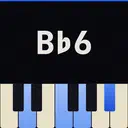
Try It: G6 in the Chord Finder
The Notes of G6
| Degree | Note | Interval from Root | Semitones |
|---|---|---|---|
| 1 (Root) | G | Perfect unison | 0 |
| 3 | B | Major 3rd | 4 |
| 5 | D | Perfect 5th | 7 |
| 6 | E | Major 6th | 9 |
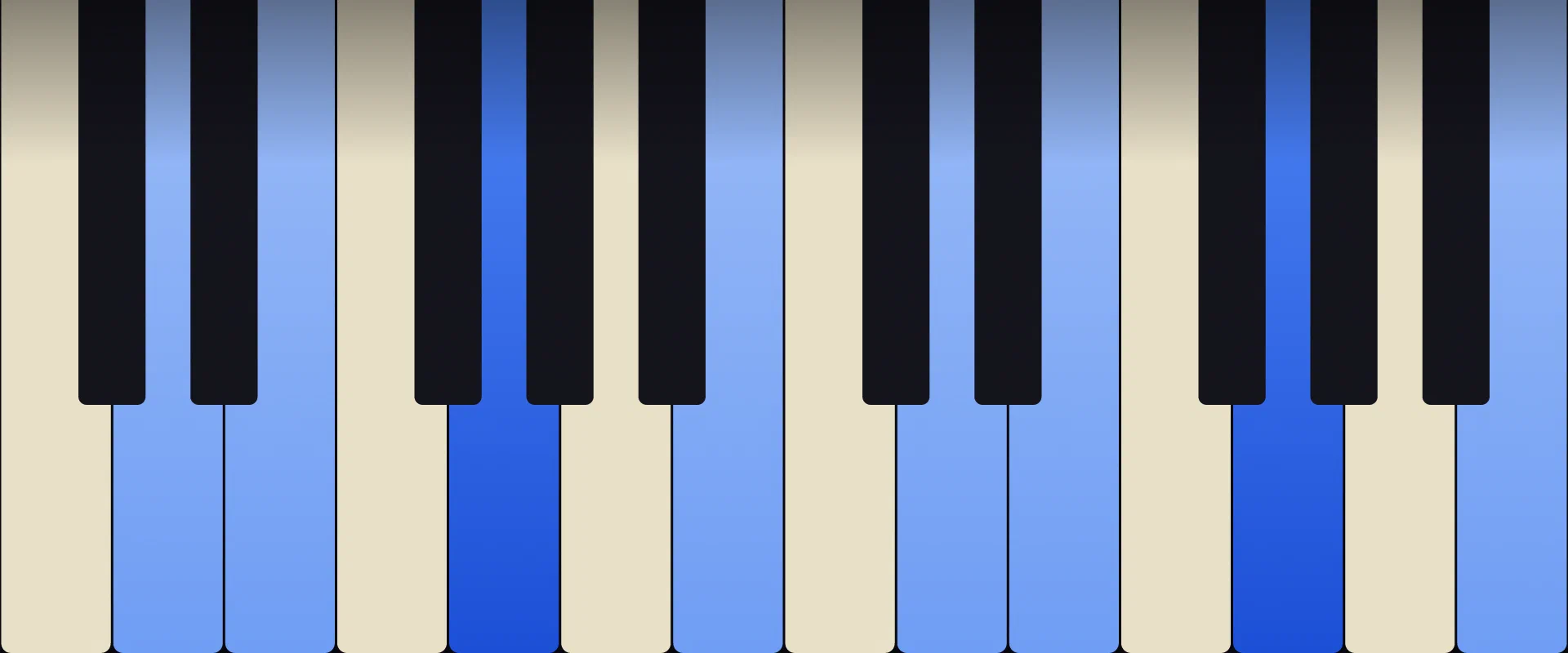
Four notes and four white keys, which makes G6 one of the easiest four note chords to find on a keyboard.
How G6 Is Built
Start with G major, G B D, and add the sixth degree of the G major scale on top. E sits a major 6th above G and a whole step above D, far enough from everything else to add colour without souring the triad, which is why a major 6th chord is the sweetest of the four note chords: no sevenths, no half step clashes, nothing that has to resolve.
The distinction that trips people up is 6 against 13. Both names point at E over a G root, but they describe different chords. A 13th is a dominant chord with a seventh underneath, so G13 contains F as well, and that F is what makes it want to move to C. G6 has no seventh at all. Take the F out of G13 and you have not simplified the chord, you have changed what it does. If a chart says 6, leave the seventh out; if it says 13, the seventh is not optional.
G6 is also not quite one chord. G, B, D, E is Em7 with the notes rotated, so the same four pitches carry two functions and only the lowest voice says which is in force.
G6 on the Piano
Four naturals, and the hand covers them comfortably. Root position spans a major 6th from G up to E, which fits under 1, 2, 3 and 5 in the right hand without a stretch and under 5, 4, 2 and 1 in the left.
The problem is that root position also puts D and E next to each other at the top, and a whole step in the highest voice thickens the sound. Better to spread it: G and D in the left hand, then B, E and G in the right. The sixth then sits in the middle of the upper voices where it reads as colour rather than as a clash.
Make the ambiguity audible in one gesture. Hold B, D, E and G in the right hand and do not move it. Play G in the left hand and the chord is a bright, settled major. Play E instead and the same fingers become Em7, wistful and unresolved. Alternate the two bass notes slowly and listen to the top of the piano change meaning without changing a pitch.
G6 on the Guitar
The open form is 3 2 0 0 0 0, sounding G, B, D, G, B and E from bottom to top. Index on the 5th string at the 2nd fret, middle on the 6th at the 3rd, four strings open. It rings harder than open G major because two thirds of it is unfretted string.
Now play 0 2 0 0 0 0. One finger has left the bottom string, the open low E takes over, every other note is identical, and the chord is Em7. It is the cleanest demonstration on the instrument of a chord’s identity living in its bass, and it makes a useful vamp: alternate the bottom string between the 3rd fret and open and you have I to vi in G with nothing changing above the 5th string.
| Form | Frets | Notes sounded |
|---|---|---|
| Open | 3 2 0 0 0 0 | G B D G B E |
| Open, thinner | 3 x 0 0 0 0 | G D G B E |
| Em7, same top | 0 2 0 0 0 0 | E B D G B E |
| E shape barre | 3 5 5 4 5 3 | G D G B E G |
| A shape barre | x 10 12 12 12 12 | G D G B E |
| Compact, no 5th | x x 5 4 5 3 | G B E G |
The barre forms are less rewarding than usual. The E shape at the 3rd fret asks for a full index barre plus three fingers that are not all on one fret, and gains only volume over the open form. The A shape lands at the 10th, where the frets are narrow and four fingers crowd onto one of them.
The compact grip on the top four strings is the one that travels. x x 5 4 5 3 drops the fifth and keeps G, B and E, enough to state the chord when a bass player has the root, and it slides to any root you like. Jazz and western swing comping uses exactly this, because a sixth chord survives losing its fifth better than a seventh chord does.
Inversions
| Inversion | Notes | Bass | Symbol |
|---|---|---|---|
| Root position | G B D E | G | G6 |
| 1st inversion | B D E G | B | G6/B |
| 2nd inversion | D E G B | D | G6/D |
| 3rd inversion | E G B D | E | G6/E, or Em7 |
The third inversion is the interesting one, because its second name is the one everybody uses. E, G, B, D with E in the bass is simply Em7, and nobody writes G6/E on a chart. The reverse holds too: Em7/G is the same chord as G6 in root position, and which label an arranger picks says more about the key of the passage than about the sound.
First inversion is the least stable of the four. B in the bass puts the third under a chord that already carries a major 6th on top, and the result reads as a passing sonority, not a resting place.
Voicings
Whether E sits on top or in the middle decides almost everything. The open guitar form puts it in the highest voice, which is why that shape sounds bright and folky rather than jazzy. Move E down into the inner voices, as the piano spread above does, and the chord turns plusher, closer to what a big band arranger means by a sixth chord.
Avoid the low registers here. B below middle C is already muddy in a plain G triad, and adding E under it makes the bottom unreadable. Keep the root low and alone and everything else above middle C. For a fuller version, adding A gives G6/9, G B D E A, the standard ending chord of a great many jazz arrangements.
Which Keys Contain G6
- I of G major
- V of C major
- IV of D major
- III of E natural minor
- VII of A natural minor
- I of G lydian
The chord needs a major 3rd and a natural 6th and nothing else, so it cannot tell the three major flavoured modes on G apart. G major, G lydian and G mixolydian all contain B and E, so G6 is the tonic of all three and gives away none of them. The note that would settle it, C or C♯ or F or F♯, is simply not there, which makes a G6 vamp stay open until the melody names the mode.
All four notes also sit inside the G major pentatonic scale, so any pentatonic lick in G fits over the chord with no wrong note available.
Where G6 Shows Up
| Progression | Chords | Typical use |
|---|---|---|
| I, vi with one shape | G6, Em7 | Guitar vamps where only the bass moves |
| I6, IV, V in G | G6, C, D | Western swing, country, rockabilly |
| ii, V, I ending in G | Am7, D7, G6 | Jazz standards and swing tunes |
| I, vi, IV, V in G | G6, Em, C, D | Doo wop and early rock |
| V6 of C | C, G6, C | Bright, non urgent cadences |
| IV in D major | D, G6, A, D | Folk and country in D |
The third row is where sixth chords earned their place. Before the bebop era a tune ending on a major 7th sounded unfinished, so the resting chord at the end of an arrangement was the 6th: fully consonant, no leading tone jutting out, nothing that wants to go anywhere. A swing band finishing on G6 rather than plain G is not decorating the chord, it is using the sound that period considered final.
Row one is a guitarist’s discovery rather than a theorist’s. Hold 3 2 0 0 0 0 and rock the bottom string between the 3rd fret and open, and a listener hears two chords going by. Countless acoustic intros in G are built on that alone.
The last row is about keys. G6 as the IV chord of D major turns up constantly in fiddle and country repertoire, because the E on top is the second degree of D and the chord blends into a melody sitting in D major pentatonic without anybody having to think about it.
Related Chords
- G Major Chord, the triad underneath, one finger harder to play
- G Minor Chord, whose own sixth chord, Gm6, borrows the same E
- G Sus2 Chord, the other way to open up a G without a seventh
- G Sus4 Chord, which removes the third rather than adding a note above the fifth
- G Augmented Chord, which raises D rather than adding E
- Em7, the same four notes read from the bottom up
- The G Major Scale
- The G Major Pentatonic Scale
- Guitar Chord Shapes: The CAGED System
Learn More
Practice Chords
Drill chord recognition with a metronome, MIDI support, and score tracking.
Start PracticingRelated Articles
A Major 6th Chord: Notes, Voicings, and How to Play It
Aug 26, 2026 · 8 min
A♭ Major 6th Chord: Notes, Voicings, and How to Play It
Aug 26, 2026 · 8 min
B Major 6th Chord: Notes, Voicings, and How to Play It
Aug 26, 2026 · 8 min