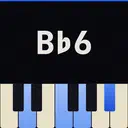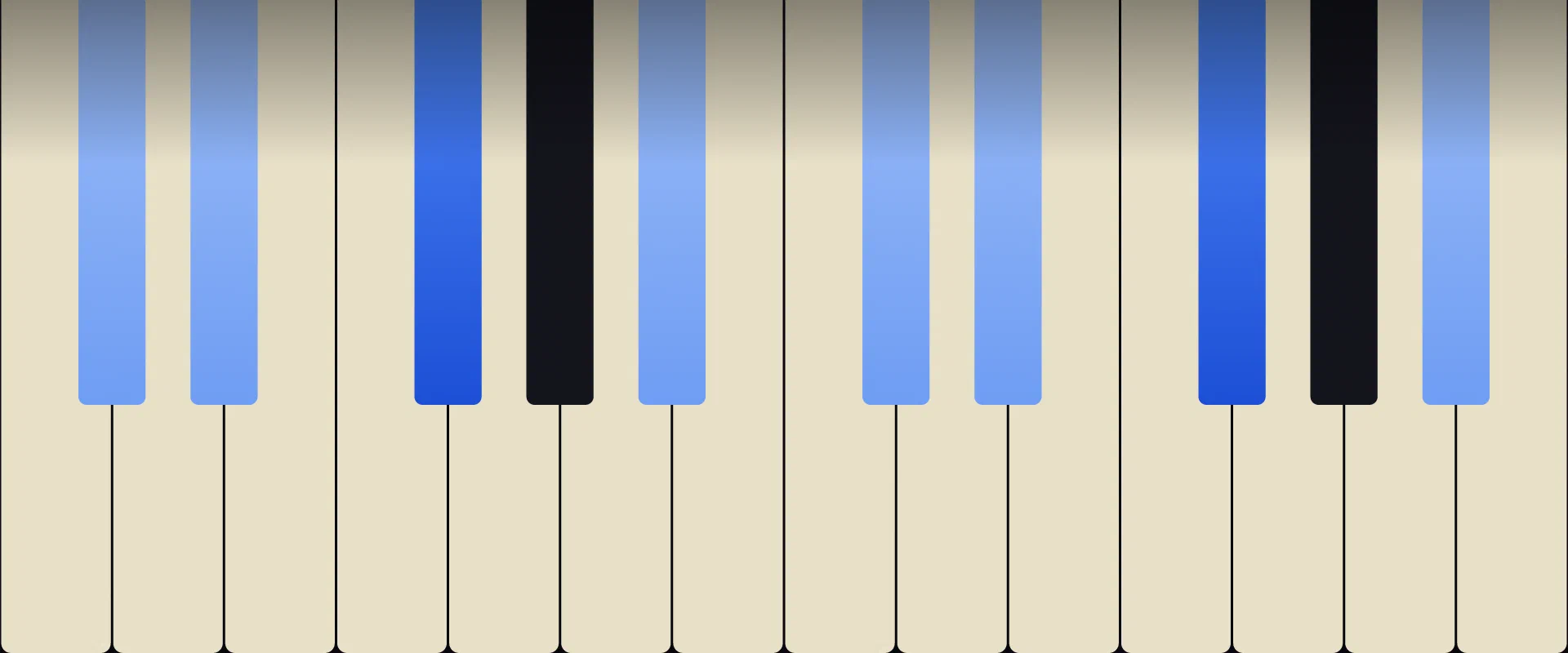
Play F♯6 on a piano and your hand never touches a white key. F♯, A♯, C♯ and D♯ are four black keys, and they are four of the five: the only one left out is G♯. No other major 6th chord sits entirely in that group, because no other root has all four of its chord tones in the sharps.
The same four notes have a second name. Stack them from D♯ instead and you get D♯, F♯, A♯, C♯, which is D♯m7. Nothing distinguishes the two chords on paper. The bass line does all the work.
Try It: F♯6 in the Chord Finder
The Notes of F♯6
F♯6 contains four notes.
F♯, A♯, C♯, D♯
| Degree | Note | Interval from root | Semitones |
|---|---|---|---|
| 1 | F♯ | Root | 0 |
| 3 | A♯ | Major 3rd | 4 |
| 5 | C♯ | Perfect 5th | 7 |
| 6 | D♯ | Major 6th | 9 |
The flat spelling is unusually painless. G♭6 is G♭, B♭, D♭ and E♭, four ordinary flats, and F♯6 is four ordinary sharps. Neither version needs a double accidental or a note on the wrong letter, which is rare on this root: the augmented triad here must be spelled from G♭ to stay readable, and the sus4 collects a C♭ from the flat side. For the 6th chord the choice is free, so the key of the piece decides. A chart in B major writes F♯6, one in D♭ major writes G♭6.
How F♯6 Is Built
Take the F♯ major triad, F♯, A♯ and C♯, and add the sixth degree of the F♯ major scale, D♯, above it. That is the whole operation. There is no seventh underneath, so this is not a thirteenth chord: F♯13 would need the E natural of the flat seventh inside it, and that E changes the function completely.
The consequence is that D♯ is a chord tone, not an extension. It can be doubled, put in the bass, sung as a melody note or left ringing under the next chord, none of which is safe with a genuine upper extension.
Compare it with F♯maj7, which adds E♯ instead. The E♯ sits a semitone under the octave and leans hard on the root. D♯ sits a whole tone under C♯ and leans on nothing. That is why the 6th is the restful ending chord and the major 7th is the dreamy one.
F♯6 on the Piano
Four black keys means the hand plays entirely at the back of the keyboard, with nothing to fall forward onto. Right hand, 1 on F♯, 2 on A♯, 4 on C♯ and 5 on D♯, spanning a comfortable major sixth. The trouble is at the top: C♯ and D♯ are adjacent black keys with only D between them, so fingers 4 and 5 sit on two narrow surfaces and catch each other. Roll the wrist slightly outwards and they clear.
The improvising trick here beats the fingering. F♯, G♯, A♯, C♯ and D♯ are the F♯ major pentatonic scale, and they are also simply the black keys. This chord is four of those five, and the one it leaves out, G♯, is the 9th, which sounds fine over it anyway. Hold F♯6 in the left hand, play anything at all on the black keys with the right, and there is no wrong note available. No other chord on the keyboard gives a beginner that guarantee.
F♯6 on the Guitar
There is no open form, but both movable shapes land in useful places.
The A shape barred at the 9th fret is the one guitarists actually use: x 9 11 11 11 11. Index finger on the fifth string at the 9th for the F♯ root, then the ring finger flattened across the fourth, third, second and first strings at the 11th. Two fingers, one flat bar, and the frets up there are narrow enough that the bar is easy. The grip gives C♯, F♯, A♯, D♯ above the root, with the 6th on top where it rings clearest.
The E shape at the 2nd fret is fuller and harder: 2 4 4 3 4 2. Set it against the F♯ major barre, 2 4 4 3 2 2, and one string moves, the second, from the 2nd fret to the 4th. That is one string too many for the hand: with the index barring and the middle on the third string at the 3rd fret, two fingers must cover the 4th fret on the fifth, fourth and second strings. Barre the fifth and fourth with the ring finger and take the second with the little finger, all while the index holds a full barre at the tightest point on the neck. Most players abandon the sixth string and play x 4 4 3 4 2 instead, letting a bass carry the root.
The shuffle figure is the other reason this chord lives at the 2nd fret. Hold the F♯ root on the sixth string at the 2nd fret and alternate the fifth string between the 4th fret (C♯) and the 6th fret (D♯). That two-finger rock between the 5th and the 6th is the engine of rockabilly, jump blues and early rock and roll, and in F♯ it sits right at the nut.
Inversions
| Inversion | Notes | Bass note |
|---|---|---|
| Root position | F♯ A♯ C♯ D♯ | F♯ |
| 1st inversion | A♯ C♯ D♯ F♯ | A♯ |
| 2nd inversion | C♯ D♯ F♯ A♯ | C♯ |
| 3rd inversion | D♯ F♯ A♯ C♯ | D♯ |
The 3rd inversion is D♯m7 in root position, note for note. Every major 6th chord is the minor 7th chord a minor third below it. Put F♯ in the bass and the ear hears a bright major chord with a colour note on top; put D♯ there and the same four notes turn minor and restless. Chord Inversions and Voice Leading covers how a bass line makes that decision.
Voicings
Keep C♯ and D♯ out of the low register. A whole tone down there is muddy, and the 6th needs air to read as sweetness rather than a clash. Put F♯ and A♯ at the bottom and spread C♯ and D♯ above.
Drop the fifth for a leaner sound: F♯, A♯, D♯ has no mud in it. On guitar, x x 4 3 4 2 gives exactly that on the top four strings.
Which Keys Contain F♯6
| Degree | Key |
|---|---|
| I | F♯ major |
| V | B major |
| I | F♯ mixolydian |
| IV | C♯ mixolydian |
| II | E lydian |
| VII | G♯ natural minor |
Fewer keys hold a 6th chord than hold a triad, since it needs four specific notes rather than three. The mixolydian rows matter most in practice: a 6th chord as the tonic of a mixolydian key is the default blues and country sound, and F♯ mixolydian supplies the E natural that F♯6 itself leaves out.
From the flat side, the fourth degree of D♭ major gives the identical sound written G♭, B♭, D♭ and E♭. Same frets, different chart.
Where F♯6 Shows Up
G♯m7, C♯7, F♯6 in F♯ major. The ii, V, I with a 6th as the landing chord instead of F♯maj7. Jazz and swing arrangements end this way because the 6th closes without the shimmer of a major 7th, and big band writing has used the 6th as its final tonic since the 1930s.
E, F♯6, B in B major. Here F♯6 is the dominant carrying a sixth, and the D♯ in it is the third of the home key arriving early. The chord is also D♯m7, so the same bar can be read as iii7 with the bass walking, which is how arrangers get a dominant to sound less like an announcement.
F♯6 as a static vamp. Hold it under a melody and nothing pushes anywhere, since the 6th removes the leading note a major 7th would supply. Bossa nova tonics, surf guitar and the last chord of countless film cues use exactly this, though a Brazilian chart is far likelier to call it G♭6.
Guitarists reach F♯ from an E shape two frets up, which is why the key turns up in guitar-led music that horn players would never choose. Faced with six sharps a saxophonist reads carefully; a guitarist has moved a familiar grip.
Related Chords
- F♯ Major Chord, the triad underneath the added 6th
- F♯ Sus4 Chord, the other way to alter this triad, by removal rather than addition
- F♯ Sus2 Chord
- Guitar Chord Shapes: The CAGED System
Learn More
- Seventh Chords: The Complete Guide, including D♯m7, which shares all four notes
- Extended Chords and Jazz Harmony, for the difference between a 6th and a 13th
- The F♯ Major Scale
Practice Chords
Drill chord recognition with a metronome, MIDI support, and score tracking.
Start PracticingRelated Articles
A Major 6th Chord: Notes, Voicings, and How to Play It
Aug 26, 2026 · 8 min
A♭ Major 6th Chord: Notes, Voicings, and How to Play It
Aug 26, 2026 · 8 min
B Major 6th Chord: Notes, Voicings, and How to Play It
Aug 26, 2026 · 8 min