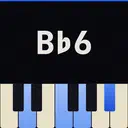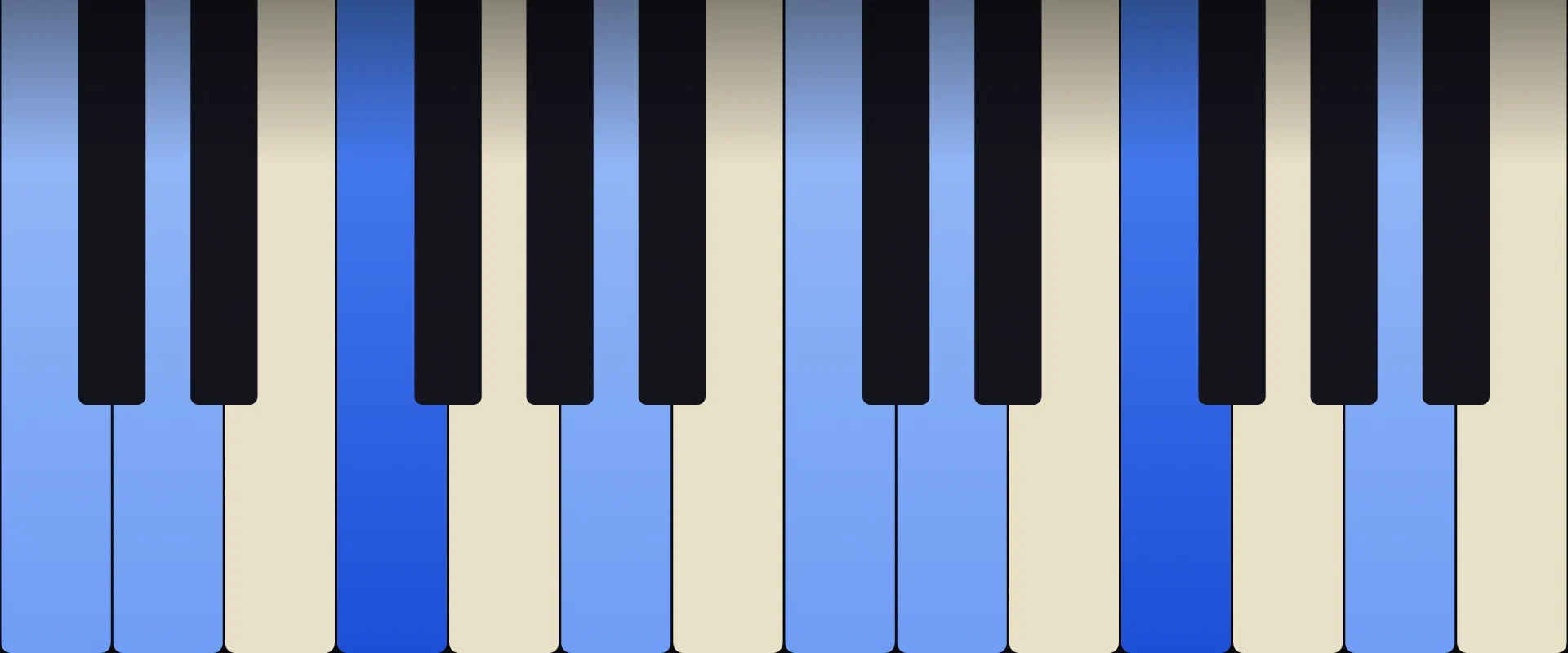
Put F, A, C and D in one hand and you have played two chords at once. With F underneath it is F6, the IV chord of C major carrying a 6th. Put D underneath and the identical notes become Dm7, the ii chord. Nothing inside the chord settles it. The bass does, which is why arrangers swap the two freely and why guitarists have been playing F6 for years while calling it something else.
A 6th suits the subdominant because of what it does not do. Add a 7th to F and you get Fmaj7, whose E sits a semitone under the root and leans; add a flat 7th and F7 wants B♭ next. The D adds weight and no obligation, which is why gospel and soul players sit on a IV chord with a 6th for whole bars.
Try It: F6 in the Chord Finder
Set F as the root, play the chord, then play it again with D lowest. Same four keys, two names.
The Notes of F6
| Degree | Note | Interval from Root | Semitones |
|---|---|---|---|
| 1 (Root) | F | Perfect unison | 0 |
| 3 | A | Major 3rd | 4 |
| 5 | C | Perfect 5th | 7 |
| 6 | D | Major 6th | 9 |
Nine semitones from bottom to top, against eleven for Fmaj7, so a 6th chord in root position fits one hand and one fret span more comfortably than a seventh chord does.
How F6 Is Built
Take the F major triad and add the 6th degree of the F major scale, D, above the 5th. That is all. No note is replaced, which is what separates this from a suspension.
Two things it is not. It is not F13: a 13th chord carries a 7th underneath its upper note, F13 being F, A, C, E♭ and D, so with no 7th present the label reverts to 6. And it is barely separate from Dm7. Stack thirds from D and you get D, F, A and C, the same four notes. A major 6th chord is the seventh chord of its relative minor with the bass moved down a third, which is why D minor and F keep sharing a bar.
F6 on the Piano
Four notes, four white keys, no accidental to negotiate. Only three of the twelve major 6th chords manage that, and here the whole distance between F major and F6 is one finger arriving on the white key directly above C.
Root position is thumb on F, index on A, middle on C, little finger on D. The stretch is only a 6th, so the hand stays relaxed, but C and D sit a whole step apart at the top and thicken badly below middle C. Keep the close voicing in the right hand and let the left take a single low F.
Two better shapes are worth learning by feel. Drop the 5th and play F, A and D, a 3rd below a 4th, which is the clean version for a busy arrangement. Then add G for F6/9, voiced as a low F in the left hand with A, D and G in the right: two perfect fourths stacked over the root, and the sound of an amen chord in every gospel hymnal.
Demonstrating the ambiguity costs one note. Hold A, C, D and F in the right hand, play F below it, then drop the left hand to D. The right hand never moves and IV has become ii.
F6 on the Guitar
Guitarists already know this chord. The open Dm7 shape, x x 0 2 1 1, is D, A, C and F, which is F6 with its 6th in the bass. Every time a bass player lands on F under that shape the band is playing F6, and no barre was involved.
That matters because F has no open form and the E6 shape at the 1st fret, 1 3 3 2 3 1, is close to unplayable: the barre sits where the string is clamped hardest and the notes above it want four separate fingers at two frets. Almost nobody plays it.
Two shapes do the work instead. The A6 form barred at fret 8, x 8 10 10 10 10, is an index barre on the 5th string with the ring finger flat across the other four, sounding F, C, F, A and D. It is one of the easiest four note chords on the neck and it keeps the root in the bass.
Closer to the nut, x x 3 2 3 1 gives F, A, D and F on the top four strings: ring finger on the 4th, middle on the 3rd, little finger on the 2nd, index on the 1st. This is the grip behind swing rhythm guitar, where a chunked 6th chord on the beat carries a whole band. It omits the 5th, which no one misses.
Inversions
| Inversion | Notes | Bass Note | Symbol |
|---|---|---|---|
| Root position | F, A, C, D | F | F6 |
| 1st inversion | A, C, D, F | A | F6/A |
| 2nd inversion | C, D, F, A | C | F6/C |
| 3rd inversion | D, F, A, C | D | F6/D |
The last row is where theory stops matching practice. Nobody writes F6/D. A chart says Dm7, and the ear agrees, because D underneath a stack of thirds sounds like a root rather than an added note.
The first inversion earns its keep in C major, where A under the IV chord lets a bass walk A, B, C into the tonic by step while the 6th stays at the top where it belongs.
Voicings
Keep the 6th high. D above C reads as colour, D wedged below F reads as an argument about which chord this is, and that one rule explains most published 6th chord voicings.
Dropping the 5th is standard: F, A and D says everything, since the 3rd fixes the quality and the 6th supplies the colour. Adding G gives F6/9, still free of the pull a 7th would introduce.
| Shape | Frets, low to high | Sounding notes |
|---|---|---|
| A6 shape, barred at fret 8 | x 8 10 10 10 10 | F, C, F, A, D |
| Four strings, no 5th | x x 3 2 3 1 | F, A, D, F |
| Open Dm7 shape | x x 0 2 1 1 | D, A, C, F |
| E6 shape, barred at fret 1 | 1 3 3 2 3 1 | F, C, F, A, D, F |
Which Keys Contain F6
- IV of C major
- I of F major
- V of B♭ major
- VI of A natural minor
- I of F lydian
- Contained in F major pentatonic
The first two lines are what make this chord easy to use. The added note, D, is diatonic in F major and in C major alike, so the 6th enriches the chord without dragging it out of either key. Contrast F sus4, whose B♭ is a note C major does not own. The last line explains the improviser’s comfort: F6 is F major pentatonic minus its 2nd, so a pentatonic melody cannot land wrong over it.
Where F6 Shows Up
| Progression | Chords | Where it lives |
|---|---|---|
| I, IV6, I | C, F6, C | Gospel and soul in C |
| I6, VI7, ii7, V7 | F6, D7, Gm7, C7 | Swing turnaround in F |
| ii7, V7, I6 | Gm7, C7, F6 | Jazz and standards ending in F |
The first is the plagal move with the subdominant thickened. Held under a vocal, C to F6 and back gives the unhurried rock of a church organ vamp, and it works because the 6th adds no urgency to a chord that already resolves gently.
The third is a habit older than the maj7 chord. Before the 1950s, arrangers ended a tune in F on F6 rather than Fmaj7, because the major 7th, E, grinds against a melody sitting on the tonic F. The 6th does not, so big band charts, swing tunes and countless standards close on a 6 chord.
The middle line uses the chord as a tonic rather than a decoration. Rhythm guitarists in western swing and gypsy jazz treat the 6 chord as their default major, chunking it on beats two and four, and F is squarely in the territory those bands share with horn players.
In a chart in C, then, ii7 and IV6 are the same four notes, and an arranger chooses between them by deciding where the bass belongs: on F for a hymn-like plagal move, on D for a line walking down into the dominant.
Related Chords
- F Major Chord is the triad this one is built on.
- D Minor Chord is the triad whose seventh chord shares all four notes.
- F Sus4 Chord replaces a note instead of adding one.
- Seventh Chords: The Complete Guide covers Dm7 and Fmaj7.
- Chord Inversions and Voice Leading explains why the bass note decides the name.
Learn More
For the difference between a 6th and a 13th, and for F6/9, see Extended Chords and Jazz Harmony. For this chord as the IV of C major and the I of F major at once, see Diatonic Chords: A Beginner’s Guide and the circle of fifths. For every scale containing this chord, see Scales for Piano and Guitar: The Complete Reference Guide.
Practice Chords
Drill chord recognition with a metronome, MIDI support, and score tracking.
Start PracticingRelated Articles
A Major 6th Chord: Notes, Voicings, and How to Play It
Aug 26, 2026 · 8 min
A♭ Major 6th Chord: Notes, Voicings, and How to Play It
Aug 26, 2026 · 8 min
B Major 6th Chord: Notes, Voicings, and How to Play It
Aug 26, 2026 · 8 min