The chord left ringing at the end of a surf instrumental, hanging in a tank of spring reverb while the drums stop, is usually this one. E6 is E, G♯, B and C♯, and on a guitar it costs a little finger: hold the open E shape, put the fourth finger on the second string at the 2nd fret, and 0 2 2 1 2 0 is done. Nothing else moves and no string is given up, so the chord keeps the open ring that makes E the loudest thing on the instrument while adding a note that stops it sounding blunt. Surf and rockabilly built an ending out of that, and country rhythm guitar has used it in place of a plain E for seventy years.
Try It: E6 in the Chord Finder
Choose E as the root and E major as the scale, then look at the same four notes under C♯ natural minor. They land on two different degrees, and both readings are in use.
The Notes of E6
E6 is the major triad with a major 6th added on top:
E, G♯, B and C♯
| Degree | Note | Interval from Root |
|---|---|---|
| 1 (Root) | E | Perfect unison |
| 3 | G♯ | Major 3rd |
| 5 | B | Perfect 5th |
| 6 | C♯ | Major 6th |
Two black keys, G♯ and C♯, and two white ones, E and B, with no spelling awkwardness: both accidentals land on the black key you would expect. Add F♯ to these four and you have E major pentatonic, which is worth knowing when you come to improvise over the chord.
How E6 Is Built
Take E major, E, G♯ and B, and add C♯ a major sixth above the root. Nothing is displaced, so the triad stays intact underneath and the chord remains firmly major.
It is not an E13. A thirteenth chord needs a seventh beneath the added note, so E13 would be E, G♯, B, D and C♯. Without that D the C♯ is a sixth, and the difference is functional: E13 wants to move, E6 does not.
Compare it with E7 and one semitone separates them. E7 is E, G♯, B and D. D leans hard on A and drags the music towards it, C♯ leans nowhere, and the two chords sit a fret apart on a guitar while behaving like opposites.
This chord also has a second name. Start the same notes from C♯ and you get C♯, E, G♯, B, which is C♯m7 in root position. Only the bass note and the surrounding music decide which one a listener hears.
E6 on the Piano
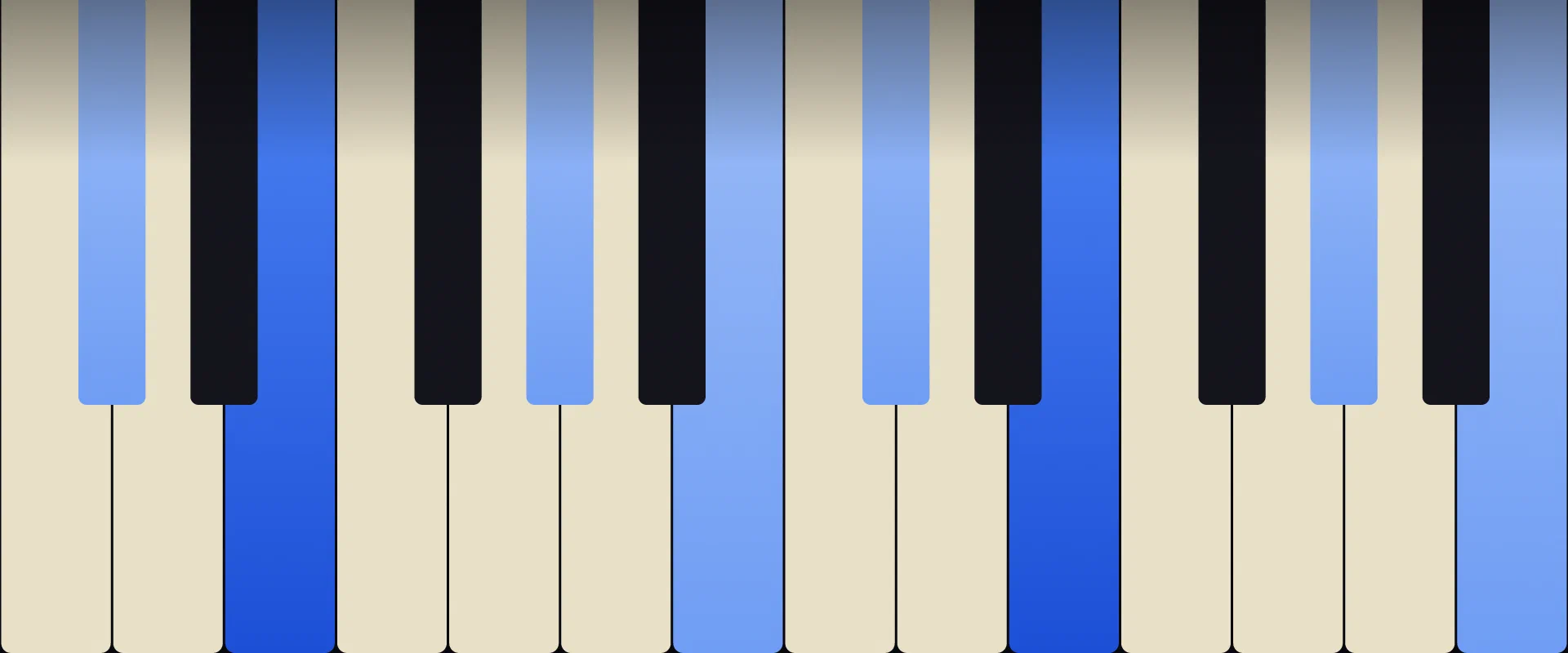
Black keys top and tail the group: G♯ just above the white E at the bottom, C♯ above the white B at the top. The hand sits deep on the keys rather than forward, and the fifth finger has to reach in for a black key, which is the one uncomfortable part of the shape.
Right hand: thumb on E, second finger on G♯, third finger on B, fifth finger on C♯.
Left hand: fifth finger on E, fourth finger on G♯, second finger on B, thumb on C♯.
Played close in the middle of the keyboard, B and C♯ sit a whole step apart in the worst possible register and the chord turns muddy. Two standard fixes: drop the fifth and play E, G♯ and C♯ with thumb, second and fifth, or split the chord with E and B low in the left hand and G♯ and C♯ above middle C. Both put C♯ on top, which is where it belongs. Buried in an inner voice it sounds like a wrong note against B; sitting above everything it sounds like the point of the chord.
E6 on the Guitar
The open form, 0 2 2 1 2 0, sounds E, B, E, G♯, C♯, E from the bottom up. The standard open E fingering uses index, middle and ring, which leaves the little finger idle, so this chord is free in a way it is not on most roots: no regrip, no muting, no lost open strings.
That accident has a consequence audible on any rockabilly record. E7 in its full form is 0 2 2 1 3 0, the same little finger one fret higher, so a player walks E, E6, E7 and back by sliding one fingertip along the second string: a whole rhythm vocabulary inside one hand position.
The sixth is native to blues in E for a related reason. The classic boogie figure alternates the fifth string at the 2nd fret with the same string at the 4th, against the open low E, and those two notes are B and C♯. The riff spells E5 then E6 one note at a time, which is why the sixth sounds correct over a shuffle even where nobody writes the symbol above the bar. Shift the figure one string set higher, open A with the fourth string at the 2nd and 4th frets, and the IV chord gives you A6.
Away from the nut, the A6 shape barred at the 7th fret gives x 7 9 9 9 9: index at the 7th fret of the fifth string, ring finger flattened across the top four at the 9th. With no open strings it stops dead when you release it, which suits fast comping where the open form would blur. For a lighter voice, x x 2 1 2 0 sounds E, G♯, C♯, E, dropping the fifth and putting the sixth against the top string, which is what surf players use behind a melody.
Inversions
| Voicing | Notes | Bass note |
|---|---|---|
| Root position | E G♯ B C♯ | E |
| 1st inversion | G♯ B C♯ E | G♯ |
| 2nd inversion | B C♯ E G♯ | B |
| 3rd inversion | C♯ E G♯ B | C♯ |
The third inversion is barely an inversion at all. With C♯ in the bass the ear takes the chord as C♯m7 in root position, and the music around it has to argue otherwise. Second inversion is the awkward one, since it puts B and C♯ side by side at the bottom, so most players spread it. First inversion, G♯ in the bass, is the one to reach for in a bass line walking down from E to C♯.
Voicings
- Open form, 0 2 2 1 2 0, six strings and the full open ring.
- Four string partial, x x 2 1 2 0, no fifth, sixth near the top.
- Barred at the 7th fret, x 7 9 9 9 9, compact and easy to silence.
- Piano, fifth omitted, E, G♯ and C♯ in one hand, the cleanest close voicing available.
- Piano, split, E and B in the left hand with G♯ and C♯ above middle C.
The one arrangement to avoid is B and C♯ adjacent below middle C. It is what gives sixth chords their reputation for cloudiness, and it is a voicing problem, not a fault.
Which Keys Contain E6
Four notes narrow things considerably. Only three major keys hold all of them, since the chord needs G♯ and C♯ together:
- degree 1 (I) of E major
- degree 5 (V) of A major
- degree 4 (IV) of B major
- degree 3 (III) of C♯ natural minor
- degree 1 (I) of E mixolydian
- rooted on degree 1 of, and entirely contained in, E major pentatonic
The C♯ natural minor entry is the C♯m7 identity seen from the key rather than the chord. E Mixolydian matters for another reason: it keeps all four notes while lowering the seventh to D, so a blues or country player in E can use this chord and a dominant seventh in the same bar without leaving the mode.
Where E6 Shows Up
As the last chord of the tune. V7 to I6: B7, then E6 held under the reverb. Before bebop reshaped popular harmony, dance bands routinely ended on a sixth rather than a bare triad, which sounded thin behind a section of horns. Western swing and country guitar inherited the habit, rock inherited it from them, and surf instrumentals in E made it a signature. Power chords later pushed sixth chords out of rock, but the final bar is where they lasted longest.
As the I chord of a shuffle in E. I6, IV6, V: E6, A6, B7, with the sixth supplied by the bass figure rather than by a strummed chord. Nobody is treating it as an extension here. It is what the riff spells, and a guitarist who strums a plain E over it fights the bass.
As the tonic of a jazz cadence in E. ii7, V7, I6: F♯m7, B7, E6. The sixth is chosen over the major seventh because it is more settled, D♯ against E being a semitone of leftover tension. It also opens a door, since a tune can end on E6 and slip into C♯ minor without anyone moving a finger.
Sixth chords ask one thing in return. They do not pull anywhere, so put E6 where the music should sit down, never where it needs a shove.
Related Chords
- E Major Chord: Notes, Voicings, and How to Play It is the triad underneath, unchanged.
- E Sus4 Chord: Notes, Voicings, and How to Play It replaces the third instead of adding to the triad, and moves the same little finger.
- E Minor Chord: Notes, Voicings, and How to Play It is what happens if the G♯ falls, which turns the chord towards Em6 rather than E6.
- Seventh Chords: A Complete Guide to maj7, min7, dom7, and More covers E7, one semitone away and pulling in a different direction.
Learn More
- Extended Chords: Which Tensions Work, and How to Voice Them explains why this is a 6th and not a 13th.
- Chord Inversions and Voice Leading on the bass note that turns E6 into C♯m7.
- Guitar Chord Shapes and the CAGED System covers the A shape used for the barred form.
- E Major Pentatonic Scale: Notes, Patterns, and How to Play It is these four notes plus F♯, and the obvious scale to solo with over the chord.
Practice Chords
Drill chord recognition with a metronome, MIDI support, and score tracking.
Start PracticingRelated Articles
A Major 6th Chord: Notes, Voicings, and How to Play It
Aug 26, 2026 · 8 min
A♭ Major 6th Chord: Notes, Voicings, and How to Play It
Aug 26, 2026 · 8 min
B Major 6th Chord: Notes, Voicings, and How to Play It
Aug 26, 2026 · 8 min