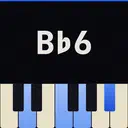
Play E♭ G B♭ D, then play E♭ G B♭ C. One note has moved down a whole tone and the chord has stopped buzzing. That D sat a semitone under the root, and a semitone under the root is the only genuinely restless thing inside a major seventh chord. E♭ G B♭ C holds no interval smaller than a whole tone, which is why arrangers writing for saxophone sections in the 1930s and 1940s ended thousands of charts on this chord and almost none on E♭maj7. E♭ is the key that repertoire lives in.
Try It: E♭6 in the Chord Finder
The Notes of E♭6
The chord contains four notes: E♭, G, B♭ and C.
| Degree | Note | Interval from root | Semitones |
|---|---|---|---|
| 1 | E♭ | Root | 0 |
| 3 | G | Major 3rd | 4 |
| 5 | B♭ | Perfect 5th | 7 |
| 6 | C | Major 6th | 9 |
Written E♭6, and E♭maj6 or E♭M6 by writers ruling out any chance of the minor sixth chord being meant. Add F and it is E♭6/9, the fuller version, which ends more records than the plain chord does.
How E♭6 Is Built
Start with E♭ major, E♭ G B♭, and add C above it. Nothing is replaced, so unlike a suspension this chord keeps its third and stays firmly major. The unusual part is the spacing: a major third, a minor third, a whole tone, then a minor third again from C back round to E♭, with no semitone at any point. E♭maj7 has one, D against E♭, and that friction is the difference between a chord that can end a piece in front of an audience and a chord that wants to say something else first.
The 6th is not a 13th, and the distinction is not pedantry. E♭13 would be E♭ G B♭ D♭ F C, with a flat seventh holding the extension up. Take the D♭ away and the C extends nothing, it is the sixth degree sitting inside the triad. A chart writing E♭13 for these four notes is asking for a dominant it has not spelled.
E♭6 on the Piano
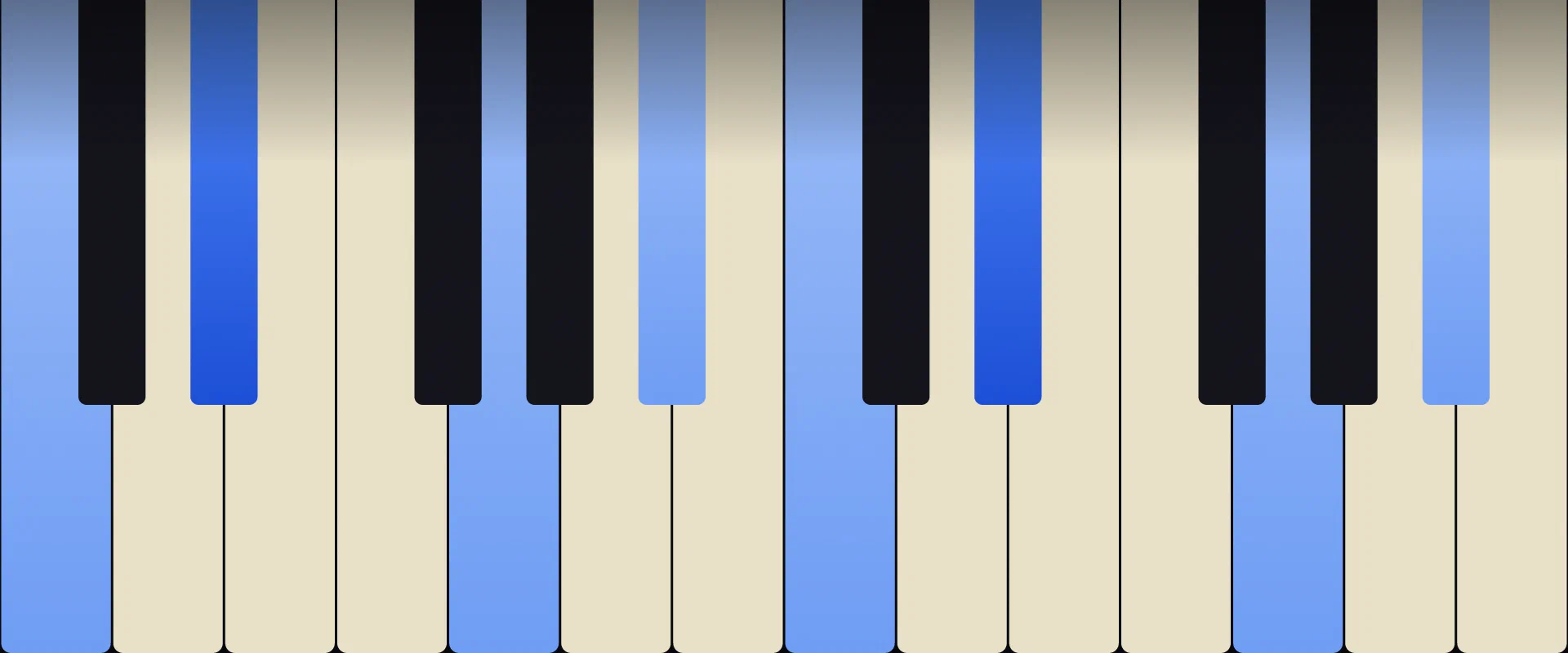
Two black keys and two white ones, alternating in a way that suits the hand. Right hand fingering is 1 on E♭, 2 on G, 4 on B♭ and 5 on C, with the left hand mirroring it 5, 4, 2, 1. Thumb and index cross from black to white at once, then the ring and little fingers take a black key and the white key beside it, which falls naturally under a relaxed hand.
Register matters more than fingering here. B♭ and C are a whole tone apart and a whole tone below middle C thickens badly, so in close position keep the top of the chord above middle C and give the left hand a bare E♭ far below. Spread across two hands it turns almost inaudibly smooth, the effect a big band’s final held chord is after.
One demonstration is worth the rest of this section. Hold E♭, G, B♭ and C in the right hand and play E♭ in the left: E♭6, the tonic of the key, finished. Change nothing above, move the left hand to C, and the same four notes are Cm7, a chord that leans forwards and expects F next. In a rhythm section that is a live problem, because the pianist and the bassist between them decide which chord the band is playing.
E♭6 on the Guitar
Nothing rings open in this key, so every voicing starts up the neck. The full grip is the A6 shape barred at the 6th fret, x 6 8 8 8 8: index on the 5th string at the 6th, ring finger flat across the remaining four at the 8th. Two fingers, no stretch, sounding E♭, B♭, E♭, G and C. As barre chords go it is generous, sitting where the strings are slackest and the frets still wide.
The E6 shape at the 11th fret, 11 13 13 12 13 11, puts a low E♭ underneath and costs a full barre plus a broken shape above it, where the frets tighten. Keep it for the bass note.
What jazz players actually use is smaller: x 6 5 5 4 x, giving E♭, G, C and E♭. Root, third and sixth remain, the fifth is gone and no barre is involved. Leaner again is 11 x 10 12 x x, three notes on the 6th, 4th and 3rd strings, root low with the third and sixth above. Freddie Green style comping plays that four times a bar, thin on purpose so the horns have room.
Drop a C into the bass of any of these and you are fingering Cm7 without changing a note. A shortcut and a trap.
Inversions
| Inversion | Notes | Lowest note |
|---|---|---|
| Root position | E♭ G B♭ C | E♭ |
| 1st inversion | G B♭ C E♭ | G |
| 2nd inversion | B♭ C E♭ G | B♭ |
| 3rd inversion | C E♭ G B♭ | C |
The third inversion is barely an inversion in practice. C E♭ G B♭ is Cm7 in root position, note for note, and once the bass plays C the ear stops hearing a chord of E♭. The relationship holds both ways: every major sixth chord is the minor seventh chord a minor third below it, and which one it is depends on context rather than spelling.
Second inversion, B♭ C E♭ G, is awkward to voice, because B♭ and C sit side by side at the bottom where the whole tone is least comfortable. Move the C up an octave and the problem goes.
Voicings
The classic is E♭6/9: E♭, G, B♭, C and F. The ninth widens the top and makes the sixth sound intentional rather than incidental, which is why it ends so much of the swing repertoire. Voice it with E♭ in the bass, then G, C and F above, and leave the B♭ out entirely.
For section writing, the sixth belongs on top. Put C in the lead voice and the chord reads bright and settled; bury it in the middle and it disappears behind the fifth. That is why lead alto so often finishes on the sixth degree rather than the tonic.
Accompanying a singer, drop the fifth: E♭, G and C over a low E♭ stays clear of the vocal range.
Which Keys Contain E♭6
- I of E♭ major
- IV of B♭ major
- V of A♭ major
- III of C natural minor
- VI of G natural minor
- Contained in E♭ major pentatonic
All four notes also fit inside C minor pentatonic and the C blues scale, the Cm7 identity seen from the soloist’s side: a blues line in C cannot collide with this chord.
Where E♭6 Shows Up
The last bar. A big band chart in E♭ holds a final chord for four beats, and it is E♭6 or E♭6/9 far more often than E♭maj7, for the reason at the top of this page: nothing inside it is still working. Ellington’s arrangers and Basie’s treated the sixth as the normal way to finish. The major seventh became acceptable as a resting place only later, when cool jazz and bossa nova taught listeners to hear that semitone as sweetness.
I6, vi7, ii7, V7: E♭6, Cm7, Fm7, B♭7. The turnaround, with the tonic already coloured. The first two chords are the same four notes, so the horns hold one voicing while the bass walks from E♭ down to C, and the harmony moves without anybody playing a new pitch.
B♭, E♭6, B♭ in B♭ major. The plagal move with the fourth degree sweetened. Western swing, jump blues and country rhythm guitar default to sixth chords for I and IV, which in a B♭ band puts it under half the tune.
Cm7 that turns out to be E♭6. A pianist in C minor who voices the tonic chord as E♭ G B♭ C has quietly moved its centre to the relative major, and whether the passage sounds minor or major from there is settled by the bass.
Why this key holds all of it: concert E♭ is what wind sections were built around. Alto and baritone saxophones read it with an empty key signature, trumpets and clarinets with a single flat. When a culture of arranging grew up in E♭, A♭ and B♭, its chords became E♭ chords first, and the sixth is the clearest survivor: a stable, ending-shaped major chord with colour in it, worked out by people writing for four saxophones who needed a final chord that would not argue with itself.
Related Chords
Learn More
Practice Chords
Drill chord recognition with a metronome, MIDI support, and score tracking.
Start PracticingRelated Articles
A Major 6th Chord: Notes, Voicings, and How to Play It
Aug 26, 2026 · 8 min
A♭ Major 6th Chord: Notes, Voicings, and How to Play It
Aug 26, 2026 · 8 min
B Major 6th Chord: Notes, Voicings, and How to Play It
Aug 26, 2026 · 8 min