Four of the five notes of the D major pentatonic scale are D, F♯, A and B. Play them together and you have D6. A chord made almost entirely of a pentatonic scale contains nothing that has to go anywhere, which is why bands end songs on it and why it never quite reads as tension. The missing note is E, and putting that back gives D6/9.
On a guitar it is a two-finger chord. x x 0 2 0 2 is D6 in open position, and the open string doing the interesting work is the second, not the first: B is a chord tone here, ringing free, while the top string has to be pressed at the 2nd fret to reach F♯. Four strings, nothing muted but the two lowest, and one of the sweeter sounds available to anyone who has just learned an open D.
Try It: D6 in the Chord Finder
The Notes of D6
D6 is four notes: D, F♯, A and B.
| Degree | Note | Interval from Root | Semitones |
|---|---|---|---|
| 1 (Root) | D | Perfect unison | 0 |
| 3 | F♯ | Major 3rd | 4 |
| 5 | A | Perfect 5th | 7 |
| 6 | B | Major 6th | 9 |
How D6 Is Built
Start with D major, D F♯ A, and add the sixth degree of the D major scale on top. The triad is untouched and the B joins it inside the octave.
That inside matters, and it is where sixth chords are most often misread. A 13th chord also contains a B over a D root, but a 13th is an extension stacked above a seventh: D13 needs a C in it to be a 13th at all. There is no C and no C♯ anywhere in D6, so the B has nothing to be an extension of. It is a chord tone, a plain sixth, and the chord is complete at four notes. Size follows from that. D up to B is nine semitones, against ten for D7 and eleven for Dmaj7, which makes it one of the most compact four-note chords a hand is likely to meet.
There is a second reading of the same four notes. Set B at the bottom and you have B, D, F♯, A, which is Bm7 in root position. D6 and Bm7 are not similar chords. They are the same collection of pitches, and the only thing separating them is which note the bass player is holding. In D the twin is the B minor seventh that any guitarist in this key already plays constantly.
D6 on the Piano
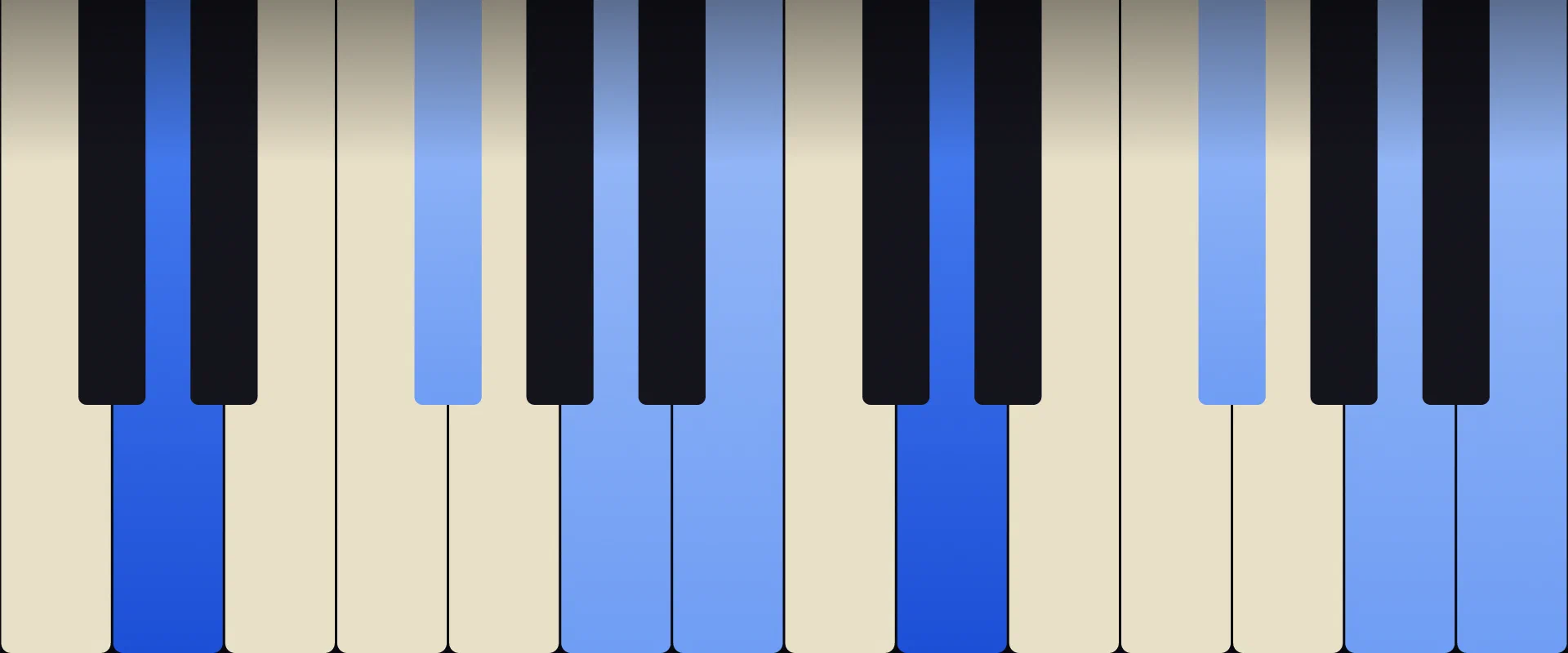
One black key and three white. D sits in its notch inside the group of two, F♯ is the first black key of the group of three, A hides between the second and third of those, and B is the white key just past them. The hand finds all four without looking.
Right hand 1, 2, 3, 5 fits it exactly: thumb on D, index on F♯, middle on A, little finger on B. Because the whole chord spans a major sixth, no finger stretches. Dmaj7 in the same position pushes the little finger out to C♯ and opens the hand to a seventh, so players who find major sevenths a strain are often surprised how easily this one lies.
Voicing it well is a matter of where the A and B end up. Those two notes are a whole step apart, and a whole step low in the register turns to mud. Put D alone in the left hand, well below, and take F♯, A and B in the right, and the second sits at the top where it reads as brightness. Drop the A and B near the bass and the same chord sounds thick and badly balanced.
Then hold that right hand still and walk the left hand down from D to B. Nothing above the bass has moved, and the chord is now Bm7.
D6 on the Guitar
x x 0 2 0 2, low to high, gives D, A, B, F♯. Open 4th string for the root, index at the 2nd fret of the G string for A, open B string, and the middle or ring finger at the 2nd fret of the top string for F♯. Adding the open 5th string, x 0 0 2 0 2, drops A into the bass, which suits fingerpicking more than a strum.
The grip western swing and jazz players actually use sits at the 5th fret: x 5 4 4 3 x. That is D on the 5th string with F♯, B and D above it, the fifth dropped because A contributes least. Four adjacent strings, no open notes, easy to mute, and movable to any root: an open C6 shape pushed up two frets.
For weight, the A6 shape barres at the 5th fret, x 5 7 7 7 7, a thick five-string version with the 6th on top. The E6 shape lands at the 10th fret, 10 12 12 11 12 10, which finally gets a low D underneath but sits where the frets are cramped.
A riff hides in this chord too. Hold D at the 5th fret of the 5th string and alternate A at the 7th fret of the 4th string with B at the 9th. Rocking between the fifth and the sixth over a held root is the boogie shuffle that runs through rockabilly and jump blues, and every other beat of it is a D6 with no third.
Inversions
| Inversion | Bass Note | Notes | Symbol |
|---|---|---|---|
| Root position | D | D, F♯, A, B | D6 |
| 1st inversion | F♯ | F♯, A, B, D | D6/F♯ |
| 2nd inversion | A | A, B, D, F♯ | D6/A |
| 3rd inversion | B | B, D, F♯, A | D6/B |
The third inversion is where the name gives way. D6/B and Bm7 are written differently and played identically, so the surrounding music decides: if the passage is heading for A major, call it Bm7; if it is resting in D, call it D6 with the sixth in the bass.
Voicings
Guitar, open (x x 0 2 0 2). Bright, ringing, two fingers.
Guitar, jazz grip (x 5 4 4 3 x). No fifth, no open strings, fully movable.
Guitar, A shape barred at fret 5 (x 5 7 7 7 7). Thick and even, good for a final chord.
Piano, spread (D low, F♯ A B above). The whole step kept high, where it sparkles.
Piano, close (D F♯ A B in one hand). Compact and clear, and easier than any seventh chord in the same position.
Which Keys Contain D6
Six keys where D6 arrives as a diatonic chord:
- I of D major
- V of G major
- IV of A major
- III of B natural minor
- I of D lydian
- I of D mixolydian
The last two entries are not padding. D lydian raises the fourth degree to G♯ and D mixolydian lowers the seventh to C natural, and D6 contains neither a fourth nor a seventh. It is therefore equally at home in all three, which is why it holds up as a vamp chord under a roaming soloist.
Where D6 Shows Up
The final chord. Western swing bands, jump blues horn sections and close harmony vocal groups routinely end on a 6th rather than a plain triad, and in D the reason is audible. Dmaj7 ends a song with a C♯ leaning hard on the root. D6 ends it with a B that leans on nothing.
Bm7 under another name. In A major the ii chord is Bm7, so the ii to V to I of that key is Bm7, E7, A. A guitarist can play the open D6 shape over a bass note of B and the chord is done. The same shape over D is the tonic of D major. One grip, two functions, decided by what is happening below it.
Sixth chords on steel guitar. Lap and pedal steel players tune their strings to a 6th chord rather than a triad, so that laying the bar straight across yields a usable chord anywhere on the neck. Bar a C6 tuning at the 2nd fret and D6 is what comes out. That convention is why Hawaiian playing, country backing and western swing all default to this sonority.
The parallel minor version. Move the F♯ down to F natural and you get Dm6, D F A B, a very different animal with a tritone in it. One semitone in one voice separates them, and hearing the two back to back shows how little it takes to change a chord’s job.
Related Chords
- D Major Chord, the triad underneath the added sixth.
- B Minor Chord, whose seventh chord is these four notes.
- Seventh Chords: The Complete Guide for Bm7, D7 and Dmaj7.
- The D Major Pentatonic Scale, which contains the whole chord plus one note.
- The D Major Scale, where D6 is the tonic.
Learn More
Practice Chords
Drill chord recognition with a metronome, MIDI support, and score tracking.
Start PracticingRelated Articles
A Major 6th Chord: Notes, Voicings, and How to Play It
Aug 26, 2026 · 8 min
A♭ Major 6th Chord: Notes, Voicings, and How to Play It
Aug 26, 2026 · 8 min
B Major 6th Chord: Notes, Voicings, and How to Play It
Aug 26, 2026 · 8 min