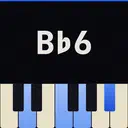
Put C♯6 in front of a beginner and one of its four notes looks like a mistake. The chord is C♯, E♯, G♯ and A♯: three black keys, plus an E♯ that carries a sharp in its name and is played on the white key F. Nothing is wrong. The third of a chord rooted on C♯ has to be some form of E, because C, D, E is three letter names and that span is what makes an interval a third, so a third standing four semitones above C♯ can only be written E♯. Call it F and the chord reads as a root, a fourth and a sixth, and every musician looking at it plays something else. In sound this chord is C♯, F, G♯ and A♯; in notation it is C♯, E♯, G♯ and A♯.
Try It: C♯6 in the Chord Finder
The Notes of C♯6
| Degree | Note | Interval from root | Semitones |
|---|---|---|---|
| 1 | C♯ | Root | 0 |
| 3 | E♯ | Major 3rd | 4 |
| 5 | G♯ | Perfect 5th | 7 |
| 6 | A♯ | Major 6th | 9 |
The gaps shrink as you climb: four semitones, then three, then two. The chord spans nine semitones, which fits under one hand, and its narrowest interval is the whole step at the very top between G♯ and A♯. That gentle rub is the sound of the chord.
How C♯6 Is Built
Start from C♯ major, C♯, E♯ and G♯, then add the sixth degree of the C♯ major scale, A♯. Nothing is taken away, so the chord stays plainly major. The extra note softens the full stop of the triad without the pull a seventh brings with it. This is not a thirteenth chord, either: a thirteenth is a seventh with an upper extension above it, and there is no B or B♯ anywhere in these four notes.
Now the point that runs through the whole sixth chord family. C♯, E♯, G♯ and A♯ are also the notes of A♯m7, which spells A♯, C♯, E♯, G♯. Not a substitution or a close relative: the same four pitches in a different order, separated only by the bass note. Put C♯ underneath and the ear hears a major chord with a bright sixth on top. Put A♯ underneath and it hears a minor seventh.
Which brings up the spelling. In flats the same sound is D♭6: D♭, F, A♭, B♭. Four plain letters, no accidental sitting on a white key, no reader doing a double take at the third. The twin becomes B♭m7, a chord every jazz musician has read a thousand times. C♯6 is correct when the music around it is sharp, in B major or F♯ major or C♯ mixolydian, and D♭6 when it is flat. Far more music at this pitch is written flat, so D♭6 is what you meet on the page and the sharp spelling is largely a guitar and keyboard convenience.
C♯6 on the Piano
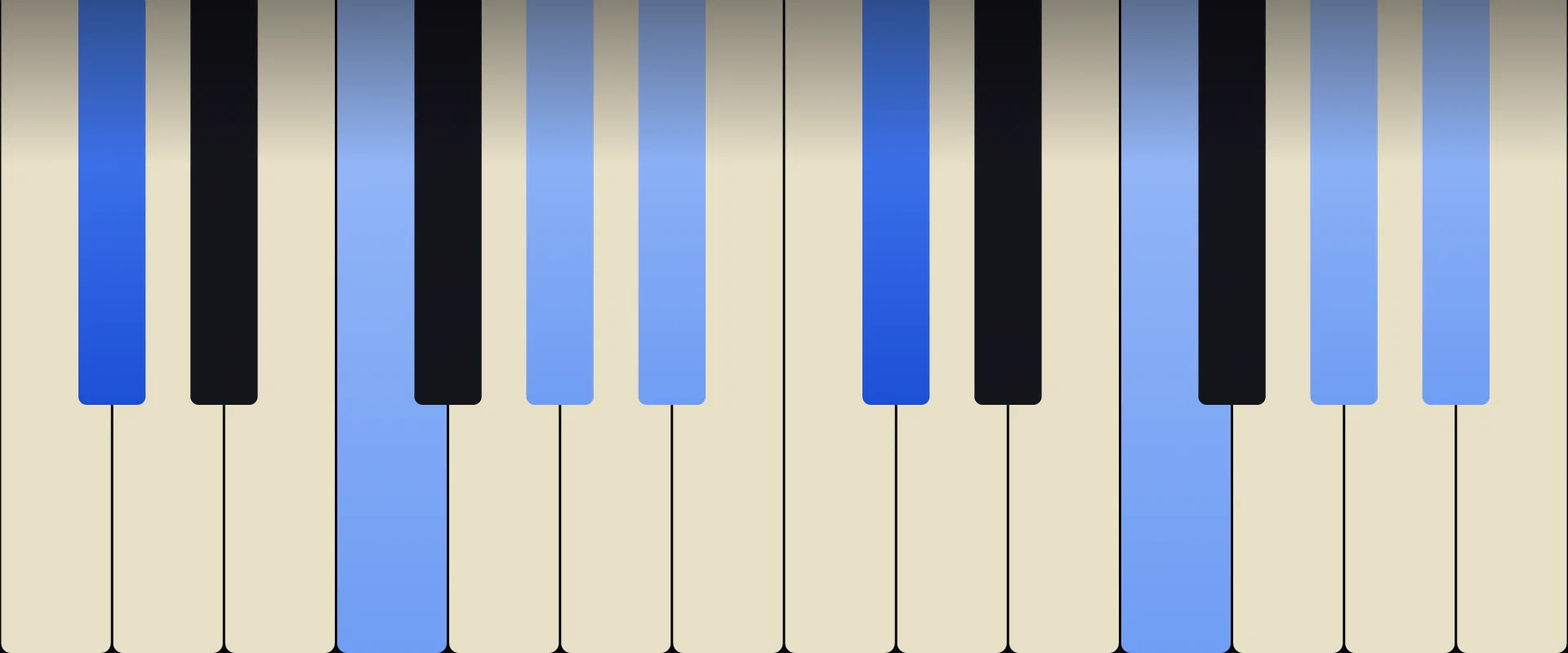
Three black keys and one white, and the white one lands in the most awkward spot available. C♯ is the left key of the pair; G♯ and A♯ are the second and third of the group of three; E♯, which is F, is wedged in the notch between the two groups, further forward and lower than everything else. The hand cannot settle on one plane: three fingers stay back on the raised keys and one drops forward into the gap beside F♯.
Right hand, root position: 1 on C♯, 2 on E♯, 4 on G♯, 5 on A♯. The second finger does all the work, dropping forward while the thumb, ring and little fingers hold the black row. Fingers 4 and 5 put two adjacent black keys under the two weakest fingers, so keep the wrist level rather than letting the hand roll outward, which is what slides the little finger off a narrow key.
There is a shortcut worth knowing. Play A♯, C♯, E♯, G♯ instead, the same notes with A♯ at the bottom, and the hand falls into the far more familiar shape of a minor seventh chord. Plenty of pianists learn this chord that way round, then simply change what the left hand holds. And if the surrounding key is flat, the printed version reads D♭, F, A♭, B♭ with an identical fingering, because the keys are identical. Spelling changes no note you play, only how fast you understand the page.
C♯6 on the Guitar
There is no open form and no useful partial one, because the chord contains no natural note at all. Its notes sound as C♯, F, G♯ and A♯, and the open strings offer E, A, D, G and B. Nothing lines up.
The full voicing is the A form barred at the 4th fret: x 4 6 6 6 6. Index on the fifth string at the 4th for the root, then flatten the ring finger across the fourth, third, second and first strings at the 6th. That second barre under one finger is the whole trick. It sounds C♯, G♯, C♯, E♯, A♯, the plush voicing most people picture for a sixth chord on guitar, and fret 4 is low enough that the ring finger needs real pressure across four strings.
The E form at the 9th fret asks for 9, 11, 11, 10, 11, 9: an index barre plus four independent fingers above it. No hand has that, so players drop a string, usually the fifth, and accept a partial voicing high up where the chord is already thin.
What actually gets used is the compact grip on the middle four strings, x 4 3 3 2 x, giving C♯, E♯, A♯, C♯: root, third and sixth, with the fifth left out. Dropping G♯ costs nothing, and what remains sits under a comping hand without fighting a bass player. The twin pays off here too. The movable minor seventh grip at the 1st fret, x 1 3 1 2 1, which every guitarist knows as B♭m7, holds exactly the notes of D♭6 with the sixth in the bass, and jazz rhythm players slide between the two readings without naming either.
Inversions
| Inversion | Notes | Lowest note |
|---|---|---|
| Root position | C♯ E♯ G♯ A♯ | C♯ |
| 1st inversion | E♯ G♯ A♯ C♯ | E♯ |
| 2nd inversion | G♯ A♯ C♯ E♯ | G♯ |
| 3rd inversion | A♯ C♯ E♯ G♯ | A♯ |
Root position keeps the whole step at the top where it is least intrusive, which is why the chord can end a piece without sounding unfinished. Second inversion is the harshest, putting G♯ and A♯ adjacent at the bottom, and a whole step low down turns muddy quickly. Third inversion is barely an inversion at all: A♯, C♯, E♯, G♯ is A♯m7 in root position, and once A♯ is lowest that is what a listener hears.
Voicings
Leave out the fifth. C♯, E♯ and A♯ carries all of the character in three notes, which is what a guitarist plays and what an arranger writes for three horns. G♯ adds nothing.
Add the ninth and you get C♯6/9: C♯, E♯, G♯, A♯ and D♯. Richer than the plain sixth and still without a seventh to complicate it, this is one of the great ending chords, and written flat as D♭6/9 it closes a great many arrangements.
Or spread the four notes across two hands, left taking C♯ and G♯, right taking E♯ and A♯ above. Keeping the whole step out of the low register is what makes the chord sound warm rather than cloudy.
Which Keys Contain C♯6
- I of D♭ major
- V of F♯ major
- IV of A♭ major
- III of B♭ natural minor
- I of C♯ mixolydian
- degree 2 of B♭ minor pentatonic
Four notes constrain a chord more tightly than three, so this list is short where a triad’s would sprawl. Notice how the spellings split. The D♭ major, A♭ major, B♭ natural minor and B♭ minor pentatonic pages all write these notes as D♭, F, A♭ and B♭, because those keys are flat. Only F♯ major and C♯ mixolydian write C♯, E♯, G♯ and A♯. The last entry is the twin again: B♭ minor pentatonic, the scale of B♭m7, contains this chord as four of its five notes read from D♭.
Where C♯6 Shows Up
| Progression | Chords | Turns up in |
|---|---|---|
| V7, I6 in D♭ major | A♭7, D♭6 | Standards and ballad endings |
| I, IV6, I in A♭ major | A♭, D♭6, A♭ | Gospel and soul turnarounds |
| I6 vamp in C♯ mixolydian | C♯6, F♯, C♯6 | Funk and soul guitar |
| ii7 read as IV6 in A♭ major | B♭m7 over D♭ | Reharmonisation |
The first row is the chord’s oldest job. Before the major seventh became the default resting place in jazz, tunes ended on a sixth, and a great many ended in D♭ because it suits singers and the horn players behind them. That is not incidental. Concert D♭ reads as E♭ major, three flats, on a B♭ instrument, and as B♭ major, two flats, on an alto or baritone saxophone, so a D♭6 in a chart is easy for the whole section. Meanwhile the guitarist is thinking C♯ and barring at the 4th fret. One chord, two mental models, and the arranger picks whichever spelling suits the reader.
Rows two and four are two views of one event. A♭ major is the home key of much gospel and classic soul, and D♭6 is its IV chord dressed up. Voice the same notes with B♭ lowest and it becomes B♭m7, the ii chord of that key, so a pianist can slide between subdominant and supertonic function without changing a note in the right hand.
The third row is the modern use. Over a static C♯ mixolydian vamp the sixth replaces the dominant seventh, keeping the brightness and dropping the tension, which is why funk and neo soul guitarists reach for it on a one chord groove. Flatten the third to E natural and you get the minor sixth on this root, C♯, E, G♯ and A♯, which shares three notes with C♯6 and behaves nothing like it.
Related Chords
- C♯ Major Chord, the triad this one is built on, and the page that deals with E♯ in more depth
- C♯ Minor Chord, which flattens the third that gives this chord its brightness
- C♯ Sus4 Chord, which removes that third altogether and so dodges the E♯ problem entirely
- Seventh Chords: The Complete Guide for the A♯m7 side of the coin
- Extended Chords and Jazz Harmony for 6/9 voicings and why a sixth is not a thirteenth
Learn More
Practice Chords
Drill chord recognition with a metronome, MIDI support, and score tracking.
Start PracticingRelated Articles
A Major 6th Chord: Notes, Voicings, and How to Play It
Aug 26, 2026 · 8 min
A♭ Major 6th Chord: Notes, Voicings, and How to Play It
Aug 26, 2026 · 8 min
B Major 6th Chord: Notes, Voicings, and How to Play It
Aug 26, 2026 · 8 min